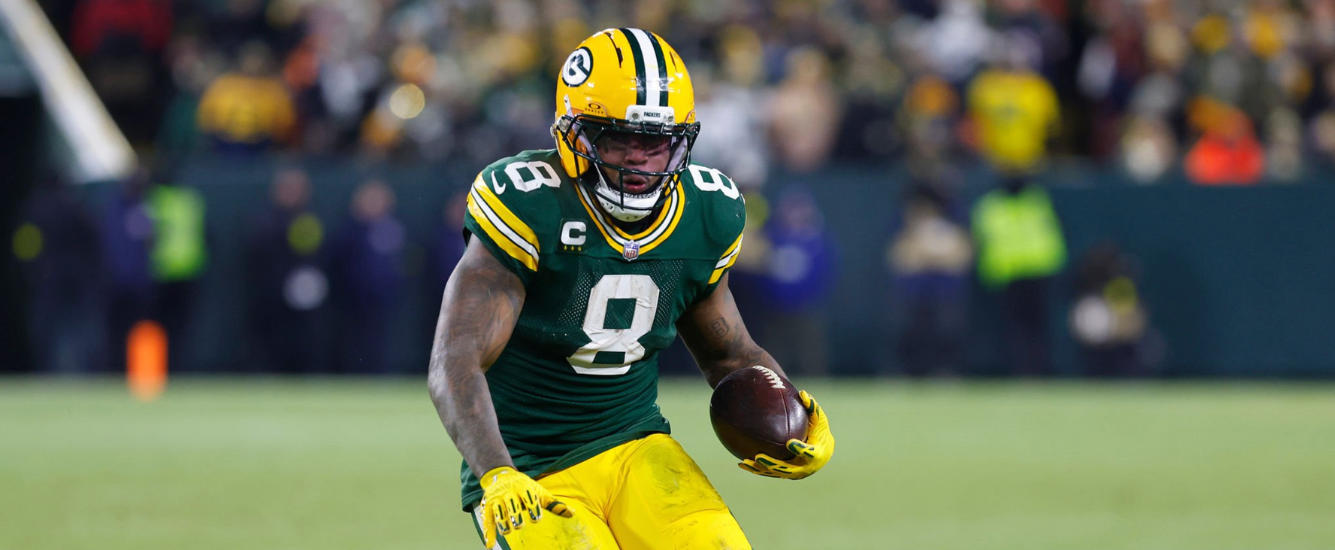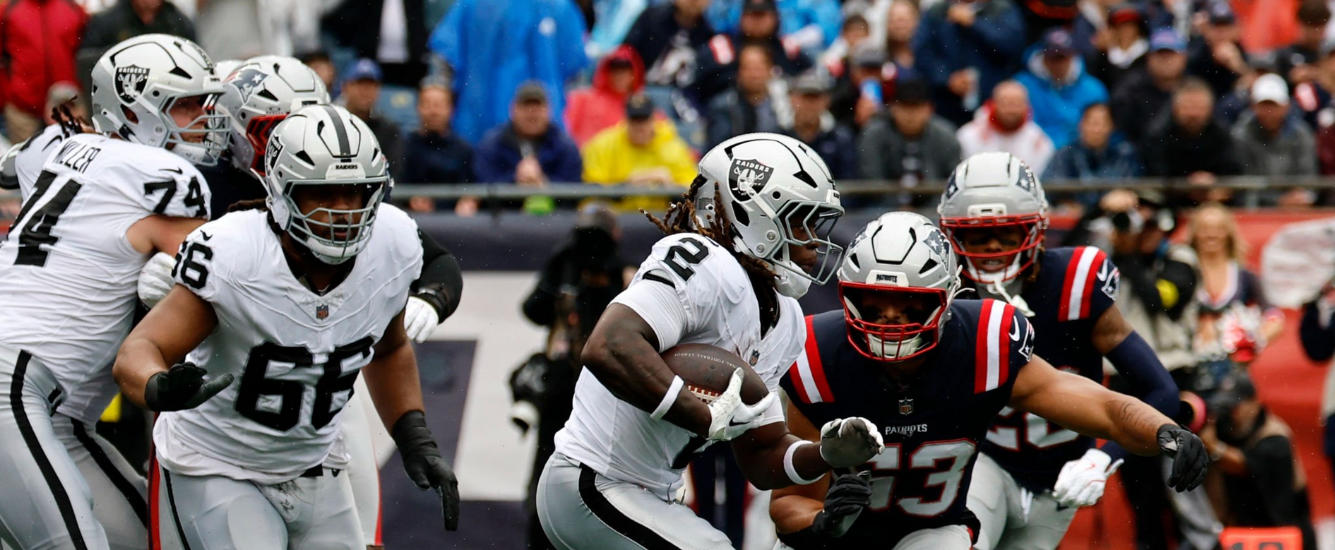
Kevin Szafraniec looks back at the journeys that the top-scoring quarterback, running back, and wide receiver from the 2025 NFL Draft class have taken over the past year.
With the 2026 NFL Combine currently winding down, we find ourselves firmly in the heart of draft season. But here at RotoViz, we have been deep in the weeds scouting the 2026 rookie class long before 2025 came to a close. Our unique view on prospecting has led to favorable results in the past, and we are dedicated to keeping that trend alive with the current crop of 2026 draft hopefuls.
Recently, Jesse Cohen dove a little bit deeper into our rookie rankings from the past five years. In his exercise, Jesse compared RotoViz rankings to Lance Zierlein’s scouting grades, evaluating the differences and similarities that arise when exploring the Analytics War:
In the Analytics Wars, There’s Safety in Numbers
The divide between film- and analytics-based prospecting has been narrowing, but remains an essential part of our dynasty DNA:
Years ago it was fashionable to argue about whether NFL prospect scouting should rely on film-based evaluation, or on the analytics and “box score scouting.” If the “analytics wars” don’t seem as contentious now, it’s mainly because most people are tired of arguing. But it’s also because those who championed film-based scouting have in many ways come to see the value of the advanced analytical data. It’s possible that these concessions will encourage the analytics side to subsequently lend more weight to scouting opinions that clash with the numbers.
Trusting the objective numbers — in particular, age-adjusted production — is foundational to the humility-based approach that helps RotoViz subscribers craft squads with ultimate flexibility and value. A strong highlight package helps, but we aren’t grinding film.
My Dirty Secret
All that said . . . and please don’t tell anyone . . . I also like to look at Lance Zierlein’s prospect profiles on NFL.com. He’s as smart as any scout we have access to, and his grades follow a technical and consistent rubric. It’s a fun read.
But are his grades incrementally helpful for projecting fantasy success — such that we ought to lend some weight where they clash with the analytics? That’s what I set out to find out.
Building and Testing the Model
I created a spreadsheet listing all 240 relevant prospects from the 2021-2025 rookie drafts, their RotoViz rookie ranking tiers and their NFL.com grades, and assigned an outcome to answer the question: are we happy to have drafted that player at cost? Yes, No, or Ambiguous (Y/N/A). This is, intentionally, a dynasty portfolio question (not a player-talent evaluation), and the “Ambiguous” category helps smooth subjectivity and chaos[1] — these are largely assets that could have been ‘re-rolled’ in the dynasty market, even if they haven’t consistently maintained value, and 2025 rookies where we still need to see more.
I then ran a logistic regression model to: (i) estimate the probability of each outcome (Y/N/A) based on tier/grade, and then (ii) test those predictions against actual results in a cross-validated[2] way. To ensure the underlying strength of the model, I then applied “Brier” scoring that, in addition to testing accuracy, punishes overconfident wrongness and rewards confident rightness.[3]
The Results
RotoViz Rookie Rankings Predict Fantasy Success
I mean, I should hope so. But just for fun, let’s highlight one aspect of the results here:
What RotoViz rookie rankings might do best is avoid busts[4] — by 21% in the model relative to a baseline analysis that always picks the majority outcome. Statistically, the results are sound.[5] And anecdotally, without naming names,[6] RotoViz subscribers know what it’s like to have a dynasty portfolio with only a few of those guys.
NFL.com Grades Carry Real, But “Unhelpful” Signal
The NFL.com grades are within the ballpark[7] of the RotoViz tiers in the bust avoidance model. Lance, who has to care about blocking and does his grades pre-draft, is a freaking stud.
At a global level, though, the prospect grades do not add meaningful marginal signal once RotoViz rookie rankings are accounted for. In that sense, the information is statistically redundant and unhelpful.[8]
So is my dirty secret also a waste of time? There was a sliver of light — redundancy at the global population level does not preclude usefulness at the margins — and turns out, one impacted cohort and actionable insight.
Winning the Analytics War with Humility, Part 1: My Dirty Secret
Volume 1 of the 2026 RotoViz Rookie Draft Guide is out now! Jam-packed with comprehensive player profiles, advanced stats, player comps, strategies, and rankings from the RotoViz staff, it is a must-have for every fantasy manager who wants to crush their best ball, dynasty, and redraft leagues in 2026!
Keep an eye out for Volume 2, scheduled to release following the NFL Combine, and Volume 3, which will drop after the 2026 NFL Draft!
Jaxson Dart
When the final installment of the 2025 RotoViz Rookie Draft Guide dropped at the beginning of May, our staff had Jaxson Dart ranked as the 11th overall player in our Superflex rookie rankings, which came in a couple spots ahead of his 13.6 ADP from rookie drafts in FFPC RotoViz Triflex leagues. It is safe to say that if fantasy managers had an opportunity to revisit their rookie drafts from last season, Dart would never fall outside the top five.
Here is what Shawn Siegle had to say about Dart in his initial pass through the prospects in Volume 1 of last year’s guide:
Dart led the SEC with 4,279 yards in 2024, while leading the nation in adjusted net yards per attempt (11.5) and passer rating (180.7). Among our early-round contenders, he was easily the most aggressive vertical passer in the group, averaging 168 YPG on passes that traveled at least 15 yards in the air. He gapped the prospect field with a 70% on-target rate and 15% TD rate on deep passes.
Although he only finished with 100 attempts that fit our scheme-adjusted parameters,[9] Dart impressed in this area with a 119 IQR and a 72.4% on-target rate that barely trailed Sanders and came in well ahead of Ward.
The statistical weakness in his profile comes on third-and-medium or longer, where he threw INTs on 5% of attempts and took sacks 11% of the time.
Dart ran for 1,541 yards and scored 14 rushing TDs in his career. The 2024 evasion rate of just 4% casts doubt on his NFL usage as a runner. The evasion rate (35%) was much better on scrambles, and he ran for 430 yards (of which 205 came after contact) in his final season alone.
Dart’s big-play ability with both his arm and his legs absolutely carried over to the NFL. In a piece I wrote back in June, I explored Dart’s fit in New York and came to the likely conclusion that his exciting traits and first-round draft status would likely result in him seeing the field earlier than later:
The Fit with the Giants
The Giants did exactly what they claimed they would this offseason by adding a young signal caller and surrounding him with veterans to help ease the transition into the NFL. With Wilson and Winston both in the fold, Dart is unlikely to see the field at the start of 2025. However, with head coach Brian Daboll and general manager Joe Schoen both on the hot seat, Dart could be thrust into action if the team underperforms early in the season.
Even though questions remain about the receiving corps and backfield, the most vulnerable aspect of the Giants’ offense is their line. The team has done little to upgrade a unit that ranked dead last in points earned per pass snap, 30th in points above replacement, and tied for 31st in blown pass block rate. With Dart being the most mobile QB on the roster, he may end up having the best chance of avoiding oncoming rushers if the line’s inadequacies continue.
The lack of upgrades was not limited to the Giants’ offensive line, as the team made minimal attempts to upgrade their offensive skill positions this offseason. Besides Dart, the biggest addition has been running back Cam Skattebo, whom the team drafted at the start of the fourth round. Beyond that, the team continued to target athletic tight ends by drafting Thomas Fidone II in the seventh round while also re-signing veteran wide receiver Darius Slayton.
It is worth questioning if the Giants have made any headway this offseason after being identified as a team in need of a big talent upgrade in their WR room heading into the draft:
The Giants have a superstar on their hands in Malik Nabers, but need to add some players around him to take away defensive attention. The Giants’ QB situation was a mess last season, but one of the beauties of SIS’s PE/P metric is that it attempts to isolate each player’s individual performance on every play. After removing the QBs from the equation, the Giants’ WRs still finished 25th in the league in PE/P as a group in 2024.
The only relevant move the Giants have made at WR this offseason is re-signing Darius Slayton to a three-year, $36.0M contract. After bringing back Slayton, the Giants have only two vacated 3.4 recEP and two targets at the WR position from last year. Perhaps the team is hoping that the combination of Russell Wilson and Jameis Winston can lift the WR corps higher next season. Rankings of 24th in points above replacement (PAR), 30th in boom percentage (BOOM%), and tying for 26th in positive percentage (POS%) would suggest otherwise.
It’s unlikely the Giants make a historical leap in the standings, so there is a strong chance we see Dart finish out the season as the team’s starting QB. Exactly how many games he will play is difficult to predict, but an advantageous playoff schedule could help boost his production in fantasy’s defining weeks. With Dart, Nabers, Slayton, Jalin Hyatt, and the TEs all being weapons in the deep passing game, the Giants have a chance to put up some explosive passing totals against weak secondaries.

While it feels good to be proven mostly right in my assessment of the Giants’ offense, many of the ideas I conveyed were written on the wall throughout the offseason. However, few would have predicted things to crumble as quickly as they did for the Giants, resulting in Dart getting his first start in Week 4. Sadly, QB was not the only position to fall apart early, as the Giants lost Nabers and Skattebo before the midway point of the season.
Despite the setbacks, Dart still persevered. In my recent article focusing on Dart’s value following his rookie year, it became apparent how instrumental his rushing ability was to his early success:
Call It Anything But Boring
From the moment Jaxson Dart set foot on an NFL field, it was hard to look away. After the Russell Wilson experience failed miserably three games into its New York debut, the Giants turned to 2025’s 25th overall pick to inject some life into the offense.
Although Dart’s time at the helm didn’t always lead to wins — the Giants went 4-8 in his 12 games as the starter — the rookie combination of Dart and Cam Skattebo reinvigorated the Giants fanbase after the team struggled to put an entertaining product on the field in recent years. Even after Skattebo went down with a gruesome dislocated ankle in Week 8, Dart continued to carry the torch by putting together plenty of highlight runs.
While Dart looks like a natural in the open field, his ability to protect himself against unnecessary hits at the end of runs remains a work in progress. After he was checked four separate times for concussions over his first seven starts, Dart was finally forced out of action for two games after suffering a head injury against Chicago in Week 10.
When Dart returned to the lineup, it was back to business as usual. The lone hiccup on an otherwise impressive resume came in Week 16 when Minnesota’s attacking defense limited Dart to 40 total yards. But even with the floor game included, Dart averaged 22.4 points per game during his time as a starter, ranking as the QB10 from the time he took over in Week 4 through the end of the season.
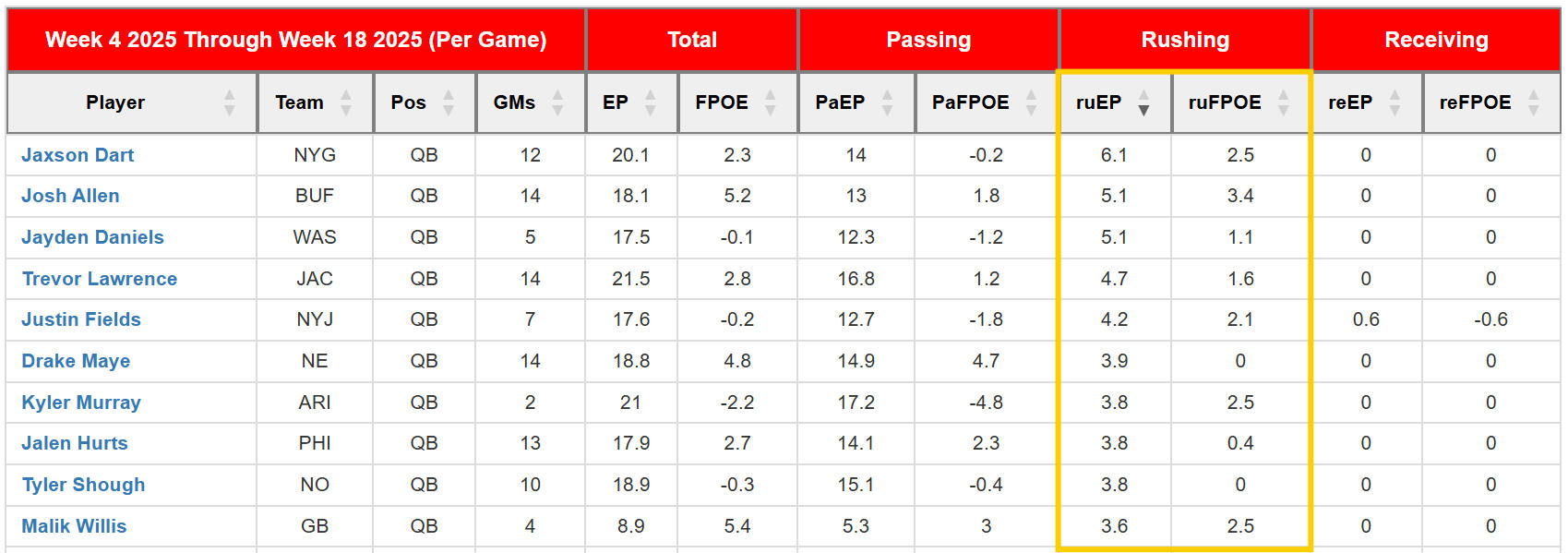
Dart’s rookie season was a textbook example of how rushing can be the great equalizer for fantasy QBs. From Week 4 onward, Dart’s 14.0 expected points per game (EP/GM) as a passer ranked 27th in the league. His efficiency as a passer was equally as bad, with his -0.2 fantasy points over expectation per game (FPOE/GM) tying for 28th at the position. Meanwhile, Dart’s 6.1 rushing EP/GM in that same timeframe cleared Josh Allen by a full point for the league lead. His 2.5 FPOE/GM on the ground only trailed Allen’s 3.4 FPOE/GM.
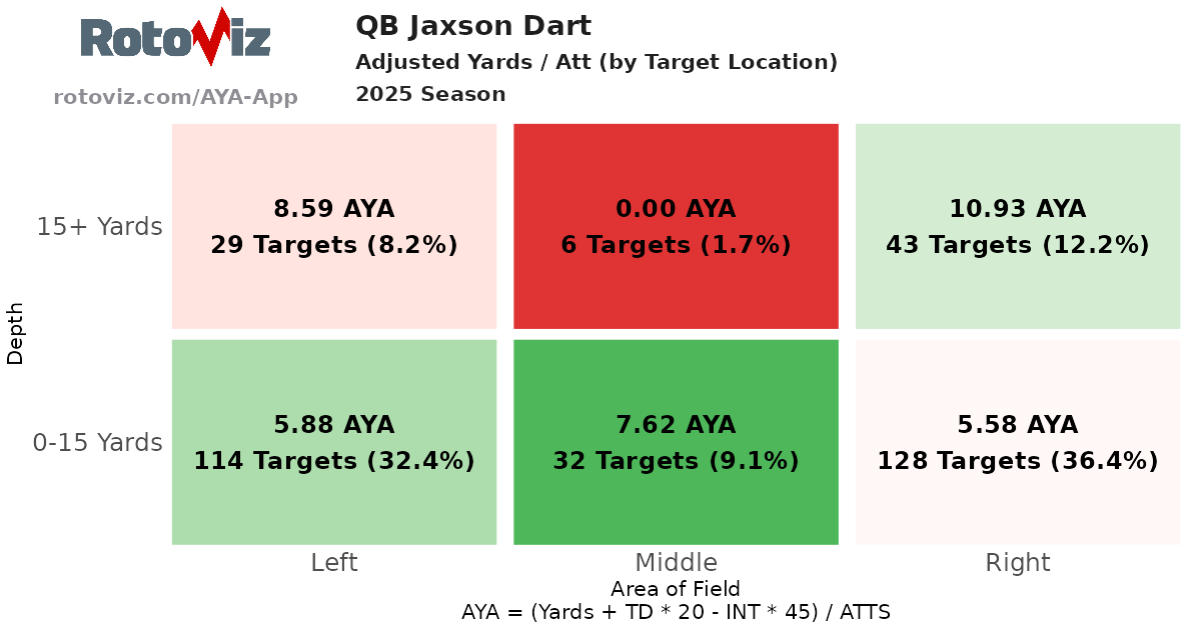
If we circle back and look at Dart’s ability as a passer with the help of the Advanced Stats Explorer, we find some interesting — but not entirely unexpected — results. When looking at the 36 QBs who attempted at least 200 passes in 2025, Dart’s 78% catchable target rate and 66% on-target rate both tie for 24th.[10] However, his reputation as a big-play merchant is somewhat justified with a 7.8-yard aDOT that ties for 11th in the group and a 23 attempts per touchdown rate that ties for 10th. And even when we are talking about passing, we cannot get away from Dart’s rushing ability, as his five pressures per sack rate ties for sixth best in the cohort.
To be fair to Dart, the midseason firing of Brian Daboll probably didn’t help accelerate his development as a passer. And he wasn’t exactly throwing to a host of All-Pros in New York this year either. Malik Nabers tore his ACL two quarters into Dart’s starting debut. Although Wan’Dale Robinson did his best to fill in for the Giants’ ascending star, it did not help Dart to become an efficient passer as a rookie.
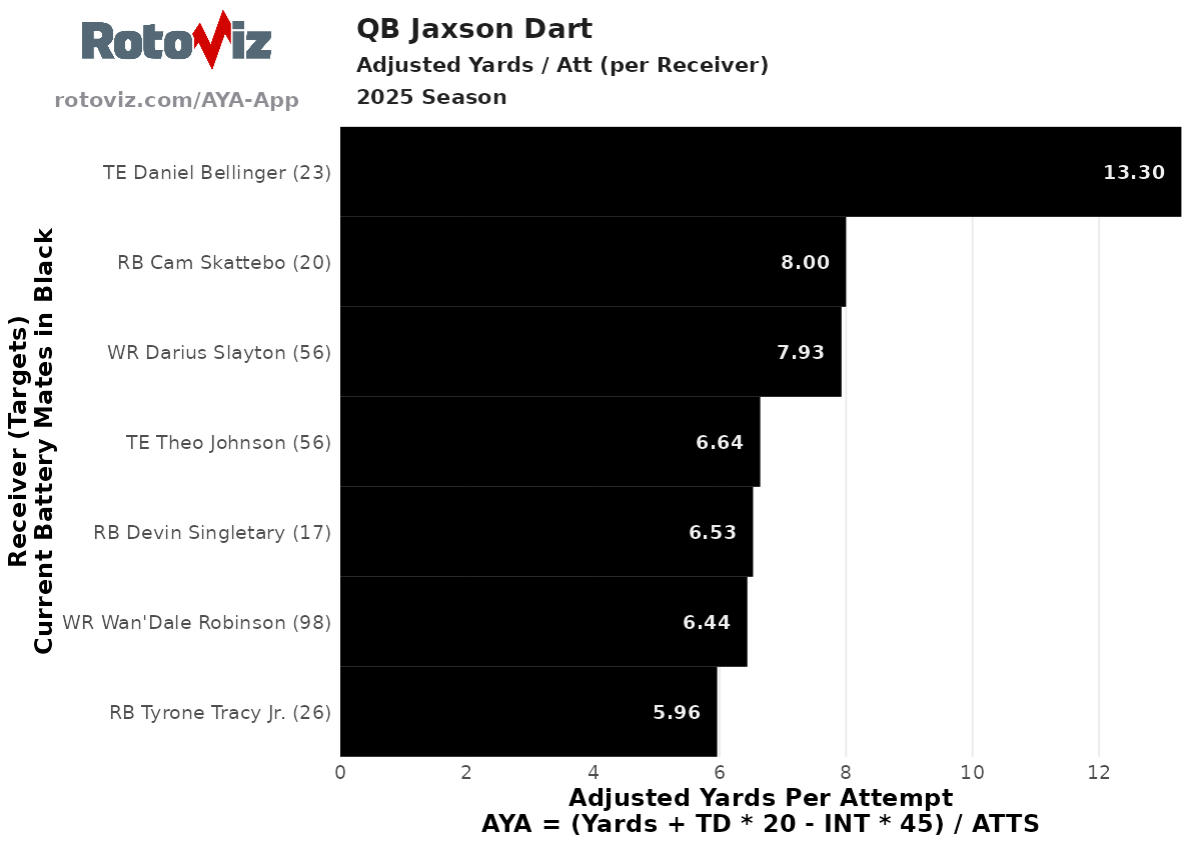
In fact, the only receiver Dart targeted more than 15 times and cleared an 8.0 AYA was his TE2, Daniel Bellinger.
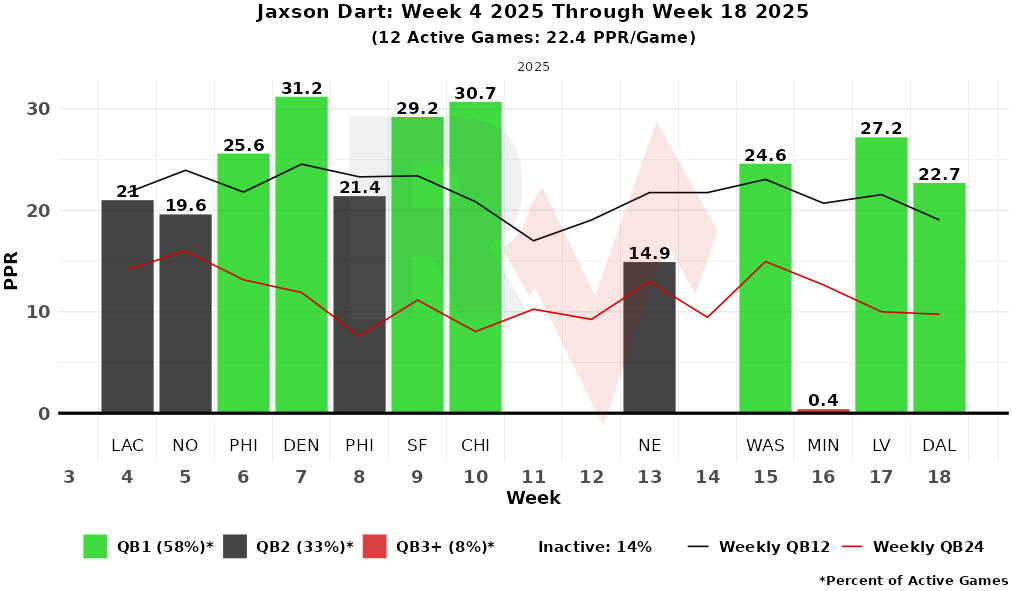
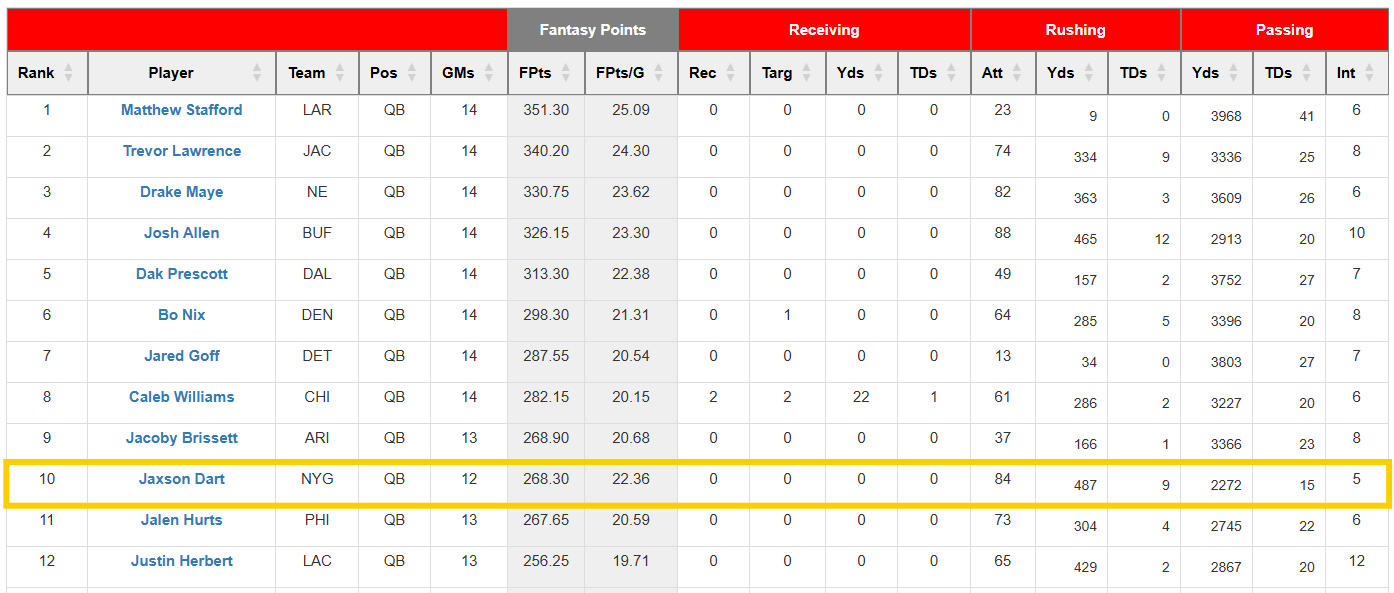
Dart’s dynamism resulted in him leading all rookie QBs in fantasy scoring, edging out Cam Ward 266.3 to 232.4. If we look solely at the rookie class’ time as starters, Dart’s 22.6 PPG beats out Tyler Shough’s average of 20.0 PPG. And there is reason to believe that Dart still has room to grow after getting a peek at some players who came up as comps for him when running a similarity search in the RotoViz Screener:[11]
PLAYER PPR/GM PPR/GM Diff paEP/GM paEP/GM Diff paFPOE/GM paFPOE/GM Diff ruEP/GM ruEP/GM Diff ruFPOE/GM ruFPOE/GM Diff 8-Player Average 20.8 3.5 13.9 2.3 0.5 0.7 5.1 1.5 1.3 -0.9 We get a fairly strong sample from the players above, with each appearing in at least 13 games in their second season in the league. The average growth these players experienced is encouraging for Dart’s 2026 outlook. In fact, the only area where the group did not experience an uptick was in their per-game rushing efficiency. However, the combined 3.8 points of additional EP/GM and an additional 0.5 FPOE/GM in the passing game more than make up the difference. While it is not featured on the table above, the group also increased their completion percentage by an average of 3% in their second seasons, which would be a welcome improvement for Dart after the Giants’ rookie only completed 57% of his passes in 2025.
Things are currently looking up for Dart heading into Year 2. The arrival of a new coaching staff and the expected return of his top two offensive playmakers should help him take a step forward, but there are still some kinks in his game that need to be addressed. Even so, seeing him flourish in such a poor situation as a rookie has the fantasy community extremely bullish on him for 2026, as he is currently coming off the board as the QB8 in the FFPC’s Never-Too-Early Best Ball tournaments.
Ashton Jeanty
Ashton Jeanty was not sneaking up on anyone after being drafted in the top 10 picks of the 2025 NFL Draft. He then went on to become the consensus 1.01 in rookie drafts, regardless of format. Given the context, we cannot blame fantasy managers all that much for being disappointed with Jeanty’s Year 1 production. I recently detailed the ups and downs of Jeanty’s 2025:
Expectations Versus Reality
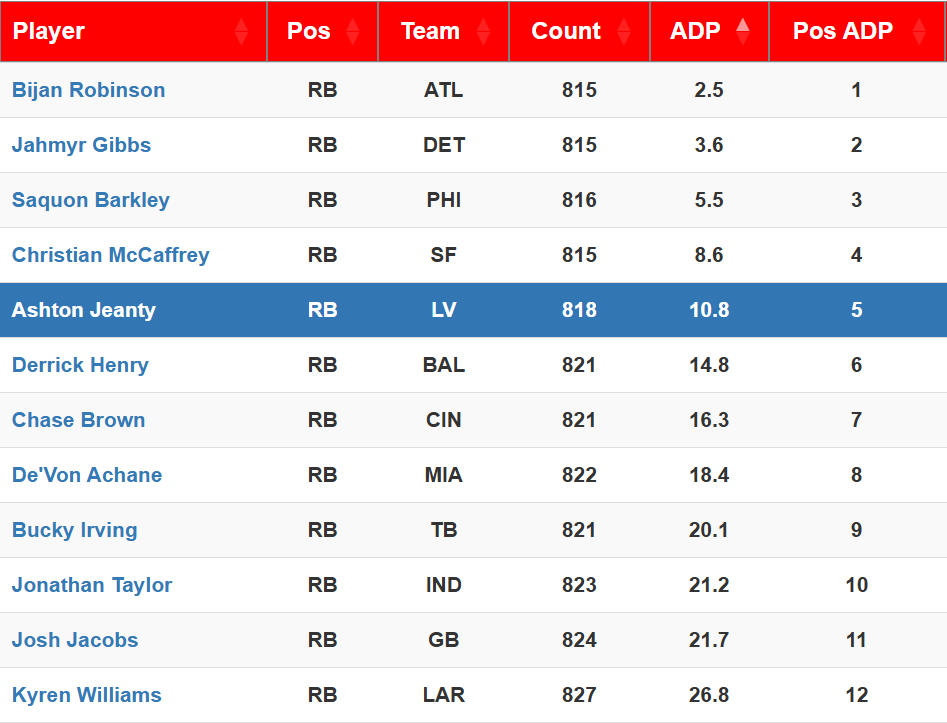
It would probably be fair to consider Ashton Jeanty’s rookie season a disappointment after he failed to deliver on his RB5 positional ADP from summer drafts.
Obviously, expectations were high for the 2025 sixth-overall pick after Jeanty became a certified superstar during his final two seasons at Boise State.
For an even better idea of exactly how dominant Jeanty was, here is an excerpt of Shawn Siegele’s write-up from the 2025 RotoViz Rookie Draft Guide:
[Jeanty] emerged as a superstar in 2023, carrying 220 times and catching 43 passes. He led college football with a 35% evasion rate as a runner, just behind Bijan Robinson’s epic 36% from 2021. His 3.9 yards per route tied Jahmyr Gibbs’ 2021 for the second-best RB YPRR in five years.
As strong as those numbers were, they paled in comparison to his 2024 season where he carried 374 times and evaded 124 tackles. To put that in context, his 84 broken tackles were 28 more than his 2023 number, which in itself was the third-best number of the last five years. Jeanty’s evasion rate ticked down to 33%, but he increased his yards after contact per attempt from 4.2 to 4.7, also the best number of the last five years.
Unfortunately, many of the concerns about Jeanty’s landing spot proved warranted, with the most glaring shortcoming being the Raiders’ offensive line. For as awful as things were up front for the Raiders in 2024, they actually got worse in 2025. Las Vegas’ front line went from tying for second-worst in the league with -0.030 points above average per play (PAA/Play) in 2024 to the absolute worst in the league at -0.040 PAA/Play in 2025. Looking solely at run-blocking snaps, the Raiders’ line ranked dead last in total points earned, after ranking 31st the year before. While the group did see a slight improvement in pass blocking, that footnote provided little comfort to Jeanty, who was consistently smothered in the backfield.
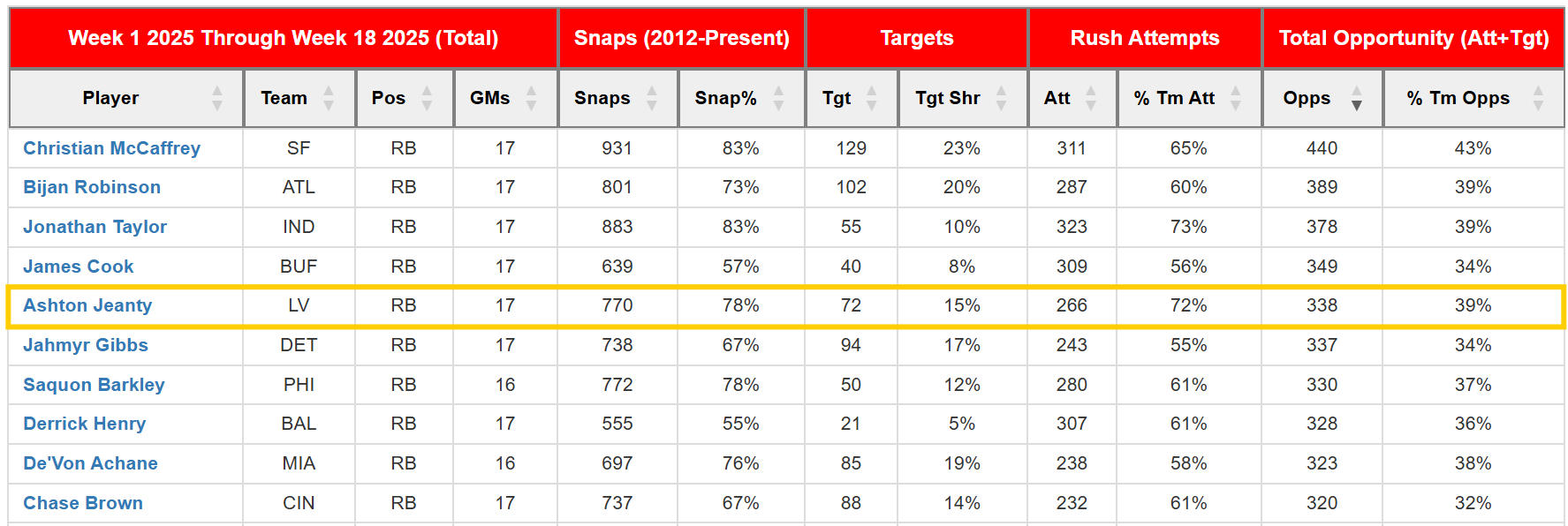
Despite the poor offensive environment Jeanty operated in, he never found himself wanting for opportunities. His 338 looks tied for fifth at the position, while handling 39% of his team’s opportunities tied for second among RBs, and a 78% snap share tied for third.
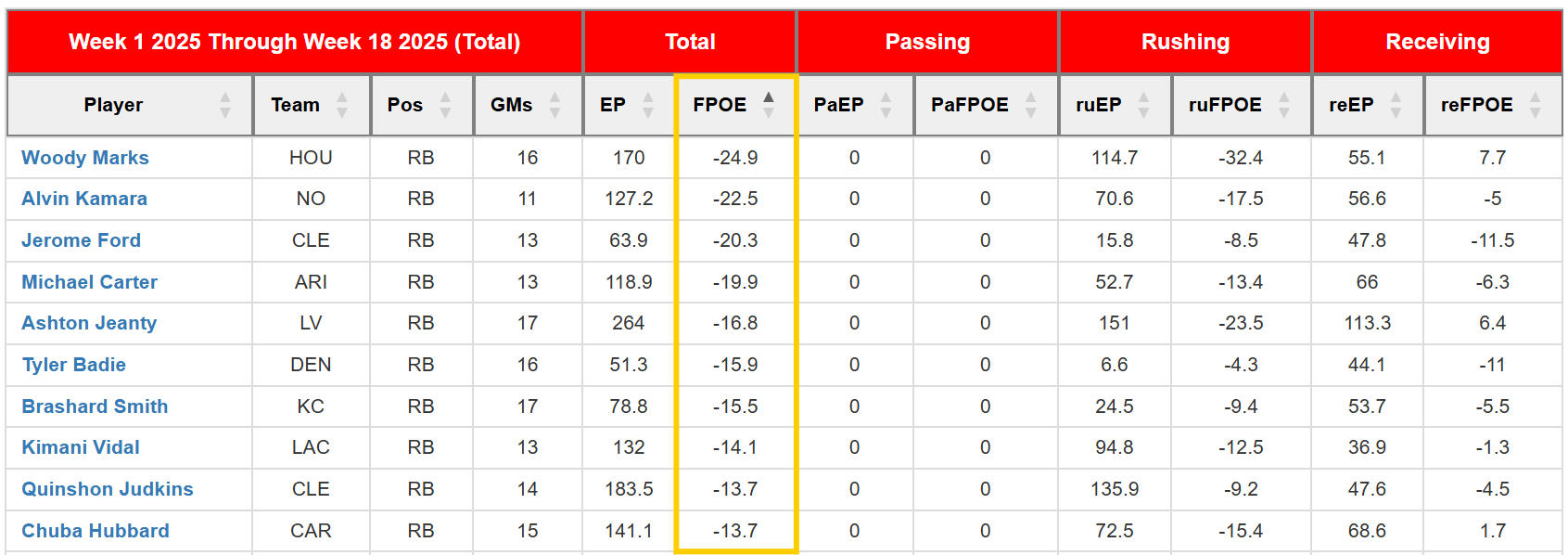
Unfortunately, Jeanty’s efficiency was far from ideal, as he finished with the fifth-worst mark in fantasy points over expectation (FPOE) among RBs as a rookie.
But as we scan the image above, we do notice that Jeanty was able to put together positive receiving FPOE this year. His receiving usage is one of the primary reasons to remain bullish on him after his 72 targets (seventh), 15% target share (sixth), 55 receptions (seventh), 347 receiving yards (10th), and five receiving touchdowns (t-third) all finished top 10 at the position.
If we head over to the Advanced Stats Explorer, we find that Jeanty remained difficult to get on the ground. Among the 43 RBs who earned 30 targets or more last year, Jeanty’s 40% evasion rate and 3.7 yards after contact per reception both came in sixth. If we look at the 49 backs to earn at least 100 carries in 2025, Jeanty’s 23% evasion rate ties for third. However, he ranks bottom two in yards before contact per attempt (0.7), hit at the line rate (52%), and stuff rate (27%). After taking these numbers into account and comparing them against Jeanty’s final stat line, it should not be surprising that he tied for top in the cohort by picking up 80% of his total rushing yards after contact.
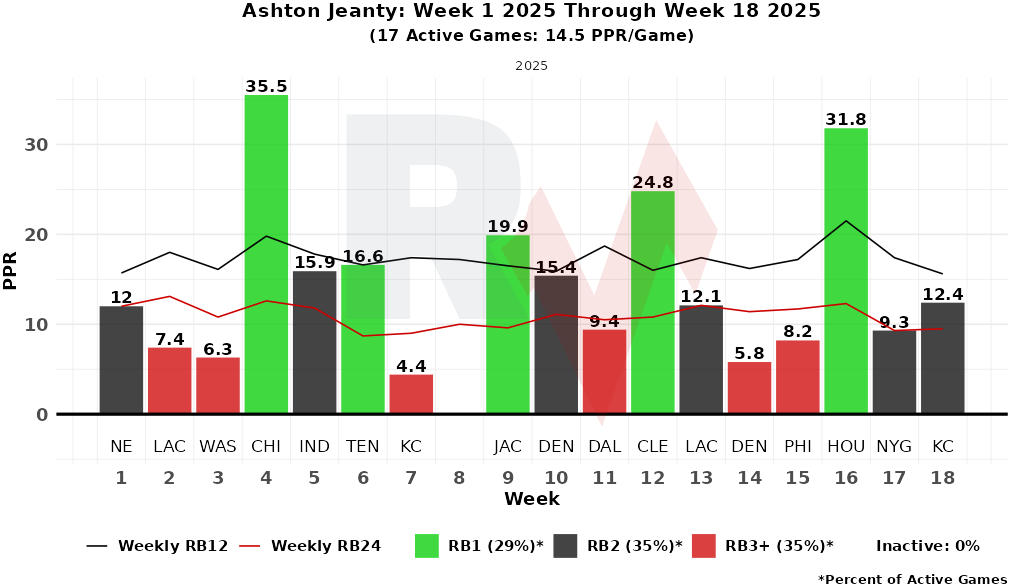
All things considered, Jeanty’s PPR RB11 finish as a rookie does not look all that bad in retrospect. He stayed healthy all year and finished as a top 24 fantasy option in 65% of his games. There is also a decent chance he helped propel fantasy managers to their championship games with an unreal performance against the Texans in Week 16.


Seize the Opportunity to Buy This Superstar in the Making Before He Explodes in 2026
Prior to the season, I theorized that Jeanty had a realistic chance of leading the NFL in opportunities as a rookie. While my high-end projections fell short — somewhat surprisingly due to a lack of rush attempts — the Raiders’ young workhorse exceeded my expectations in the pass game:
Last season, Saquon Barkley led the league with 345 rush attempts (which only accounted for 58% of Philadelphia’s total) and 387 total opportunities. Of the six RBs to surpass 300 carries last season, Jeanty’s skill as a pass catcher most closely aligns with Barkley and Bijan Robinson, the top two opportunity earners in the league last year. In Barkley’s rookie season, he earned 382 opportunities. Robinson put up 299 opportunities as a rookie while being inexplicably hamstrung by Arthur Smith. It is not outside the realm of possibilities that Jeanty blows by both numbers next season.
During Kelly’s three seasons as head coach in Philadelphia, LeSean McCoy earned a 13% target share in 2013, and Darren Sproles averaged double-digit target shares in 2014 (11%) and 2015 (13%). In his lone season as head coach in San Francisco, no RB earned more than a 9% target share.
If the Raiders average 32 pass plays next season, that would give them 544 over 17 games. Playing behind a similar offensive line in Seattle last year, Geno Smith averaged an 8% sack rate. If the same were to hold true in Las Vegas, that would leave the Raiders with 500 pass attempts for the year. Given the uncertainty in Las Vegas’ receiving corps outside of Brock Bowers and Jakobi Meyers, seeing Jeanty hit at least a 13% target share (65 targets) in his rookie season should not be a problem.
If there is a problem with the Raiders’ offense, it is on the line. Las Vegas has done little to upgrade a unit that ranked 30th in points above replacement last season. While their 1.9% blown run block rate (tied for eighth in the league) was significantly better than their 3.7% blown pass block rate (t-30th), the Raiders’ ranking of 30th in points earned per run snap should bring expectations back to reality.
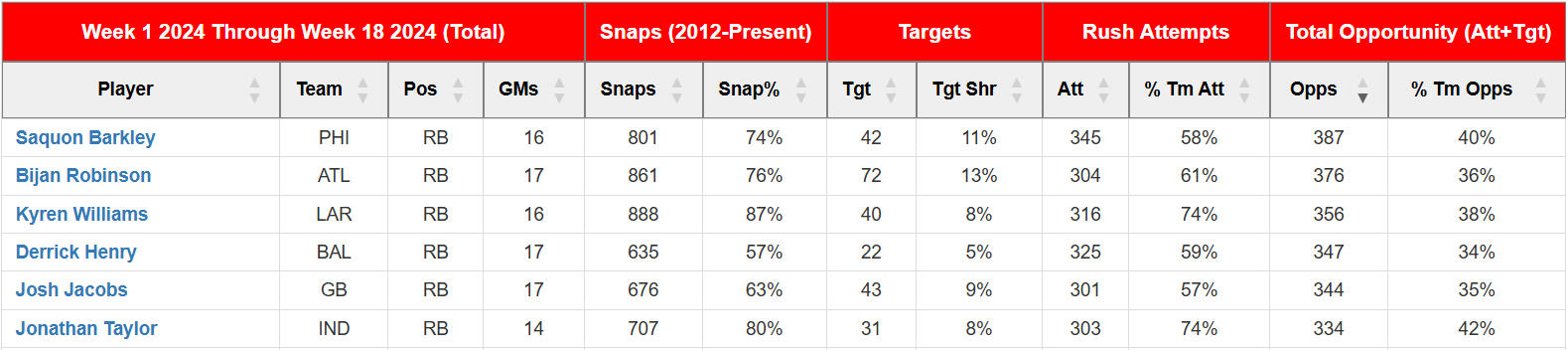
Despite Jeanty’s perceived struggles in Las Vegas last year, he still pulled in an exciting list of comps:
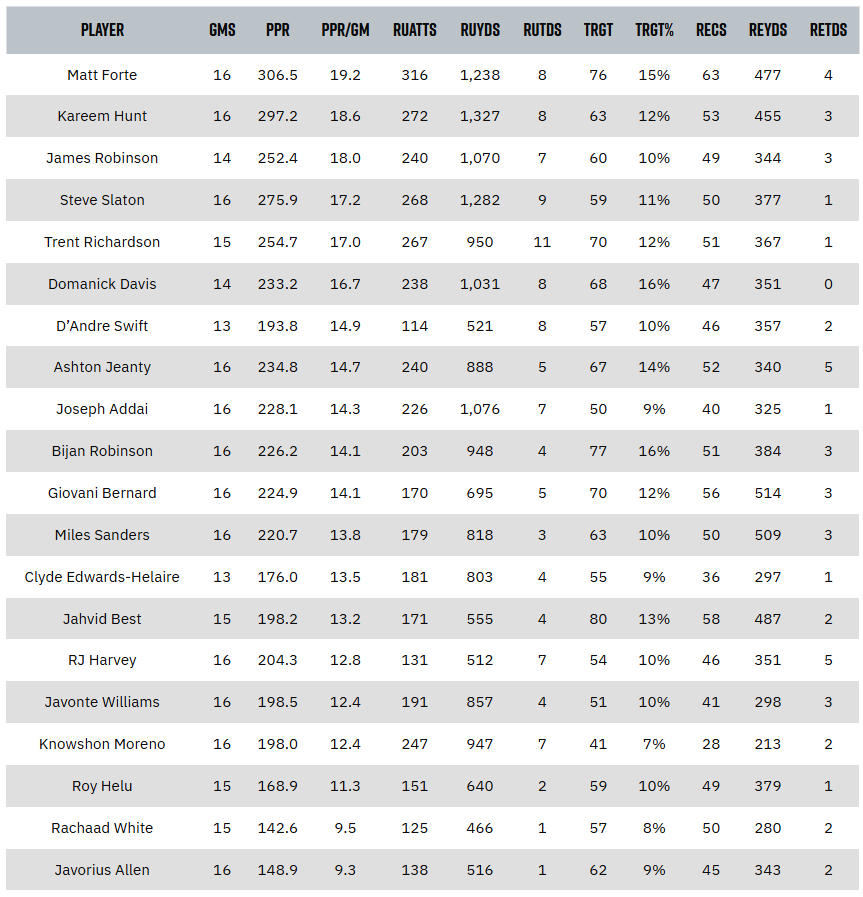
As far as the RotoViz Screener is concerned, Jeanty more than proved himself as a rookie and has the look of a superstar in the making.[12]
The group above conveniently has a cumulative 100 NFL seasons played between them and has put together 49 top-24 seasons in that time. The only player on the list who was unable to hit that benchmark was Roy Helu, whose PPR RB25 finish as a rookie explains his place on the list.
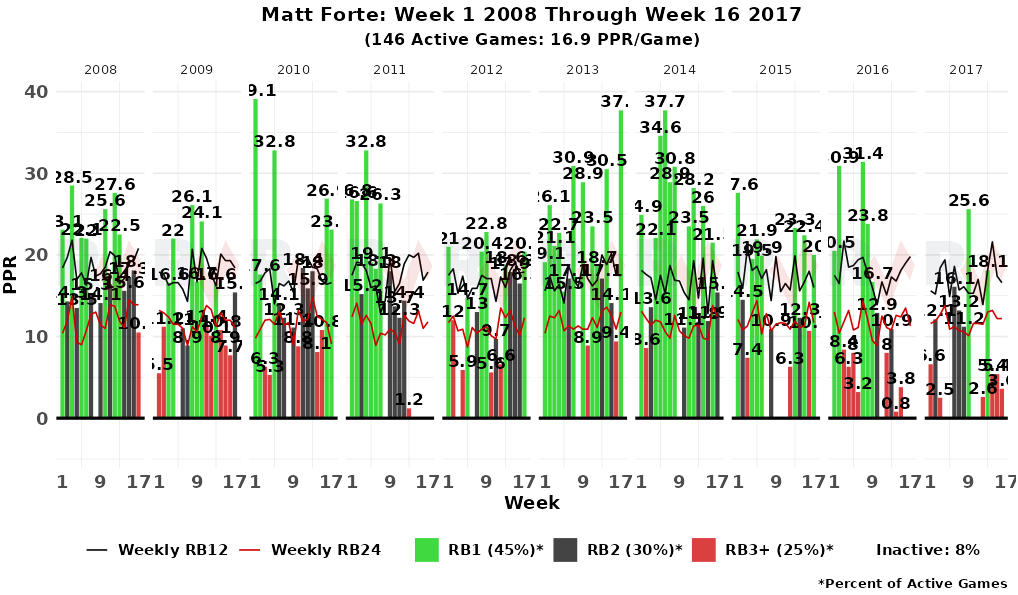
Digging deeper into the cohort, we find that this group of backs registered top-12 fantasy seasons at a 24% rate, with 10 of those years finishing inside the top five. The gold standard on the list has to be Matt Forte, who finished as a top 24 back in nine of 10 seasons, including eight RB1 campaigns and three years inside the top three. However, we should not rule out Robinson eventually surpassing Forte in career production after the Falcons’ superstar has finished as a top-eight RB in each of his three seasons, including two consecutive top-three finishes in the past two years.
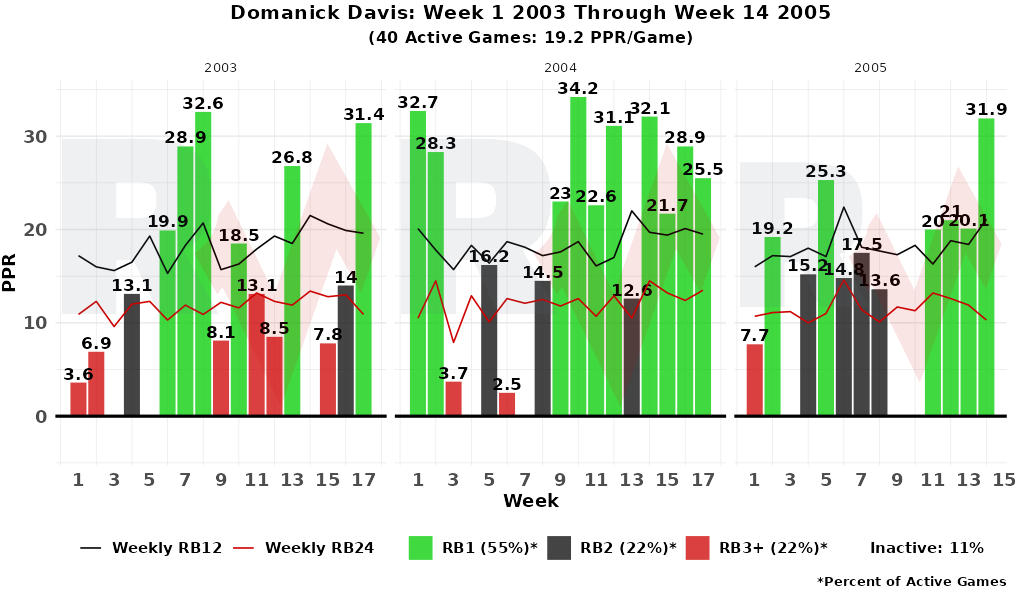
I would also be remiss if I did not acknowledge three players on the list who possessed massive upside before their careers were upended by injuries. Domanick Davis emerged from the fourth round of the 2003 draft to finish as the RB14 as a rookie. He then reached even greater heights with an RB3 finish in 2004. He was well on his way to finishing as an elite fantasy option once again — averaging 18.8 PPR/GM in Year 3 — before a devastating knee injury ended his career.
Jahvid Best and Steve Slaton did not have Davis’ level of impact early on, but each was off to a fast start before injuries took their toll. Sadly, concussions ended Best’s career midway through his second season after Detroit selected him 30th overall in 2010. Meanwhile, a neck injury Slaton suffered in Year 2 eventually ended his time in the NFL after he finished as the PPR RB7 as a rookie.
It would also be irresponsible not to mention the two biggest first-round busts on the list, Trent Richardson and Clyde Edwards-Helaire. Their appearances on the list indicate that Jeanty is not out of the woods just yet. Still, it is difficult to imagine Las Vegas’ workhorse suffering a similar fate as Richardson, who was traded two games into his second season and subsequently found himself out of the league three years after being selected third overall in 2012.
While Jeanty’s comps still include some cautionary tales, Las Vegas possesses a treasure trove of assets that should allow them to improve their roster around Jeanty this offseason, hopefully leading to a more efficient second season. The fantasy community appears to be banking on a Year 2 surge as well, with Jeanty’s 2026 ADP barely budging from the price we paid for him last year.
Tetairoa McMillan
There was not much room to be bullish on Tetairoa McMillan at his 1.04 ADP in 2025 FFPC Superflex rookie drafts. But we managed to do just that by ranking him as a Tier 1 player alongside Jeanty as our 1.02 in Volume 3 of the 2025 RotoViz Rookie Draft Guide.
Shawn laid out why we were so infatuated with the alpha WR out of Arizona:
McMillan was the No. 5 receiver and No. 51 overall prospect in the 2022 class. He became one of the highest-ranked recruits to sign with Arizona in recent memory, and immediately paid dividends on the field, averaging 18 yards per reception and scoring eight TDs as a freshman. In both 2023 and 2024, McMillan went over 1,300 yards, posted just over 3.0 YPTA, and combined for 18 TDs. His Dominator Rating jumped from 31% to 44% in 2024.
He also became an unstoppable threat all over the field, evading 14 tackles as a sophomore. Those numbers climbed to 13 broken tackles and 14 forced missed tackles as a junior. He did all of that as a vertical threat with 1,777 air yards, most among Power conference receivers, and second most over the last two seasons, trailing only Rome Odunze’s 2023. Those final-year numbers backed up the 1,671 air yards from 2023. Among Power conference receivers, he drew the most targets of at least 15 air yards in 2024 and the second most in 2023. He was also successful inside and out, drawing 48 and 50 slot targets respectively in those seasons.
McMillan didn’t post crazy YPRR numbers, but he played almost every snap for a 4-8 Arizona squad that threw for only 18 TDs and fewer than 3,000 total yards.
After McMillan earned top-10 draft capital, his Box Score Scout comps provided even more reason to get excited about his Year 1 potential:
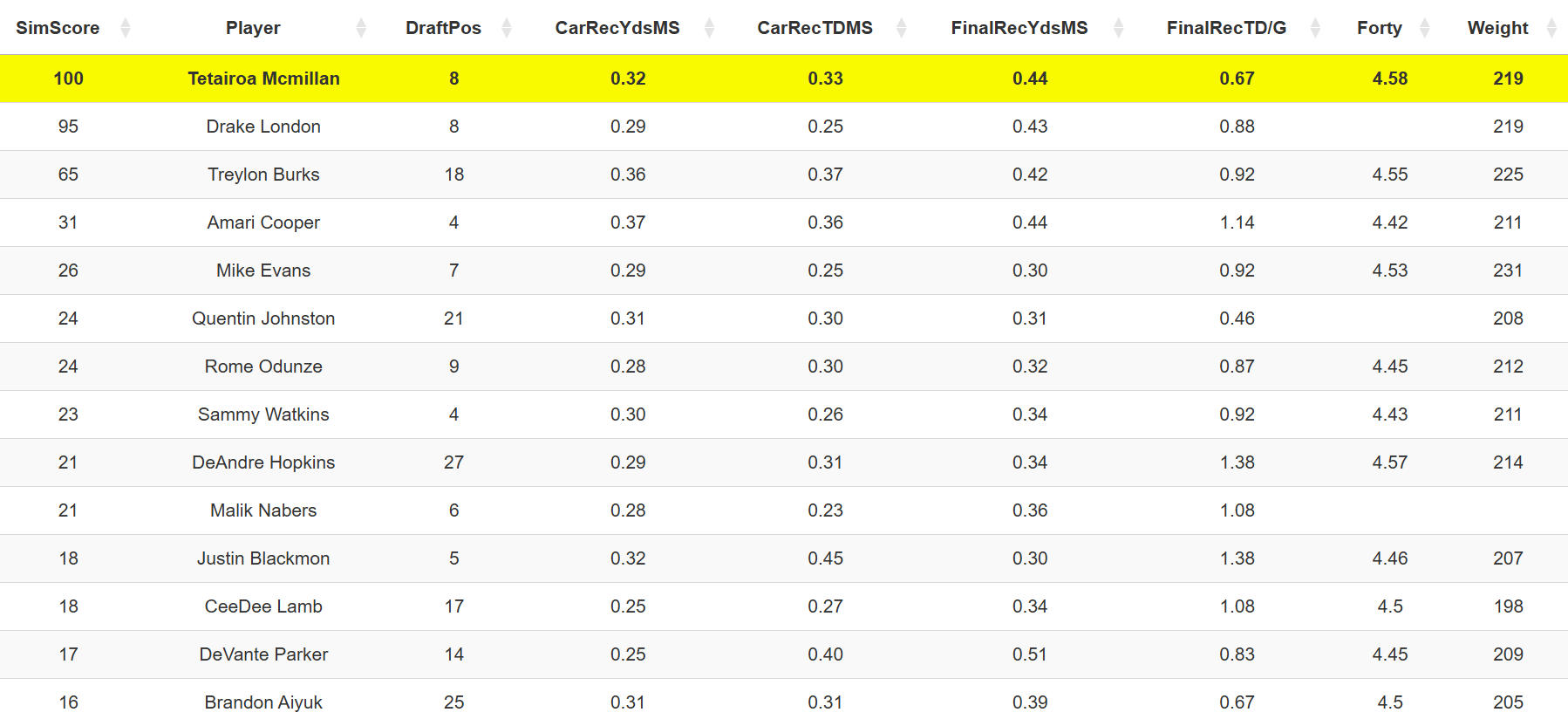
Even though Travis Hunter was selected before him, McMillan’s score of 87 in the WR Prospect Lab still came out as the highest in the class. Once again, using the 4.58-second forty time from McMillan’s pro day, the comparisons in the Box Score Scout are mostly encouraging; however, the level of correlation in the sim scores creates some uncertainty about how much we should rely on the results beyond the top few players. If we remove McMillan’s forty time altogether, the names on the list remain largely unchanged, but the sim scores actually end up going down in most cases.
From a stylistic perspective, DeAndre Hopkins and Mike Evans should be considered the dream scenario, while Drake London and Allen Robinson sit at the median, and DeVante Parker and Quentin Johnston represent his floor.
How Long Will It Take Tetairoa McMillan to Become a Target Hog in the Carolina Passing Game?
McMillan delivered in line with his high-end BSS comps as a rookie. I went over the strengths and weaknesses of his rookie year when I recently profiled McMillan’s current outlook:
As Advertised in Year 1
Tetairoa McMillan entered the NFL with high expectations after the Panthers selected him eighth overall in last April’s draft. While McMillan didn’t exactly dominate out of the gate, he produced steadily throughout the year, finishing as a high-end fantasy WR2 and earning the NFL’s 2025 Offensive Rookie of the Year honors.
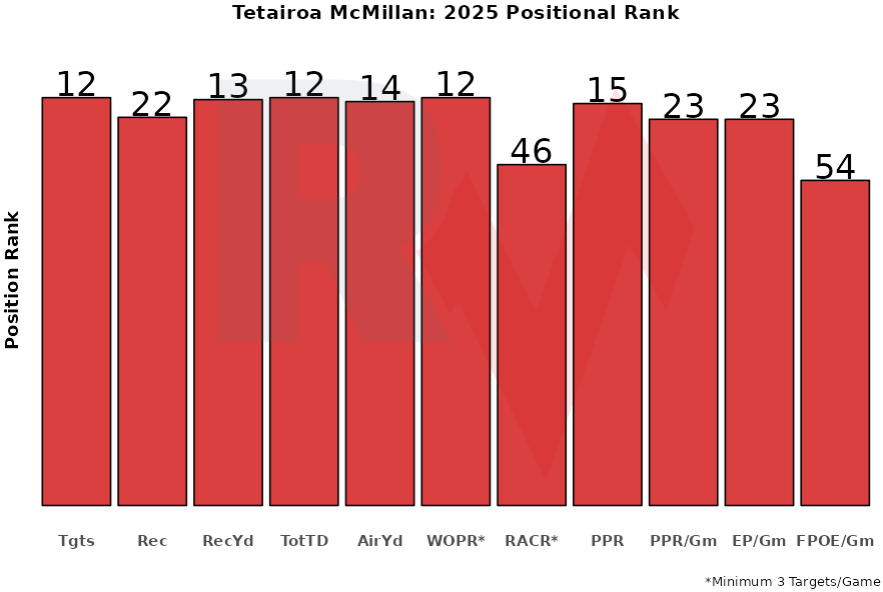
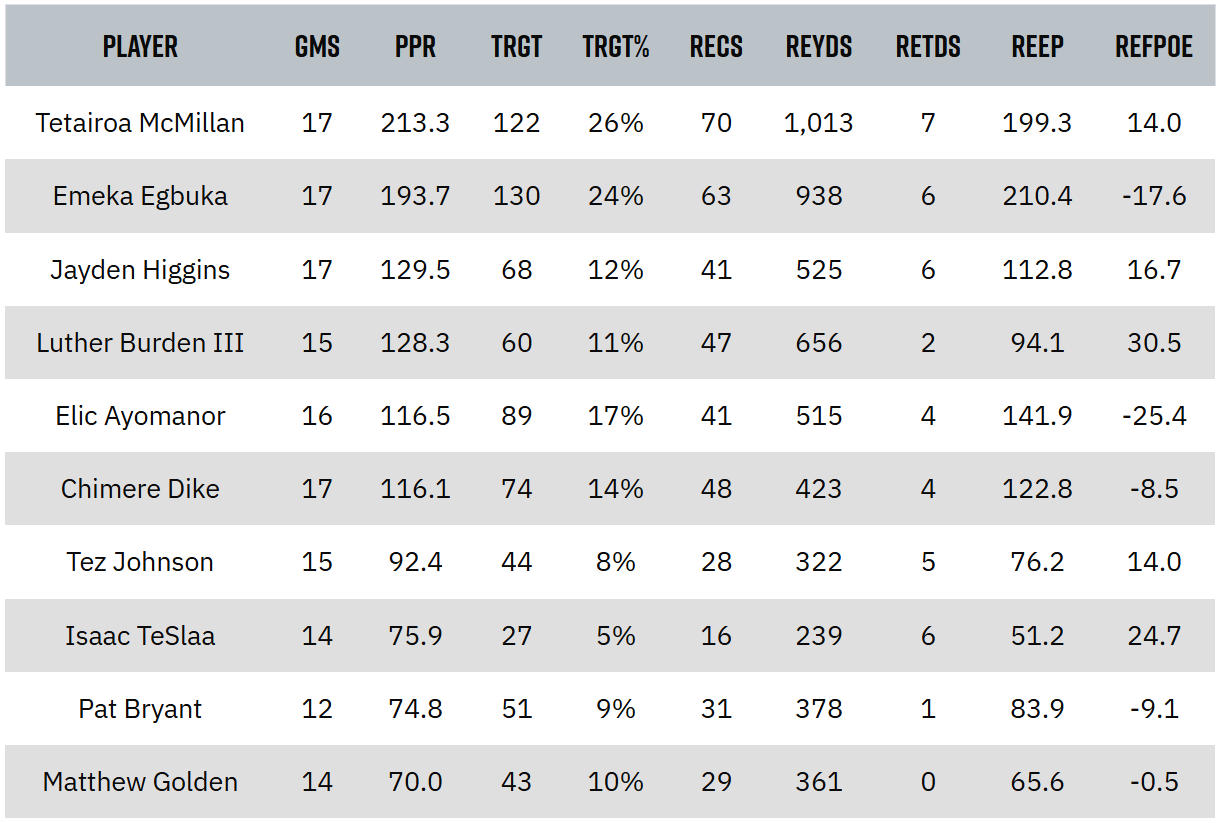
When looking at the 2025 WR class, McMillan paced the group in PPR points, receptions, receiving yards, receiving touchdowns, and target share. He came in second only to Emeka Egbuka in raw targets and expected points (EP), while ranking sixth in the class in fantasy points over expectation (FPOE).
For all of the positive signal we received from McMillan in his rookie year, there is room for improvement. Perhaps the area where McMillan should focus the most attention is securing his catchable targets. Here is what I wrote about the Panthers’ rookie receiver in Part 5 of my recent series focusing on WR advanced stats from the past seven seasons:
Even though McMillan was able to bring home the Offensive Rookie of the Year Award, a sub-25th percentile R/CT% still shows that there is more work to be done. If we want to throw a positive spin on this information, the fact that he finished as a high-end WR2 with such a poor R/CT% only demonstrates how high a ceiling 2025’s No. 8 overall pick actually has if he becomes a more reliable target.
Despite McMillan falling well short when it came to reeling in his catchable targets, his 51% air yard conversion rate still landed in the top half of WR seasons from the past seven years. If we focus solely on the 647 wideouts who had an aDOT of 12.0 intended air yards or higher in that stretch, McMillan’s rookie year moves up to the 80th percentile. What is even more promising is that McMillan’s 7.2 targets per game, 2.0 yards per route, 4.2 routes per target, and 45% first down per target rate all finished in the top 25th percentile of all WR seasons since 2019.
After running a similarity search in the RotoViz Screener and narrowing down the results to players of a similar archetype to McMillan, two star receivers from Cincinnati’s past and present rose to the surface as a potential preview of McMillan’s range of outcomes:[13]
If we want to whittle down the list above to find archetypes that more closely resemble McMillan, we can get rid of all the players who come in under 6 feet 3 inches, as well as all the wideouts who weigh more than 220 pounds.
What we’re left with is a list of six players, with Higgins (33rd overall in 2020) being the only name to be called outside the top 10. While not all the players are perfect matches stylistically, the skill sets of all six receivers are well-rounded enough that grouping them together shouldn’t be considered heresy.
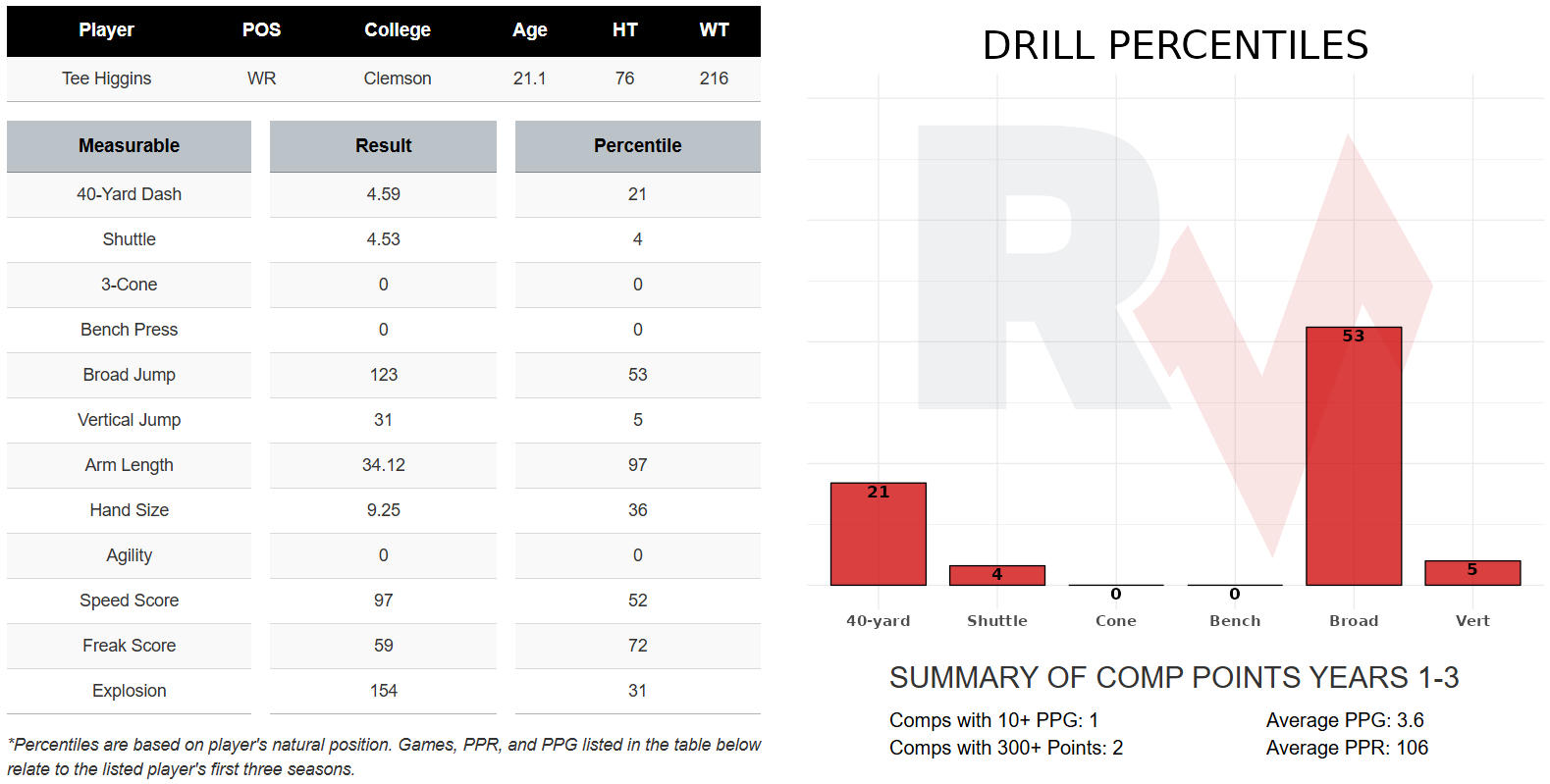
Since we do not have NFL combine data for McMillan, it is difficult to gauge his overall athleticism. It was reported he ran somewhere between 4.46 and 4.57 in the forty at his pro day. If we want to be responsible and lean into the slower times from McMillan’s pro day, the most suitable comp of the five players above would probably be Higgins.
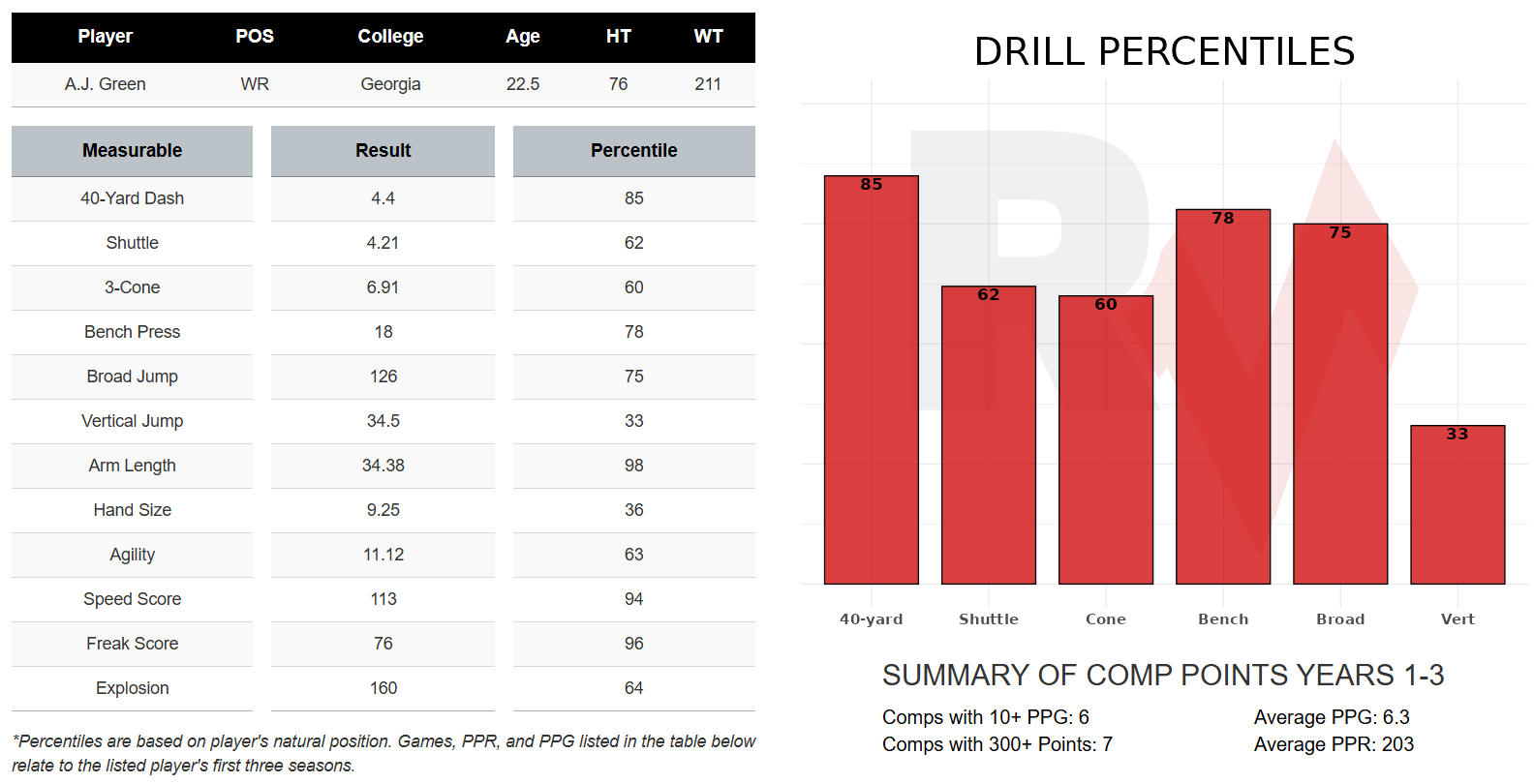
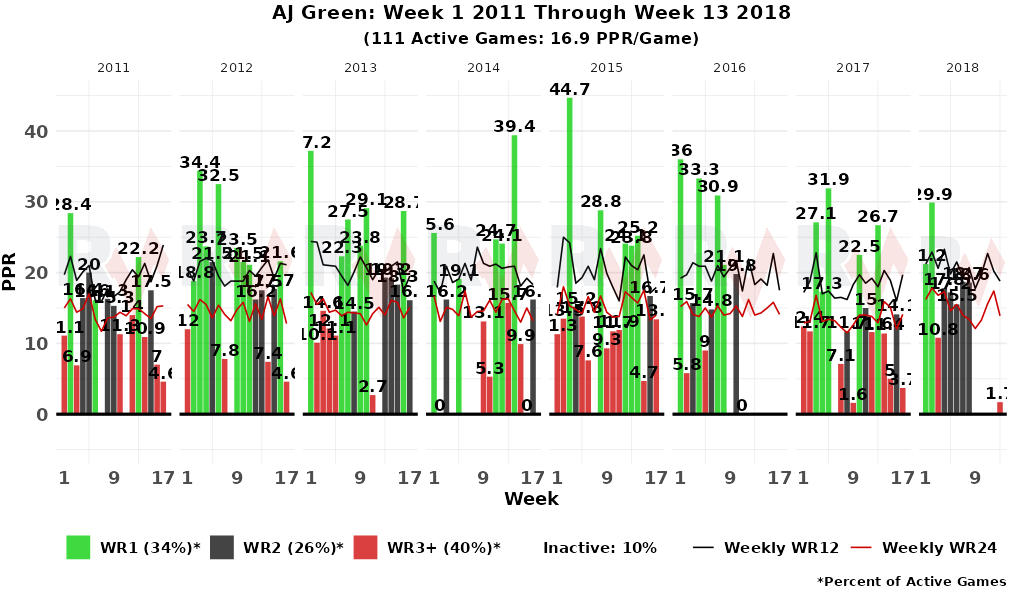
But if we want to throw caution to the wind, there is a universe where we could see McMillan take things a step further and become the next A.J. Green.
Projecting McMillan to clear 300.0 PPR points in 2026, as Green did in his second NFL season, may be a little overzealous, but it would be a disservice to McMillan’s strong rookie year to believe that it is not within his range of outcomes. However, seeing McMillan put together a prime similar to what Green experienced from 2011 through 2018 does feel a bit more attainable.
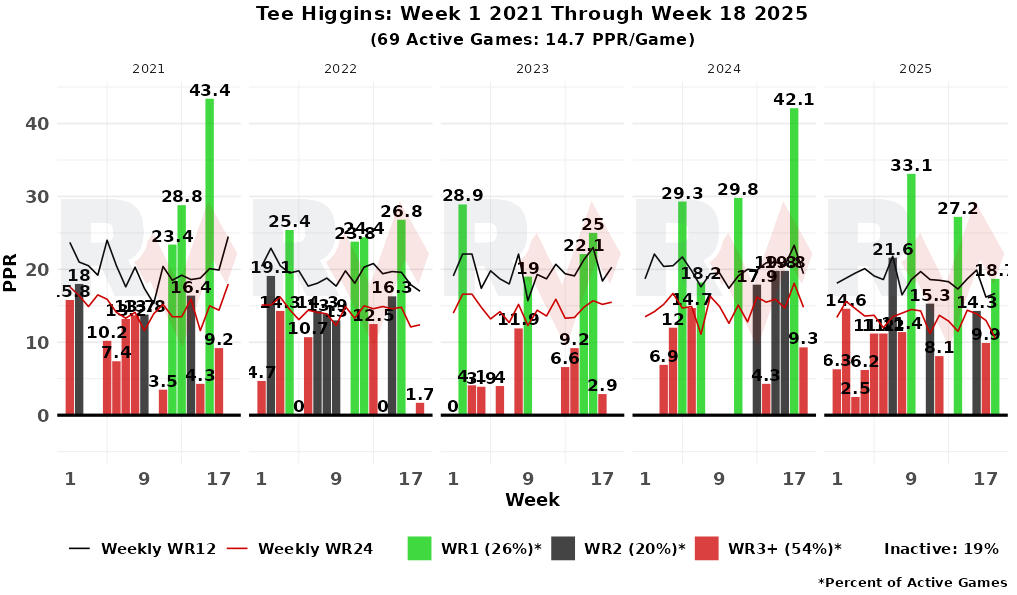
Even if McMillan levels out at Higgins’ PPR production, we should not be too upset. That is, as long as Carolina’s budding star has better injury luck than his Bengals counterpart.
Given the upside that McMillan possesses, it should not come as a surprise that I am back in on him for 2026 as the WR13 in the middle of the third round of the FFPC Never-Too-Early Best Ball Tournament. While seeing McMillan reach his ceiling outcome is also contingent on Bryce Young’s continued development, the returns we got from the duo down the stretch this season were promising enough to lean into continued growth from the Carolina offense.
Footnotes
| ↑1 | You could also disagree with some of the assessments and the analysis below would still stand statistically, as explained in the footnotes below. |
|---|---|
| ↑2 | The model trains on 80% of the dataset and then tests against the remaining 20%, repeating the process five-fold (cycling the holdout set) with a fixed random seed for reproducibility, and averaging the results. |
| ↑3 | An example of overconfident wrongness would be, the model projects Y: 80%, N: 10%, A: 10% and the actual result is “N”. I also ran a McFadden R² test, which is not classic linear regression (where you would expect much higher scores) but ensures the ordinal model is better than guessing. |
| ↑4 | Defined as “No” results, instead of “Yes” or “Ambiguous”. |
| ↑5 | The McFadden R² is ~0.08 and the Brier is ~0.21. If “Ambiguous” is kept separate from the “Yes” results, or removed from the analysis entirely, the results are directionally similar. |
| ↑6 | Another part of the humility-based approach is to Stay Classy, San Diego. |
| ↑7 | One with a deep warning track, perhaps. |
| ↑8 | Which is not to say the grades wouldn’t be helpful as compared to some other rankings. |
| ↑9 | These are throws that came on plays that did not include play action or jet motion, while also traveling at least 6.0 air yards downfield. |
| ↑10 | SIS considers a pass attempt on-target if it hits the receiver in stride; a catchable target is pretty self-explanatory. |
| ↑11 | Sorry, but if you want the full list of comps, you’ll have to check out the article. |
| ↑12 | Due to the 16-game schedule prior to 2021, the Screener was only set to capture Weeks 1-17 of each player’s rookie season. |
| ↑13 | Just like with Dart, if you want McMillan’s full list of comps, you’ll have to read the article. |