NOTE: Our tools will be updated each week as soon as data from our stats provider is available. Generally, data from Sunday’s games will be available early Tuesday afternoon. For an immediate look at the games from the previous weekend, please check out our Monday Reviewtool which includes a collection of preliminary stats.
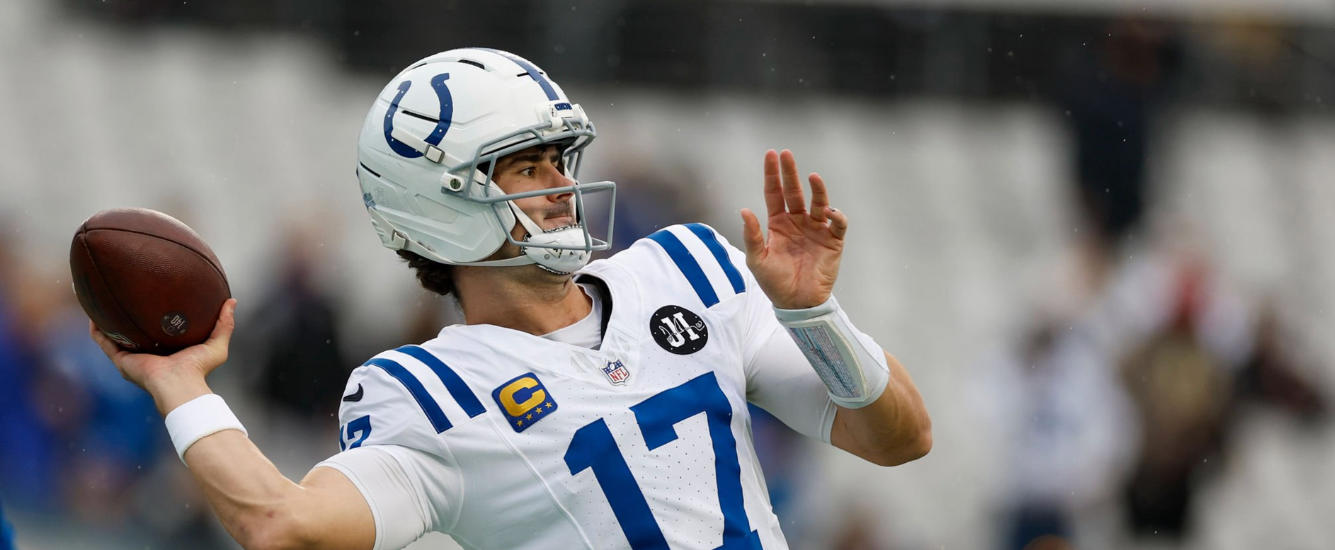
Image Credit: David Rosenblum/Icon Sportswire. Pictured: Daniel Jones.
The RotoViz staff details how to handle the shifting ADP landscape in both versions of the FFPC’s Never-Too-Early Best Ball Tournament.
Almost any player can become a buy in fantasy at the right price. Over the past month and a half, fantasy drafters have received an influx of new information from the NFL Combine and free agency. The insights we have gained from both events have rightfully had a massive impact on the ADP landscape of pre-draft best ball tournaments.
The picture of the 2026 NFL season is getting a little bit clearer, but there is still plenty of uncertainty that fantasy managers will need to navigate over the coming months. Fluctuations in ADP give us a solid understanding of how the fantasy community at-large is viewing players. But the real questions we need to be asking ourselves are: “How high should we be willing to chase the risers?” and “How far down does someone have to fall before they become a value?”
Currently, our biggest concerns are how to properly evaluate shifting team dynamics following free agency and how to value this year’s rookie class without the benefit of knowing landing spots or draft capital. Luckily for us, both concepts are intertwined. We now have a deeper understanding of team needs following free agency, which gives more clarity in projecting where 2026’s top prospects might land.
Let’s dive into some of the biggest shifts we have seen in FFPC best ball ADP since the beginning of March and flesh out how we should be playing fantasy’s biggest risers and fallers.
Are you ready to finish the 2026 pre-draft best-ball season strong? Head over to the FFPC today! New users save $25 off their first team of $35 or more with the code 25ROTOVIZ or by following this link!
Free Agency Movers and Shakers
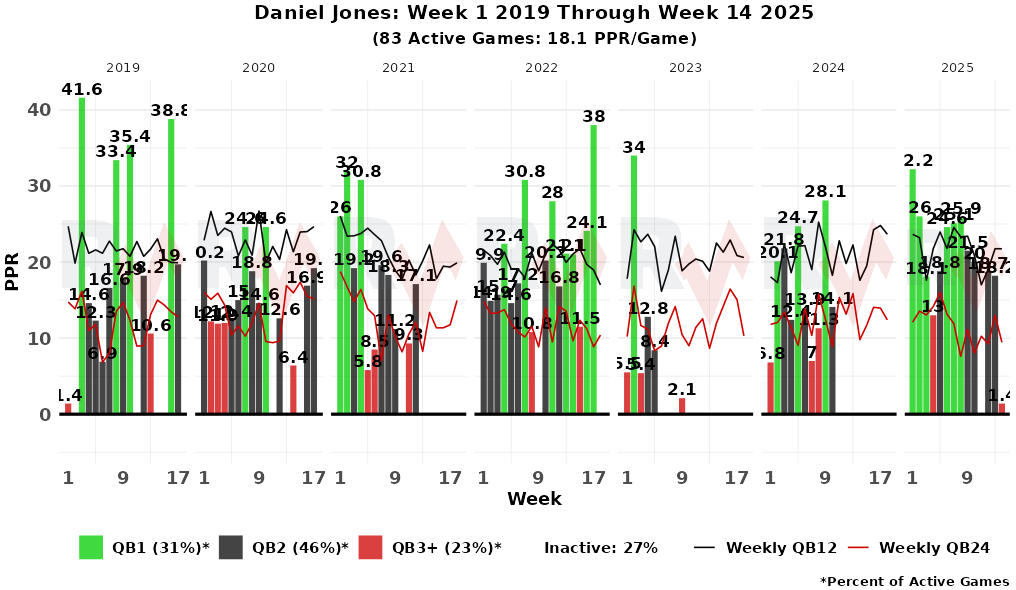
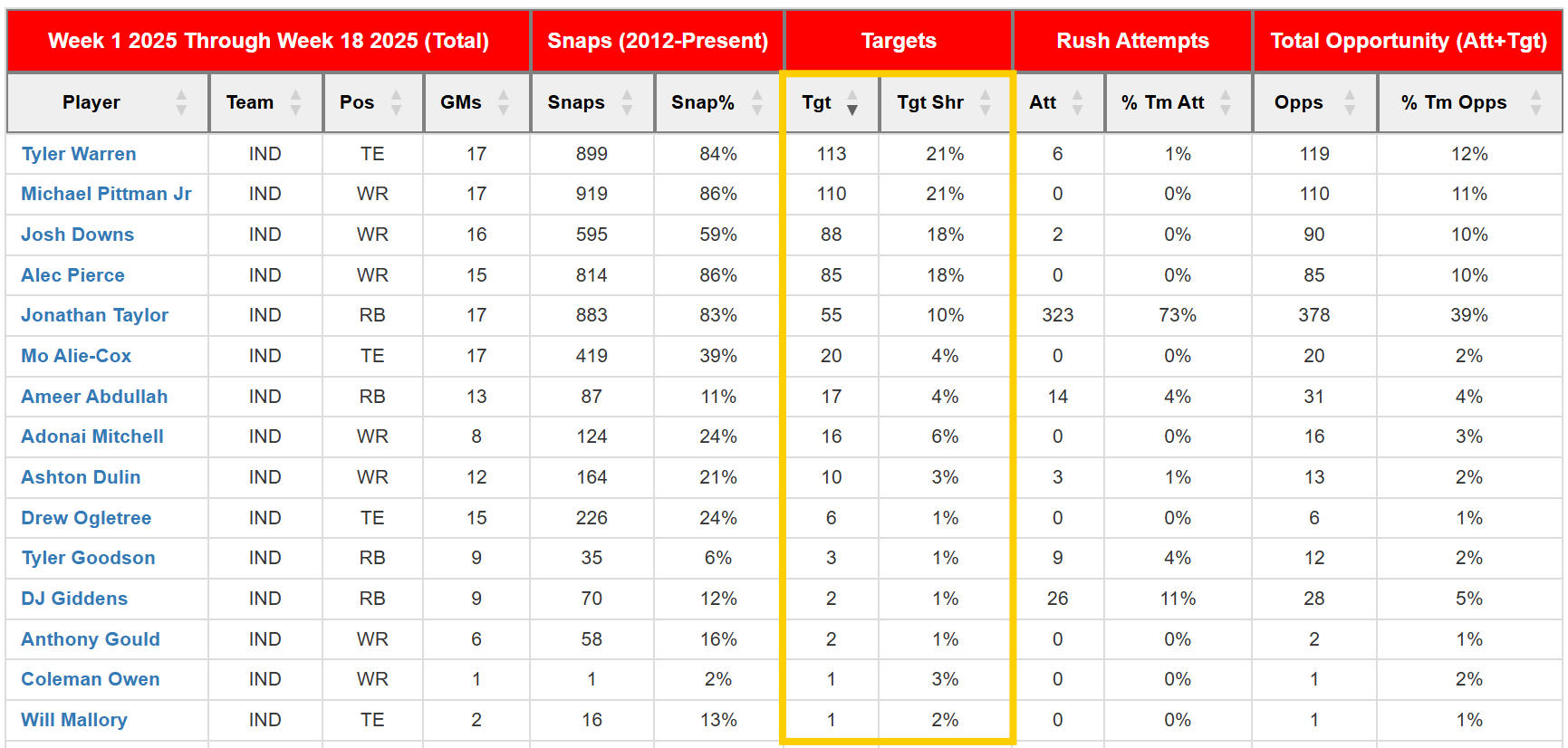
The Indianapolis passing game is in a state of flux and could go in any number of ways this season. The team prioritized Alec Pierce over former WR1 Michael Pittman, shipping the latter to Pittsburgh to clear cap room to re-sign quarterback Daniel Jones and Pierce.
Jones faces his own question marks after tearing his Achilles in Week 14 last year. And that is before we even begin to mention his erratic play prior to landing with the Colts.
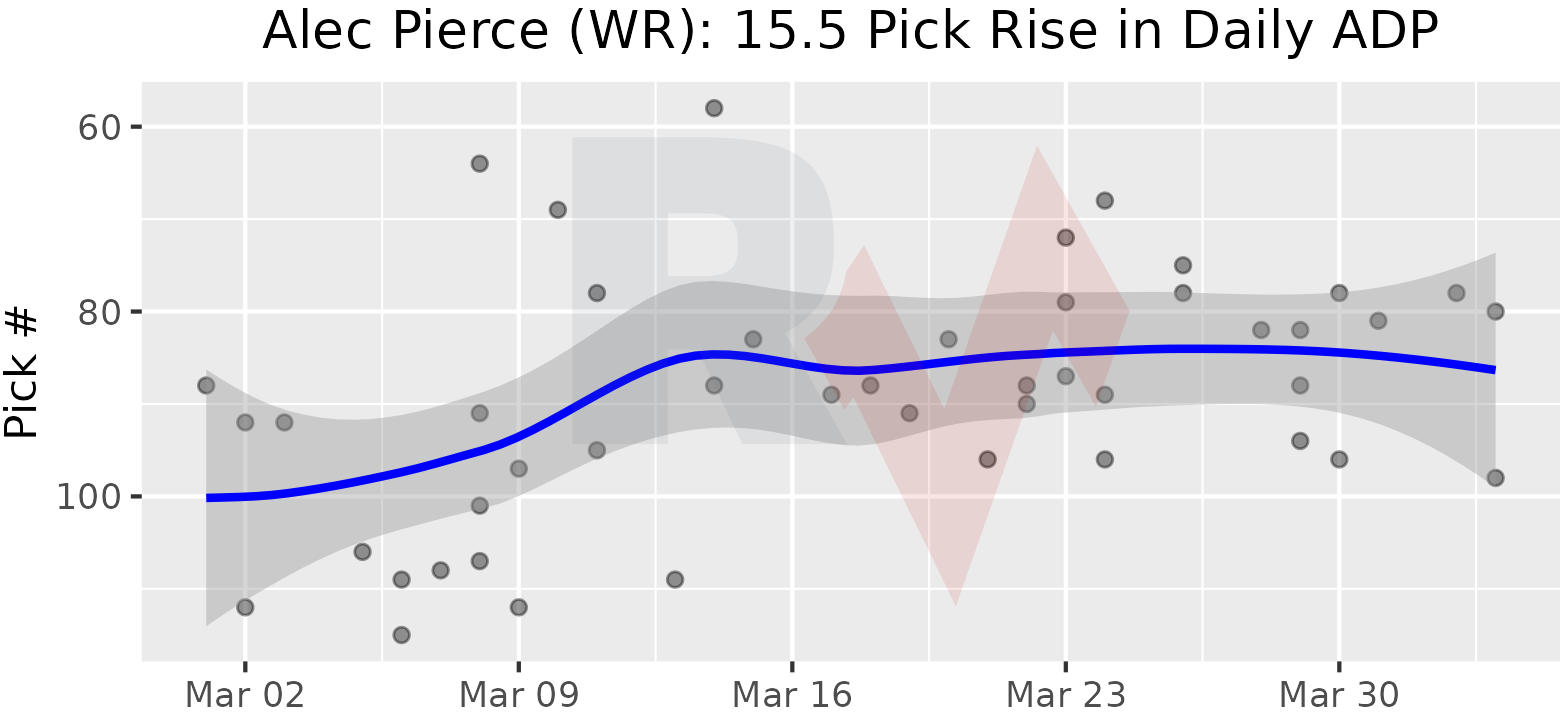
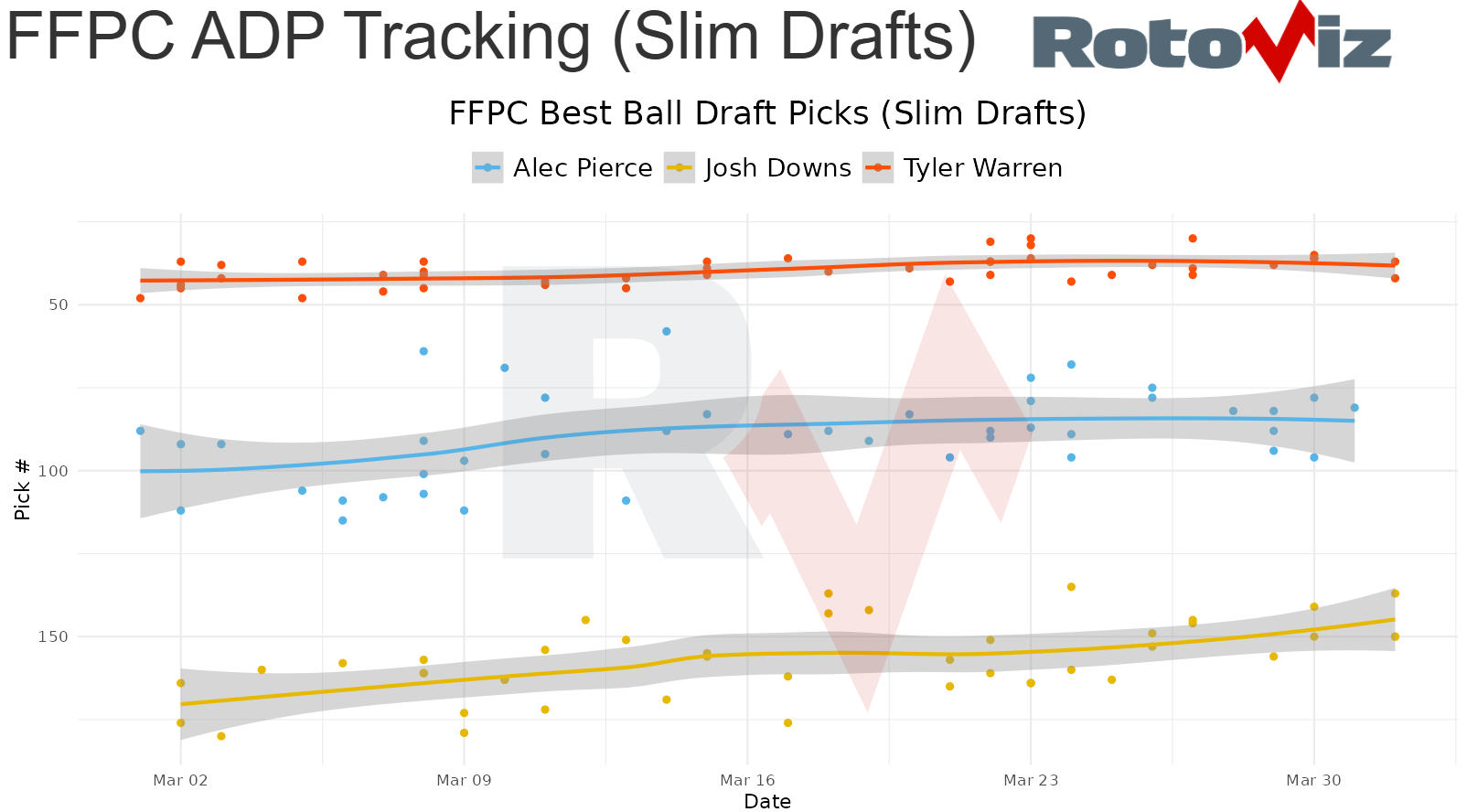
Now we add another wild card to the mix in Pierce. Once rumors began circulating at the end of February that Pierce could earn upwards of $30.0M per year in free agency, his ADP began to climb. He settled for slightly less to return to Indianapolis. But now he must deliver like the WR1 he is being paid to be. Best ball drafters are buying Pierce, but I recently looked into whether his price tag has risen enough:
Alec Pierce
Alec Pierce’s new contract is pretty wild. Yet, it is still very difficult to fully project what it means for Pierce from a fantasy perspective.
Averaging $28.5M per year entitles Pierce to the WR1 spot on the Colts’ depth chart. The departure of Michael Pittman all but ensures that outcome. But is he ready to deliver?
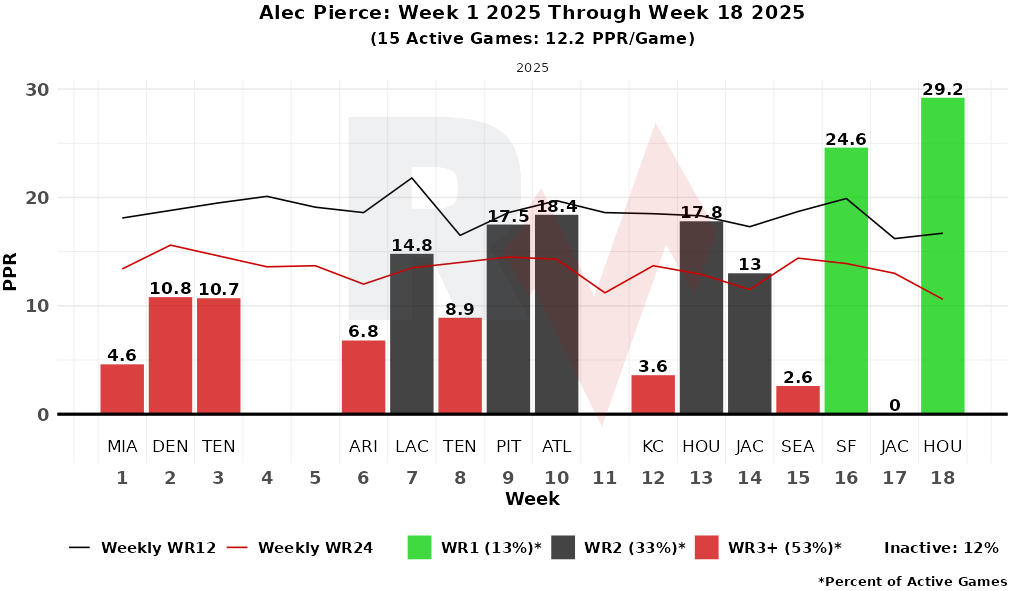
It doesn’t feel like people are talking enough about the fact that Pierce only had two WR1 performances last year. It also bears mentioning that those two games came with Philip Rivers and Riley Leonard directing the offense.
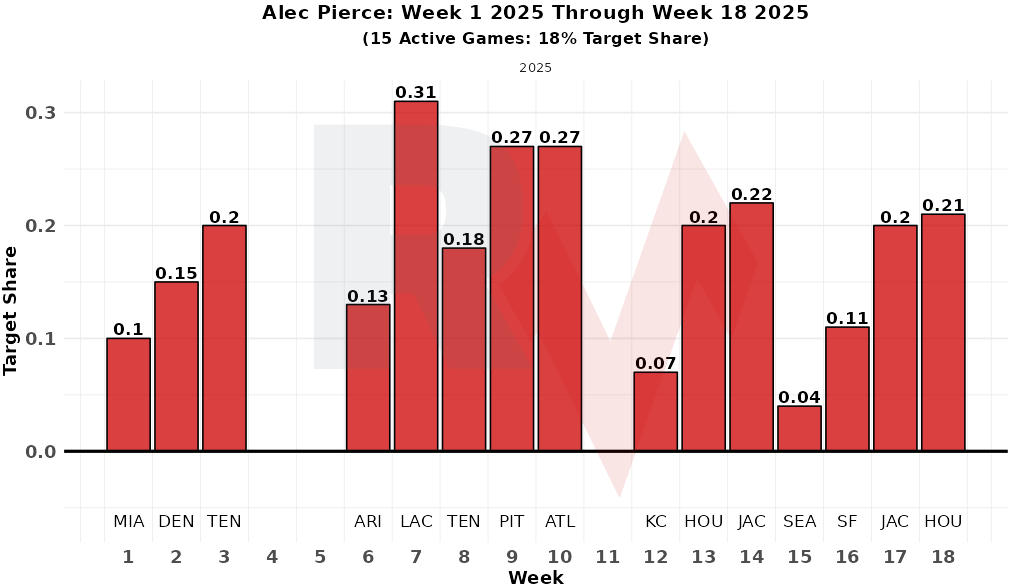
And despite the perception that Pierce did not earn sufficient volume last year, an 18% target share remains significant.
Pierce currently finds himself as the last WR off the board before more than a full-round layoff at the position. And while I’m not buying into Pierce as a true WR1, neither is anyone else. Even after his rise in ADP, Pierce is currently coming off the board as a high-end WR4 despite a PPR WR28 finish last year.
My knee-jerk reaction is to be out on Pierce. But at his current price, he makes for a reasonable selection, assuming he will operate in a more versatile role and should exceed a 20% target share. While I would still bank on Tyler Warren leading the Colts in targets this year, Pierce brings plenty of upside to the table. Just keep in mind, volatility will be part of the package as well.
Speaking of Warren, Neil Dutton recently dove into the star tight end’s rookie year. Although there were some peaks and valleys in Warren’s NFL debut, Neil lays out why we should still be looking to buy the Colts TE:
Warren’s outlook is somewhat cloudy, but mostly for reasons not directly attributable to him. The Colts are banking on Jones returning to fitness at some point early in the season and extended him accordingly. If he can return to full health, we have seen him and Warren make sweet music together. The departure of Pittman and the Colts not owning a premium pick to spend on another pass catcher should keep Warren at the top of the target totem pole, too. If he can dominate the targets and maybe visit the end zone a few more times, there is no reason to think his form in the second half of the 2025 campaign will continue.
Warren is currently the TE4 on Underdog, which is a tad higher than where we have him in our long-term vision. Warren is down at TE7 on our Dynasty Rankings. But this still makes him a player fantasy managers should look to get on their rosters. But relying on Daniel Jones to make any fantasy investment go boom is never a truly safe place to be.
Lastly, we turn our attention to Josh Downs, who has been a forgotten man in the Indianapolis receiving corps. Downs has been a difficult player to properly value during his career because he rarely plays in two-receiver sets. But he has been able to draw targets at a high rate when he is on the field, which has still kept him relevant in fantasy. Now that Pittman has moved on, I feel comfortable proclaiming Downs as one of the winners in free agency:
Josh Downs
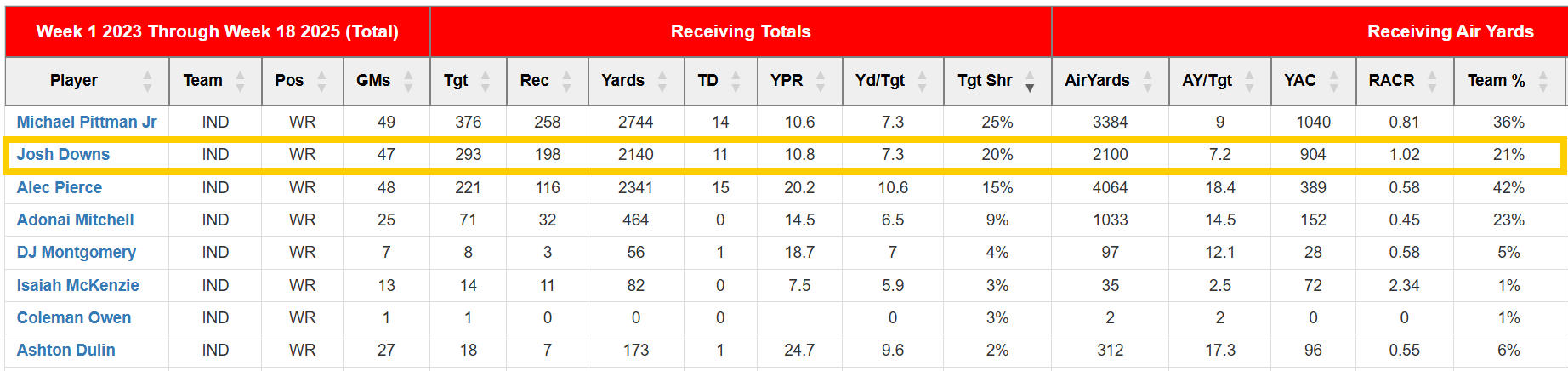
Josh Downs’ career has played out similarly to [Jayden] Reed’s in that he has been effective, but he has never been able to break through for the Colts in two-WR sets. Luckily for Downs, Indianapolis’ depth chart is relatively less crowded than Green Bay’s, and the Colts throw with more regularity than the Packers. These advantages have resulted in Downs earning a 20% target share and averaging nearly 100 targets over his first three NFL seasons.
Even with the Colts trading away Michael Pittman to make room in the books for the newly minted Alec Pierce and Daniel Jones, Downs is unlikely to be second in the target pecking order following Tyler Warren’s rookie-year breakout. Still, a depth chart that only added Nick Westbrook-Ikhine offers little resistance for Downs to claim a larger role, despite him lining up on the outside on fewer than 25.0% of his career routes.
It should also be considered a positive for Downs that the Colts do not have a first-round pick this season, meaning he won’t have a premier prospect dropped on top of him. While a Day 2 pick could eventually push him for time, Downs’ experience in Shane Steichen’s system should provide a buffer if a promising rookie lands in Indianapolis. Even if Pierce and Warren claim a large part of Pittman’s 110 targets from last season, there should still be some meat left on the bone for Downs.
Another player I labeled as a winner in free agency was Jaguars second-year back Bhayshul Tuten. Despite Chris Rodriguez being brought aboard to help ease the departure of Travis Etienne, I still made a case for why Tuten is the Jacksonville back to own when discussing the biggest ADP risers and fallers at the running back position:
Bhayshul Tuten and Chris Rodriguez
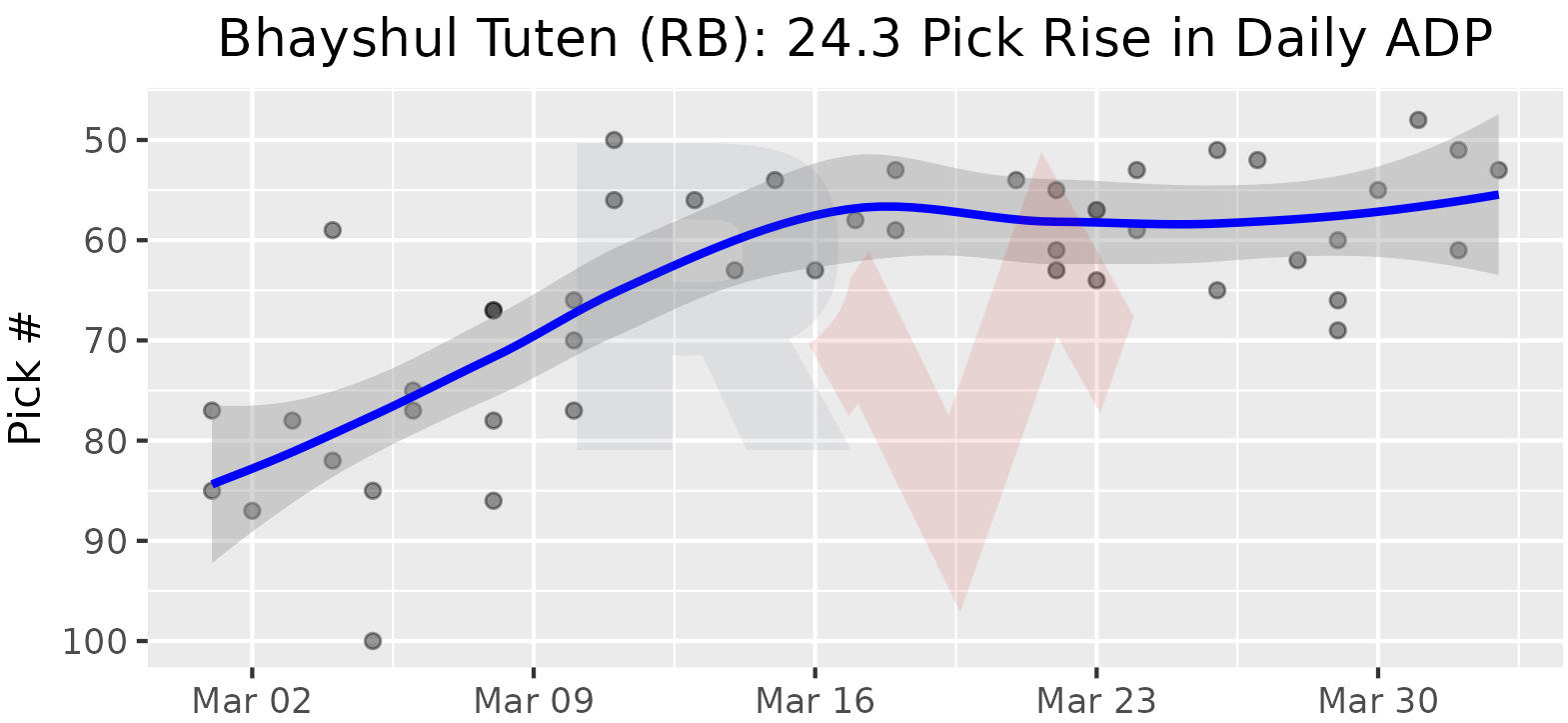
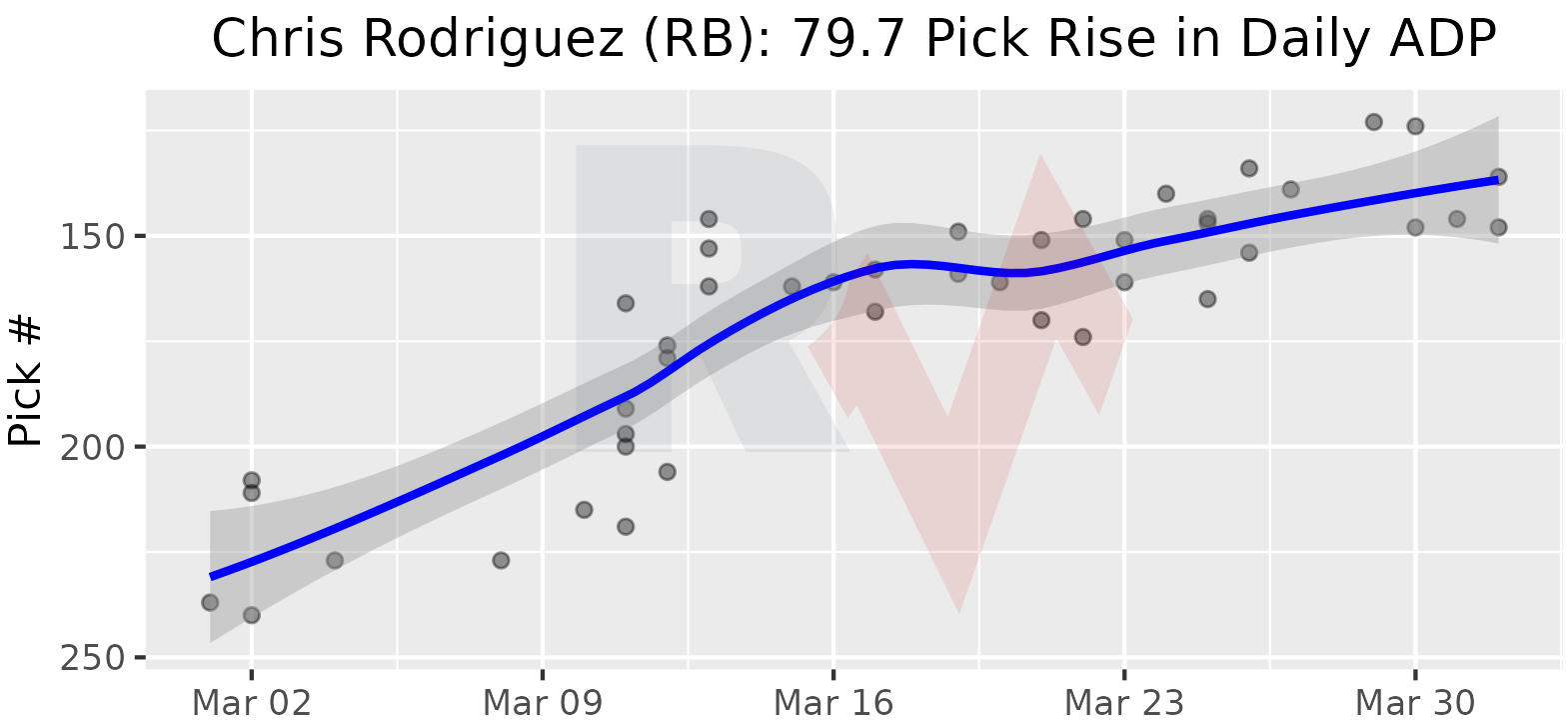
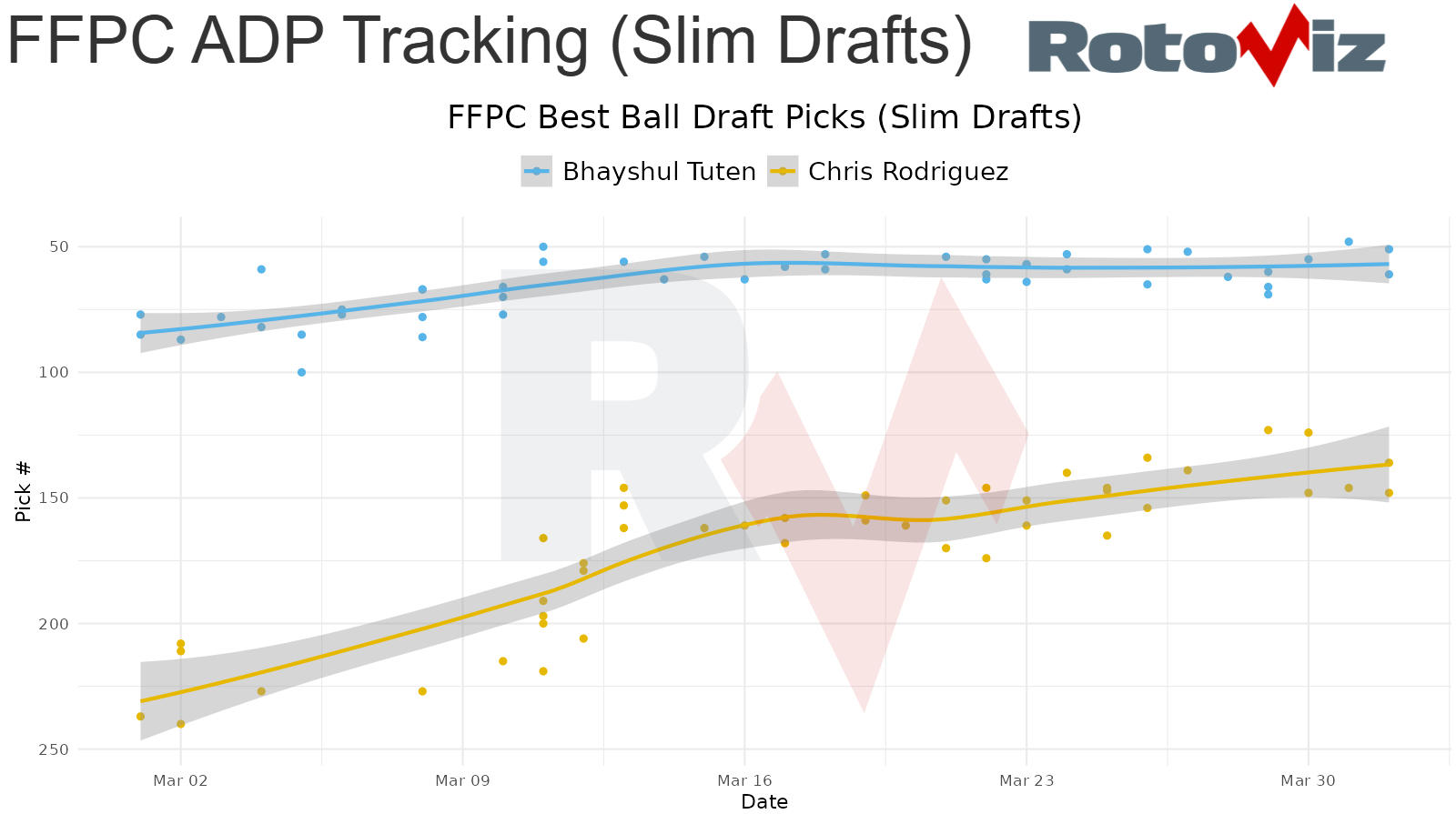
Even though Chris Rodriguez has seen the absolute biggest rise in ADP of any player over the past month — by nearly a full two rounds, might I add — he still sits well behind his new Jaguar teammate Bhayshul Tuten in drafts.
I recently discussed the outlook of the 2026 Jaguars’ backfield after proclaiming Tuten a winner in free agency:
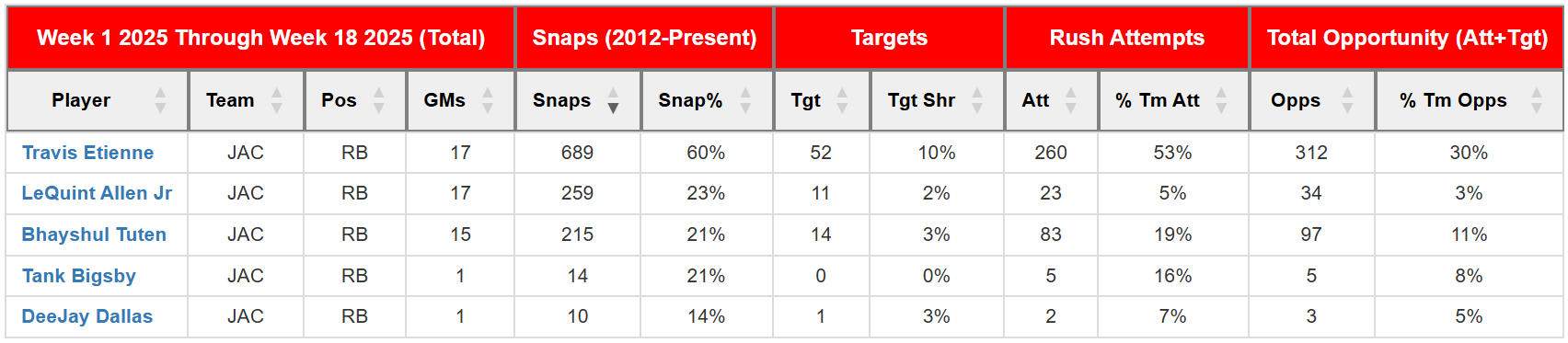
Three years into his NFL career, Rodriguez has a grand total of seven targets. LeQuint Allen’s pass-blocking chops should earn him time on the field, but he will likely be splitting Etienne’s 52 vacated targets with Tuten. Meanwhile, Tuten and Rodriguez should be divvying up the majority of Etienne’s 260 carries.
Of all the current Jaguars backs, Tuten’s 2025 rank of 26th in fantasy points over expectation (FPOE) was easily the highest. Hopefully, continued efficiency combined with a substantial increase in opportunities will be enough to pay off his rising cost in best ball drafts. While it would have been ideal to get a high amount of exposure to Tuten earlier in the year, his current RB25 (59.0 ADP) price tag in the FFPC Never-Too-Early Best Ball Tournament is still very palatable given the upside he brings to the table.
To determine whether Tuten is worth his current price tag, let’s look at the players who finished as RB25 over the past five years. Since 2021, the RB25 has averaged 181.4 PPR. For Tuten to get there, he will need to maintain his 0.9 PPR per opportunity (PPR/Opp) efficiency from 2025 across a little more than 200 total opportunities next season. Barring a major injury, that seems doable and leaves a healthy amount of breathing room to add some additional value.
Anyone who has been following my work over the past couple of years knows I have a soft spot for Rodriguez. Even after his massive rise, Rodriguez still only finds himself coming off the board as the RB46 at the end of the 11th round. Rodriguez has averaged 0.8 PPR/Opp over his three seasons in Washington, D.C., despite providing virtually nothing as a pass catcher. Following the same rationale we just used for Tuten, Rodriguez would need to earn 132 opportunities to deliver at his current price.
For as much as I love Rodriguez when he is free in drafts, he will need to earn more than half of Etienne’s vacated carries just to hit expectations. With this in mind, I find it difficult to buy into him now. Meanwhile, Tuten’s utility as a rusher and receiver gives him an opportunity to deliver, though it is easy to see why some might scoff at the second-year back’s inflated ADP.
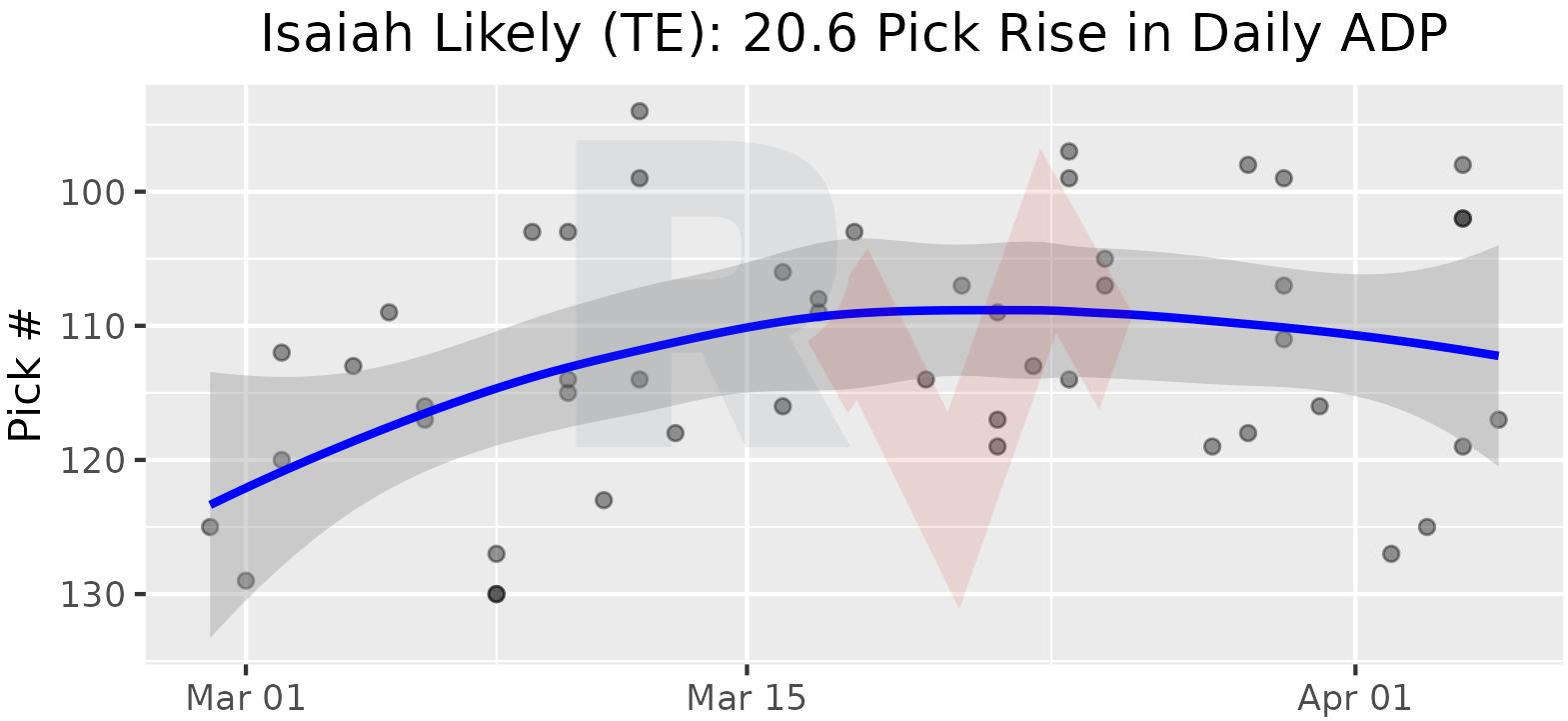
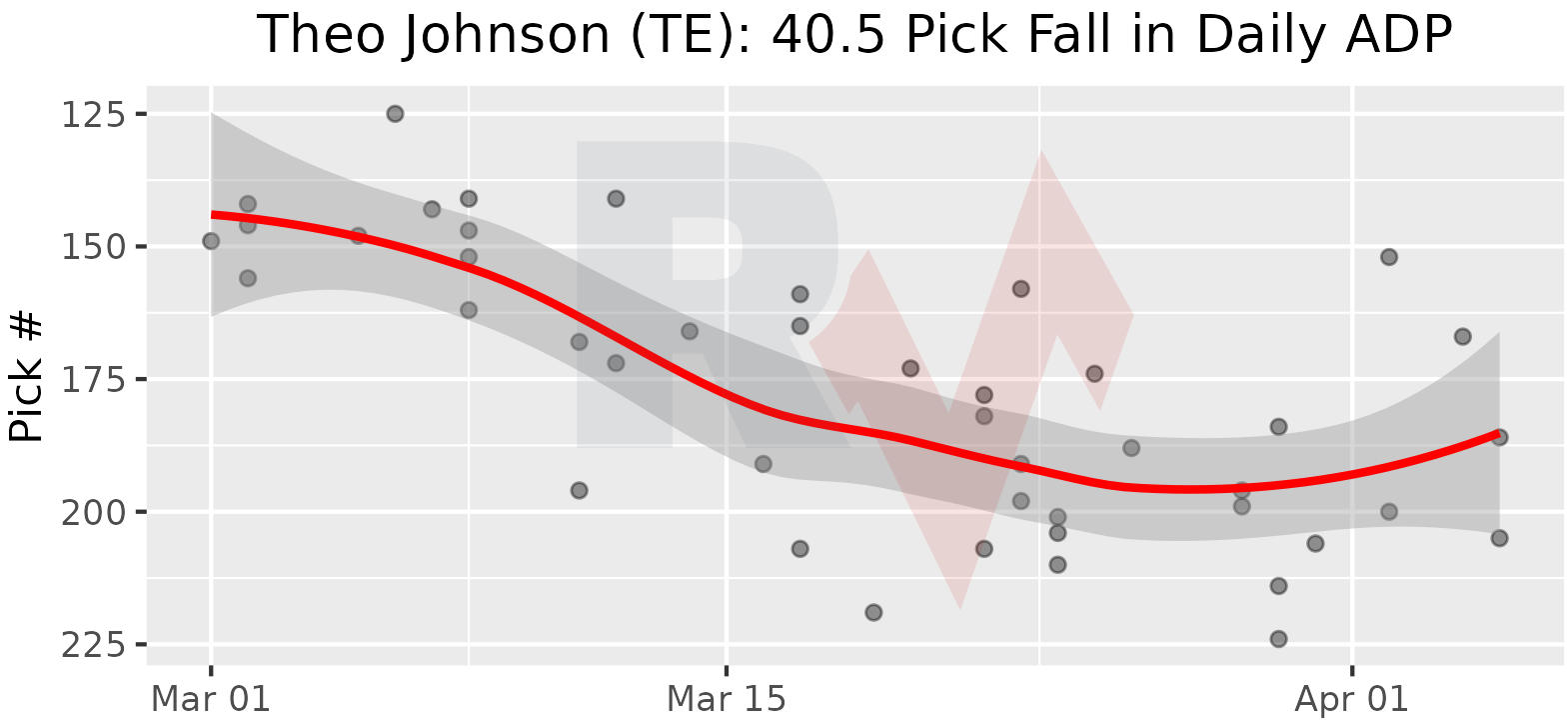
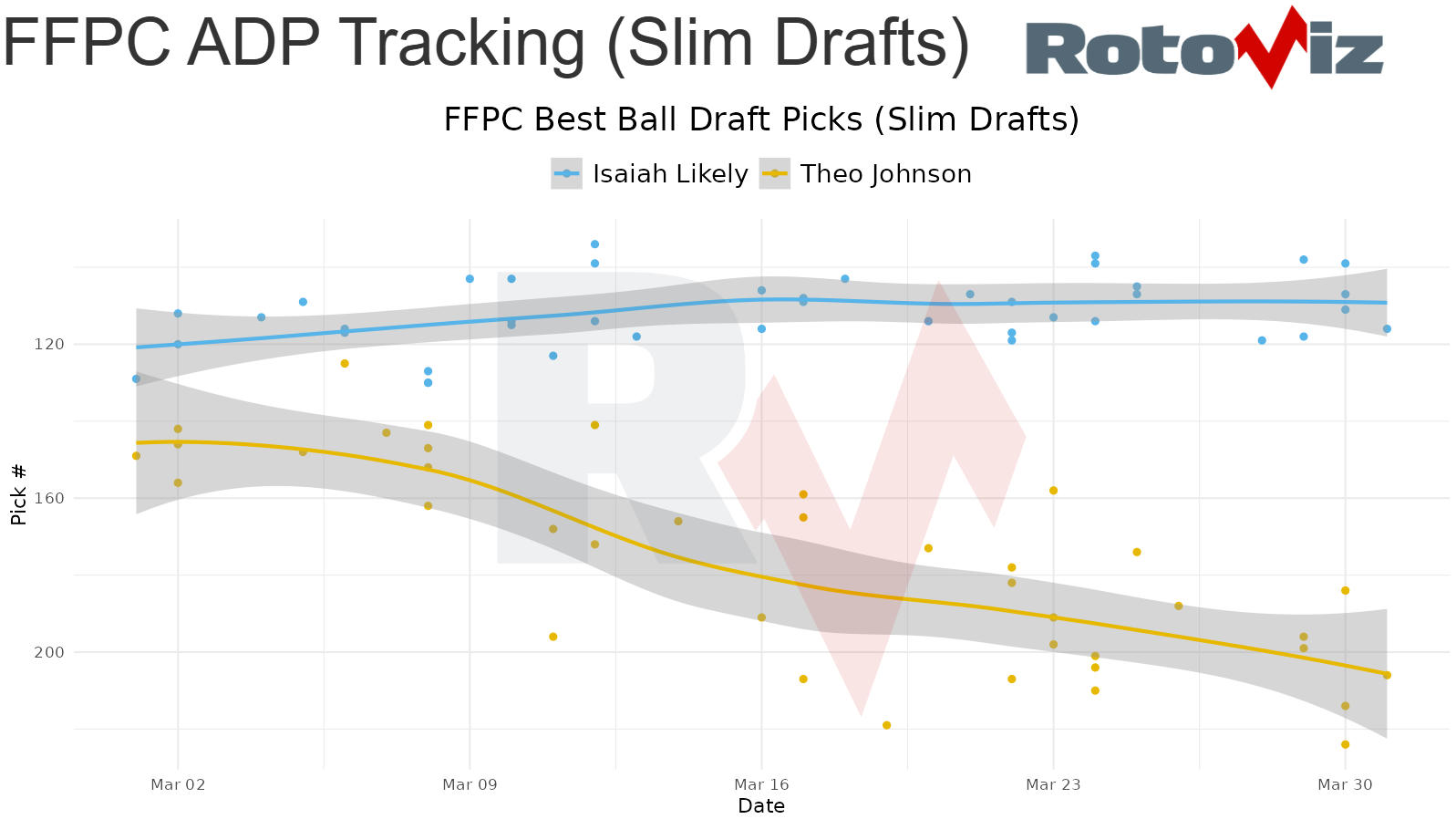
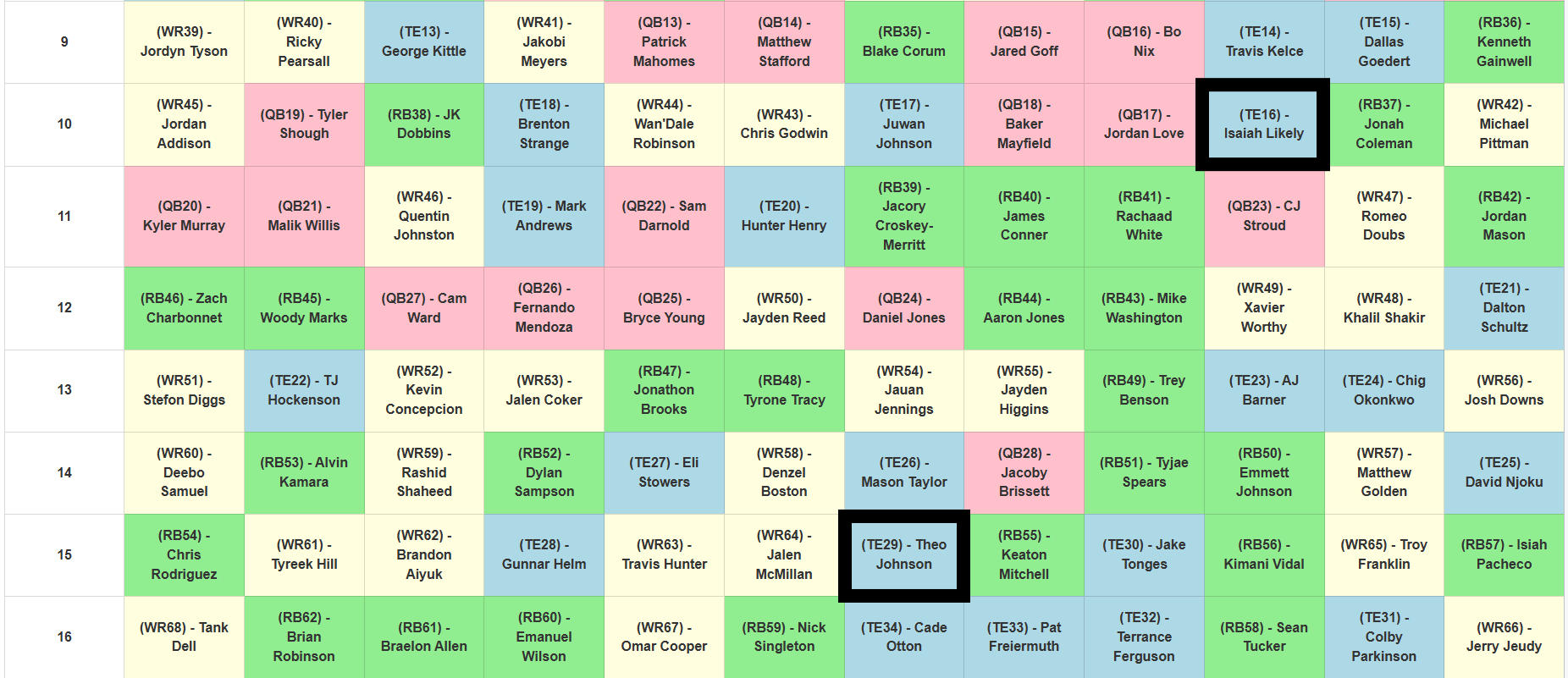
Isaiah Likely is another veteran who was dropped on top of a promising young player in free agency. Despite Theo Johnson showing some positive flashes during his first two years in the league, I recently broke down why drafters are correct in prioritizing the Giants’ new TE over their 2024 fourth-rounder:
Isaiah Likely and Theo Johnson
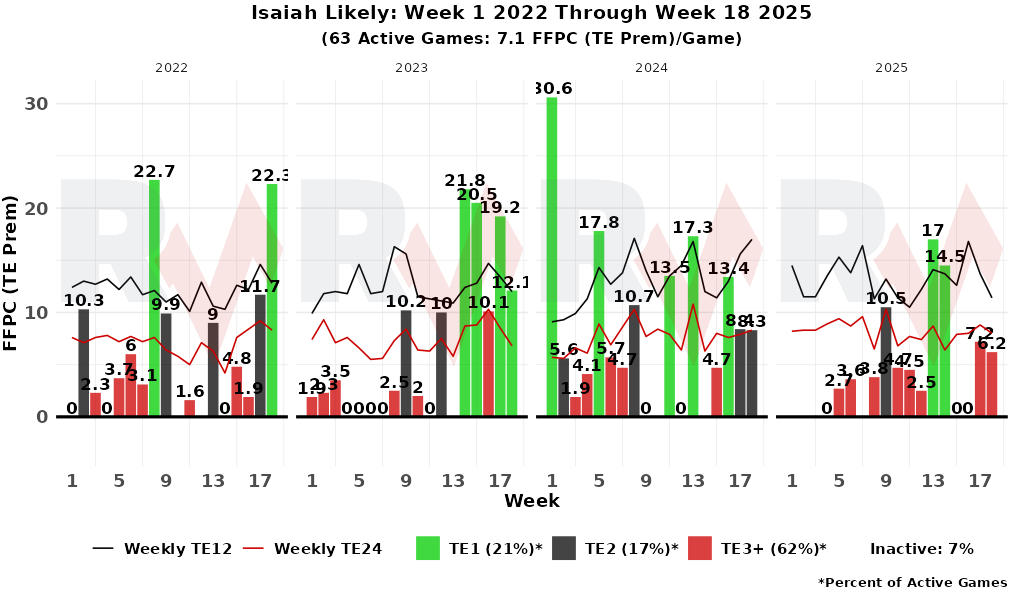
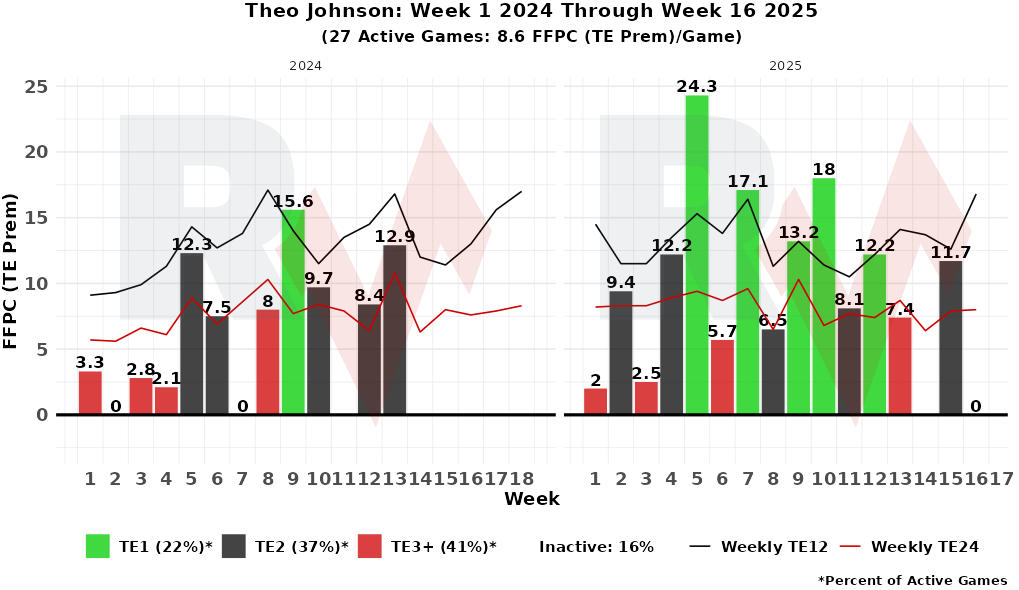
It is not a hot take to proclaim that Isaiah Likely is a better fantasy option than his new teammate Theo Johnson. However, there is a debate to be had about whether the gap between the two is as large as the fantasy community is currently assuming.
Sure, Likely now finds himself as the fifth-highest-paid TE in the league in terms of average annual salary (per Spotrac). Yet the Ravens’ choice to prioritize a declining 30-year-old Mark Andrews over his former 25-year-old running mate has to raise some eyebrows regarding Likely’s true ceiling.
Meanwhile, Johnson has just barely been able to eclipse Likely by finishing as a TE1 in 22% of his career games while also scoring as a TE2 more than twice as often. After taking these two factors into account, it should not come as a surprise that Johnson has averaged 1.5 points per game more than Likely in tight-end premium leagues across their careers.
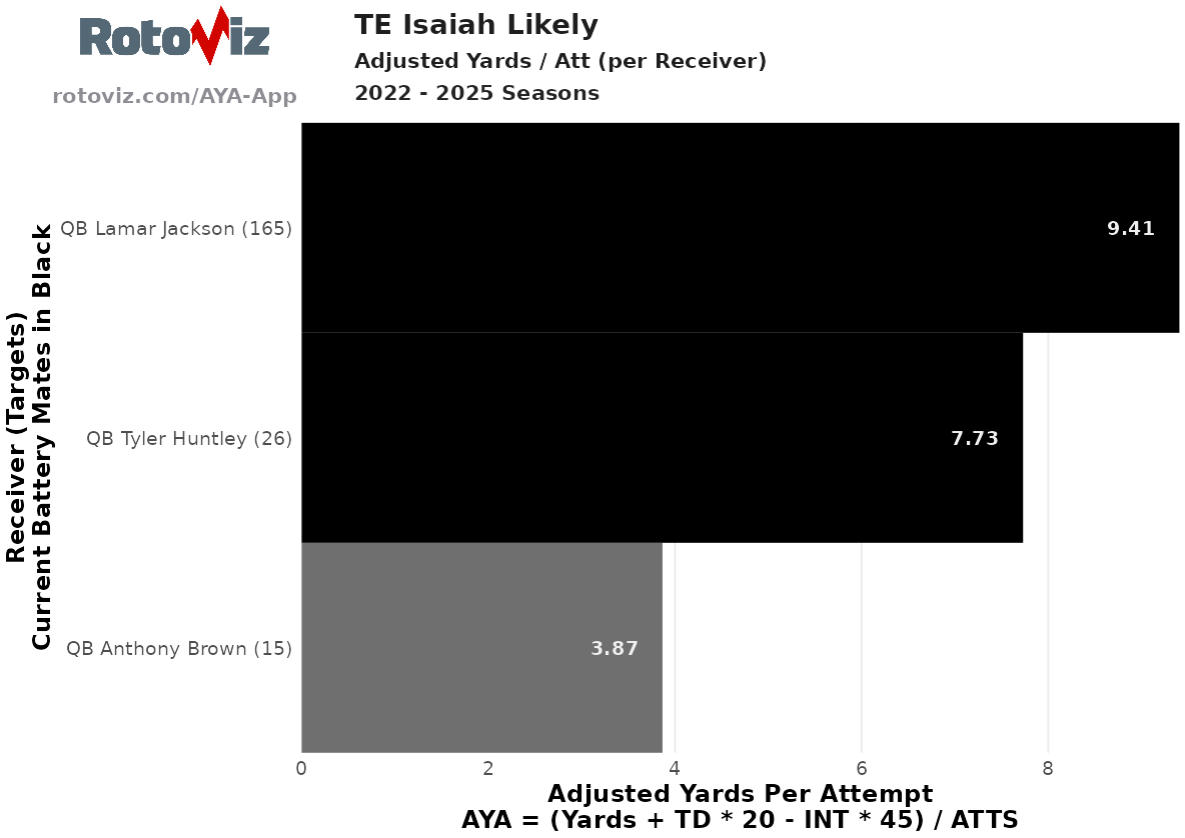
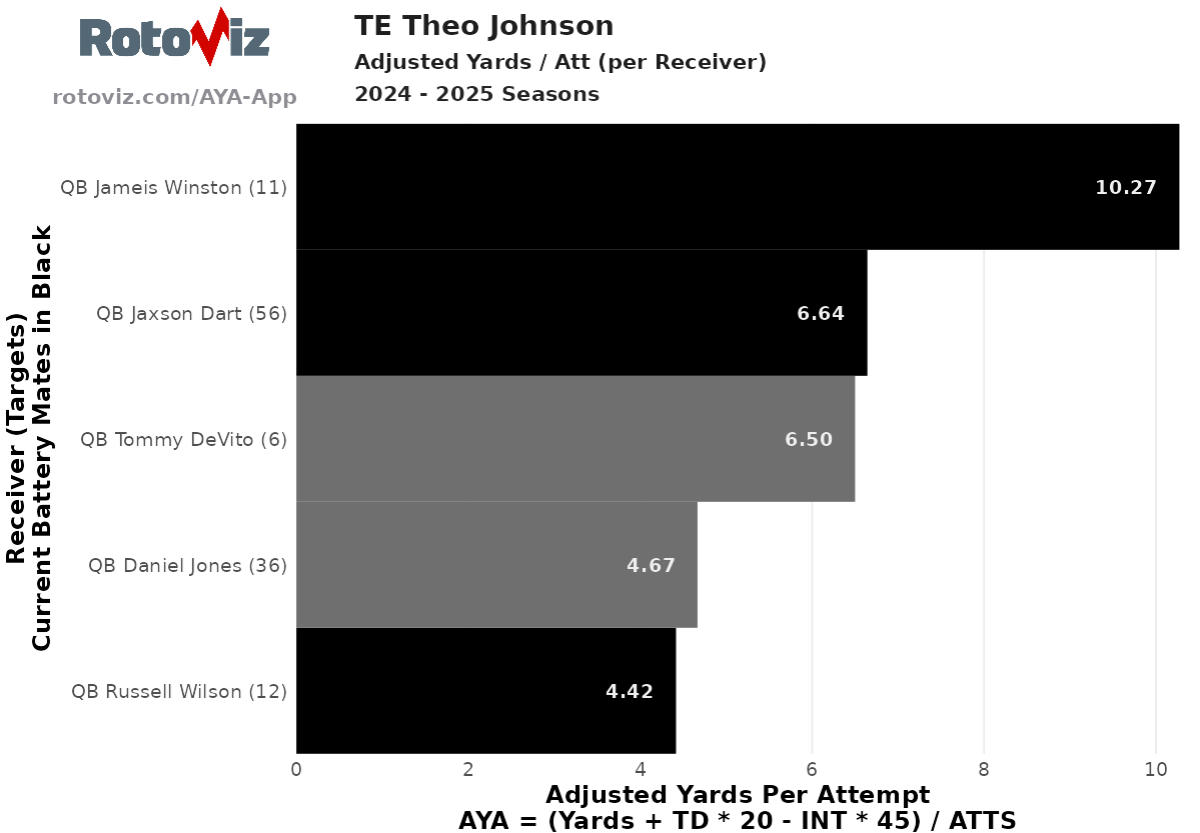
While many will point to the level of target competition as a leading factor in this discrepancy, quality and consistency at the QB position should also be taken into account.
The biggest disparity between the two from an advanced-stats perspective is their ability to secure their catchable targets. The biggest wart on Johnson’s profile after two years in the league is his continued troubles holding onto the ball, although it hasn’t caused him to fall far behind Likley from a yards per route perspective.
When it comes to making plays with the ball in their hands, both TEs performed similarly in 2025, with the most significant difference being Likely’s increased ability to force missed tackles.
Circling back around, fantasy managers are correct to value Likely over Johnson. Nevertheless, I believe that both TEs are legitimate options when building out Giants stacks. And while Likely is the only one of the two I would consider adding outside of rosters featuring Jaxson Dart, he isn’t a priority target given the interesting WRs and QBs going in the same area of drafts, as well as the intriguing TE talent that can be had later on.
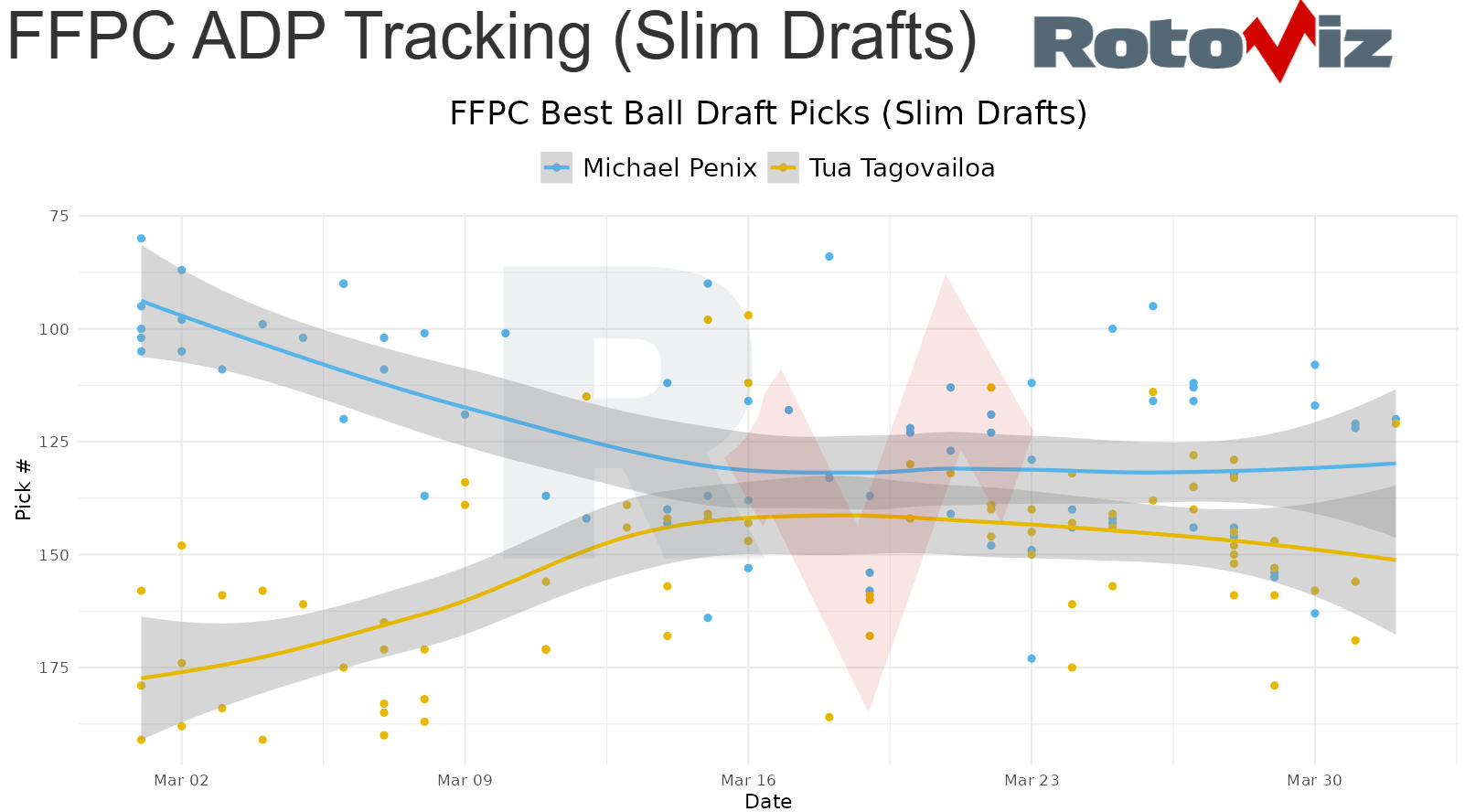
Another team that will be transitioning to a new head coach in 2026 is the Falcons. But unlike Harbaugh, Kevin Stefanski does not have a clear-cut QB1 on his roster. If current FFPC Superflex ADP is any indication, Stefanski has a difficult decision on his hands when choosing between Tua Tagovailoa and Michael Penix. While drafting either Atlanta QB in best ball drafts will not result in feelings of euphoria, I still laid out why both have the chance to return value in the double-digit rounds of superflex leagues:
Tua Tagovailoa and Michael Penix
Is it just me, or does it seem like Kevin Stefanski’s QB problems from Cleveland have followed him to Atlanta? While Joe Flacco did start the first four games for the Browns last year, he was never going to be a long-term solution. Behind the veteran were two rookies: rhythm-dependent game manager Dillon Gabriel and the flashier, yet still limited, Shedeur Sanders. Once the team moved away from Flacco, Stefanski gave Gabriel the first shot at the starting job — something that may be indicative of how 2026 may kick off in Atlanta.
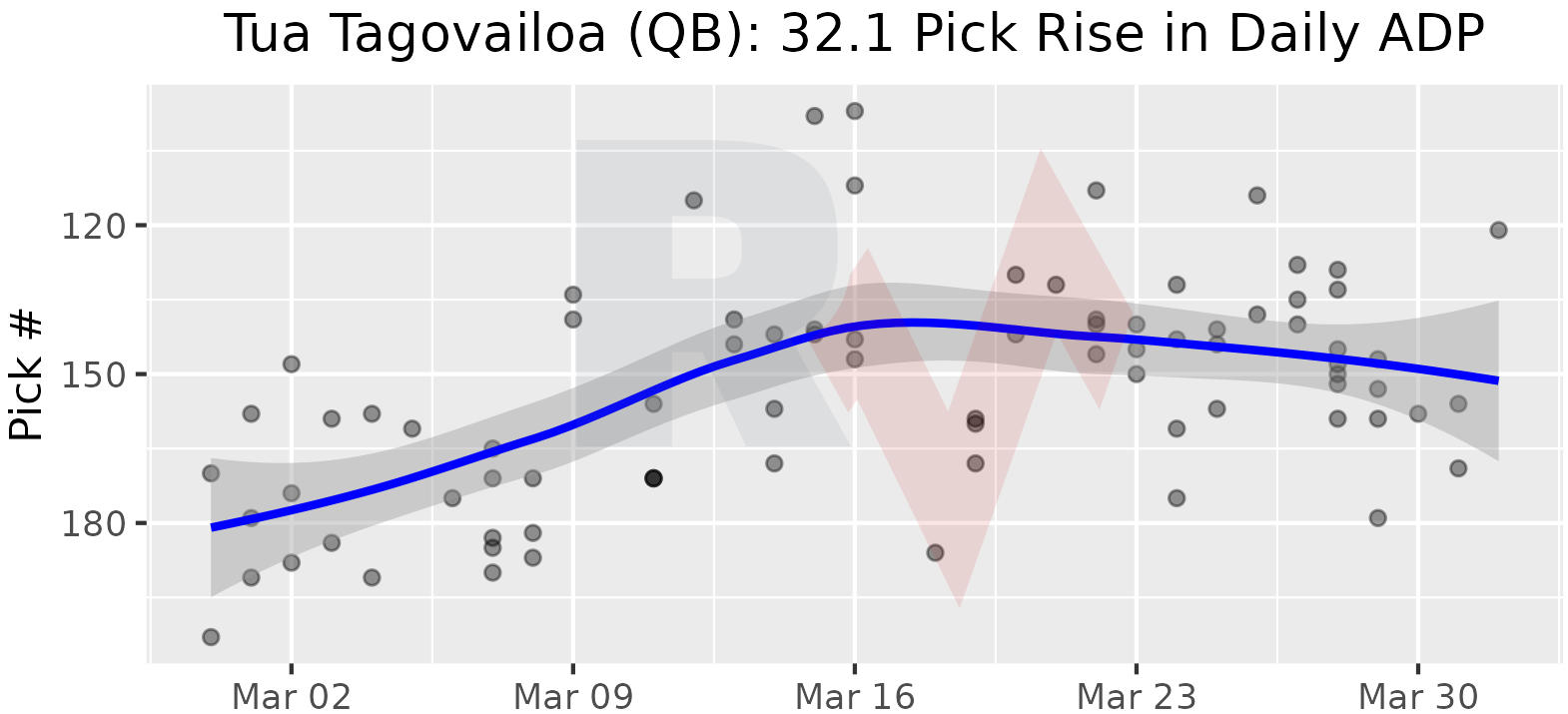
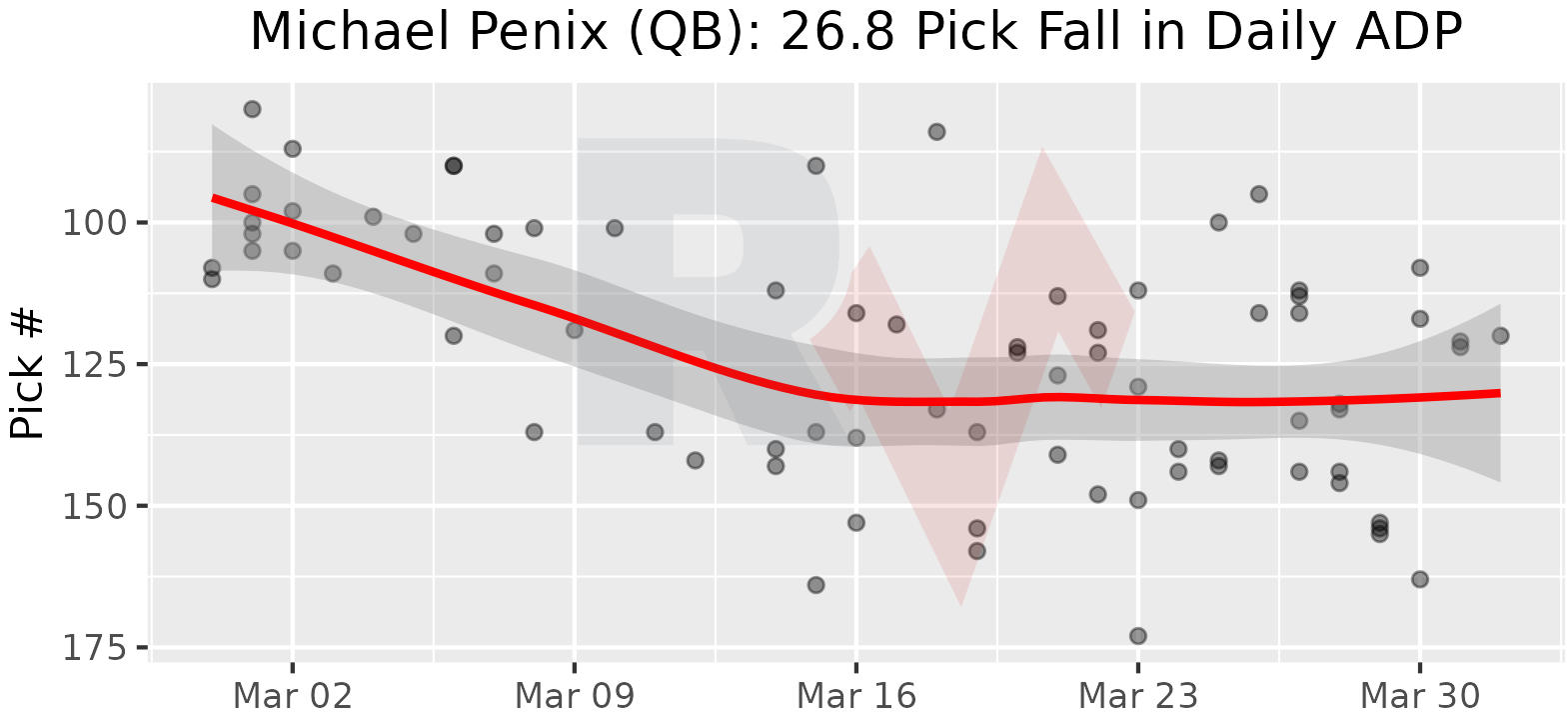
It is important to note that the Falcons only have about $1.3M invested in Tua Tagovailoa this season, while Michael Penix is still under contract for at least another two years after being a top-10 pick — albeit by another regime — back in 2024. Even though Tagovailoa and Penix find their ADPs heading in different directions, Penix is still the first Falcons’ QB coming off the board in best ball tournaments. Over the past week, the two have been sitting a little more than a round apart, with Penix going in the 11th round (129.7 ADP) as the QB30 and Tagovailoa coming off the board at the top of the 13th round (145.9 ADP) at QB32.
It is currently being reported that Penix will be healthy at some point during training camp after tearing his ACL in Week 11 last season. His 2025 injury marks the third time since 2018 that he has suffered an ACL tear; however, the most recent case is the first occurrence in his left knee. It is also noteworthy that serious injuries to both of Penix’s shoulders caused him to miss time while playing at Indiana.
Tagovailoa is no stranger to injuries himself. Most notably, he has had major issues with concussions. But we should also not forget the dislocated hip he suffered during his final year at Alabama, as well as rib and back injuries suffered while with the Dolphins. Still, it is difficult to imagine Tagovailoa landing in a more advantageous situation given his physical limitations and the current state of his career.
The Falcons will be playing nine of their games in domes this season,[1]One of Atlanta’s home games will be played in Madrid, but the date and opponent have yet to be determined.which theoretically helps mask Tagovailoa’s lack of arm strength. However, away games against the Packers, Browns, Steelers, and potentially even the Commanders could prove problematic. Meanwhile, Tagovailoa’s quick-hitting passing style aligns better with the aDOT of Cleveland’s passers last season than Penix’s propensity to push the ball down the field. Unsurprisingly, Tagovailoa also holds a solid edge in accuracy.
I’ll admit, neither Falcons QB is an exciting fantasy option. But considering that they will have Bijan Robinson, Drake London, and Kyle Pitts at their disposal, there is some value to be mined from the situation.
Based on Stefanski’s past preferences, I would assume that Tagovailoa wins the job out of camp. Still, it would be a fair bet that both QBs see time on the field this year. My current leaning is that Tagovailoa starts the year under center, and Penix comes in at some point in the middle of the season due to an injury or Tagovailoa’s ineffectiveness. By my assessment, you may guess that I am not expecting Atlanta to be one of the top teams in the NFC next season. But if you believe otherwise, leaning further into Tagovailoa would be the better option.
While I would be targeting Tagovailoa over Penix right now simply based on price, that preference could change depending on which time of the year you will be needing points at the QB position. Generally, we want our teams to be firing on all cylinders over the final three weeks of best ball contests, which may lead us to lean into Penix. But for teams that need a little more juice up front, Tagovailoa is probably the better option.
Contextualizing the Strongest Position in the 2026 NFL Draft
It’s pretty safe to say that wide receiver will be the position that fantasy managers focus the most attention on in an underwhelming crop of rookies. In order to help fantasy managers weed through a deep class of wideouts, Blair Andrews dusted off Phenom Index, a RotoViz metric that has provided fantasy managers with some strong recommendations in the past:
More than a decade ago, RotoViz changed how the NFL saw the intersection of age and production through metrics like the Phenom Index and breakout age. Back in 2015 Jon Moore introduced the Phenom Index, a revolutionary way to measure a college wide receiver’s age-adjusted production. He continued to refine it over the years to develop a metric that has identified some of the top fantasy WRs in recent memory. The results of that analysis have been striking.
2016’s iteration picked out Tyler Boyd as a potential target, ranking him ahead of first-round picks Laquon Treadwell and Corey Coleman, and well ahead of Josh Doctson.
In 2018, the Phenom Index picked out D.J. Moore as the top WR while urging caution on numerous second-round busts, including Dante Pettis, Anthony Miller, and James Washington.
The Phenom Index took a break after 2019, but the importance of age-adjusted production has not waned. We can also deploy additional metrics to sharpen the analysis. Receiving yards per team attempt (YPTA), which you can find in the Box Score Scout, enhances the Phenom Index.
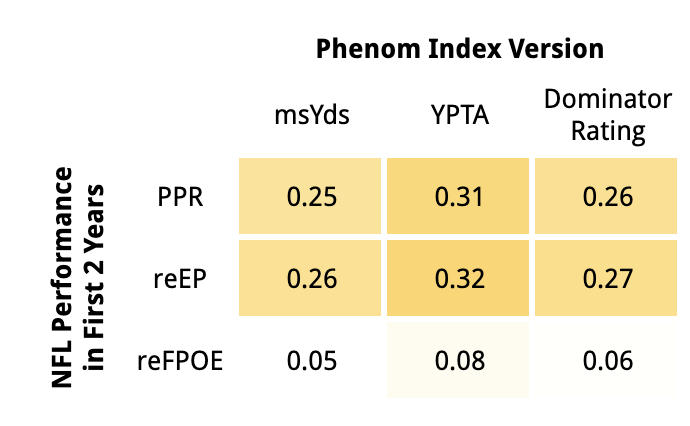
The image below shows the correlations between three different versions of the Phenom Index and a few of our favorite WR performance metrics in a player’s first two years in the NFL.
All versions of the Phenom Index show a fairly strong relationship with PPR and receiving expected points (relative to the strength of any college metrics), but YPTA gets the slight edge.
The 2026 Wide Receiver Class
What numbers are we looking for here? As Jon said back in 2015, there’s no precise threshold that predicts NFL success, but most successful NFL WRs have had a positive score. Anything below zero is a major red flag. A high score (like above 2.0) is not a guarantee of success, but many of the best receivers in the league have been elite producers at a young age in college.
That said, no one in the 2026 class is even close to the heights that some recent prospects have hit. There’s no question that the 2026 class is older than many recent classes. Only a single player was born in 2005. Many WRs in the class chose to stay in college for four years or more. While several players are expected to go in the first half of the first round in the reality draft, the current class is weaker than many recent classes in terms of age-adjusted production. And it’s not only the most recent class: there wasn’t a single player in the 2025 class with a Phenom Index above 2.0.[2]The 2026 class has one. For comparison, the 2020 class had eight rookie WRs with at least a 2.0 Phenom Index.Is this a trend we should expect to continue? Structural changes in the college football landscape suggest it might be, but only time will tell.
Given some of the disturbing trends Blair alluded to, Jesse Cohen followed up Blair’s article by introducing Era-Adjusted Phenom Index to provide some context for this year’s class compared to those from the past 22 years:
The Worrying Trendline
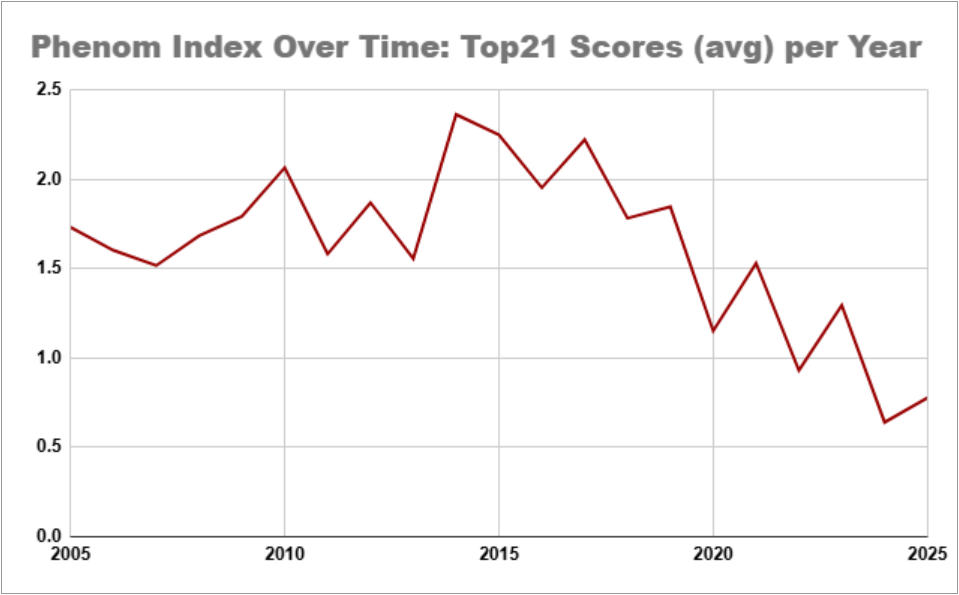
In his recent piece, Blair described a worrying trend for WR prospects that seems to only be getting worse:
While several players are expected to go in the first half of the first round in the reality draft, the current class is weaker than many recent classes in terms of age-adjusted production. And it’s not only the most recent class . . . Is this a trend we should expect to continue? Structural changes in the college football landscape suggest it might be, but only time will tell.
Looking at the average Phenom Index of the top 21-ranked WR prospects across the last twenty years, the worrying trendline is clear:
It also raises the question: are the most recent wide receiver prospects actually less talented, or is there a risk of systematically undervaluing them when comparing to historicals (or both)?
Era-Adjusted Phenom Index (E-API)
I tried answering a subset of that question: what would each player’s score look like if they played across all eras?
To answer that question, I established four eras (2005-2009, 2010-2014, 2015-2019, 2020-2025), adjusted each individual player’s score relative to each era’s baseline, and then averaged those adjusted values to produce an Era-Adjusted Phenom Index (E-API) score for each WR prospect in the database.
Going from Phenom Index to E-API naturally brings up the results from lower-scoring eras and brings down the results from higher-scoring eras. The effect doesn’t change the top of the leaderboard,[3]We see the same superstars like Malik Nabers, Jaxon Smith-Njigba, Calvin Johnson, Demaryius Thomas, Allen Robinson, Dez Bryant, Ja’Marr Chase, CeeDee Lamband, well, you get the point. There’s a reason Phenom Index has returned as a RotoViz staple!or the bottom, but we do get some interesting results:
For 2020-2025 era players, we see the elites pulled up where they belong: Malik Nabers goes from the 9th-best Phenom Index in the database to the 3rd-best E-API, Jaxon Smith-Njigba goes from 15th to 5th, and Drake London goes from 21st to 9th. We also see Tetairoa McMillan cross the 2.0 threshold (1.78 Phenom Index to 2.38 E-API) that Blair and Jon have historically cited as meaningful in the Phenom Index context, with Travis Hunter (1.98 E-API) and Jayden Higgins (1.73 E-API) now knocking on the door.
For players in the more prolific 2010-2014 and 2015-2019 eras, we see a number of the most prolific busts pulled down from a 2.0-plus Phenom Index to a sub-2.0 E-AAPI: Laquon Treadwell, Corey Davis, John Ross, Corey Coleman, Breshad Perriman, and even Leonte Carroo.
Players in the 2005-2009 era don’t get much of an adjustment, as the average E-API for that era (1.67) is similar to the average across all eras (1.65).
And of course, the scores from this year’s rookie class also get pulled up.
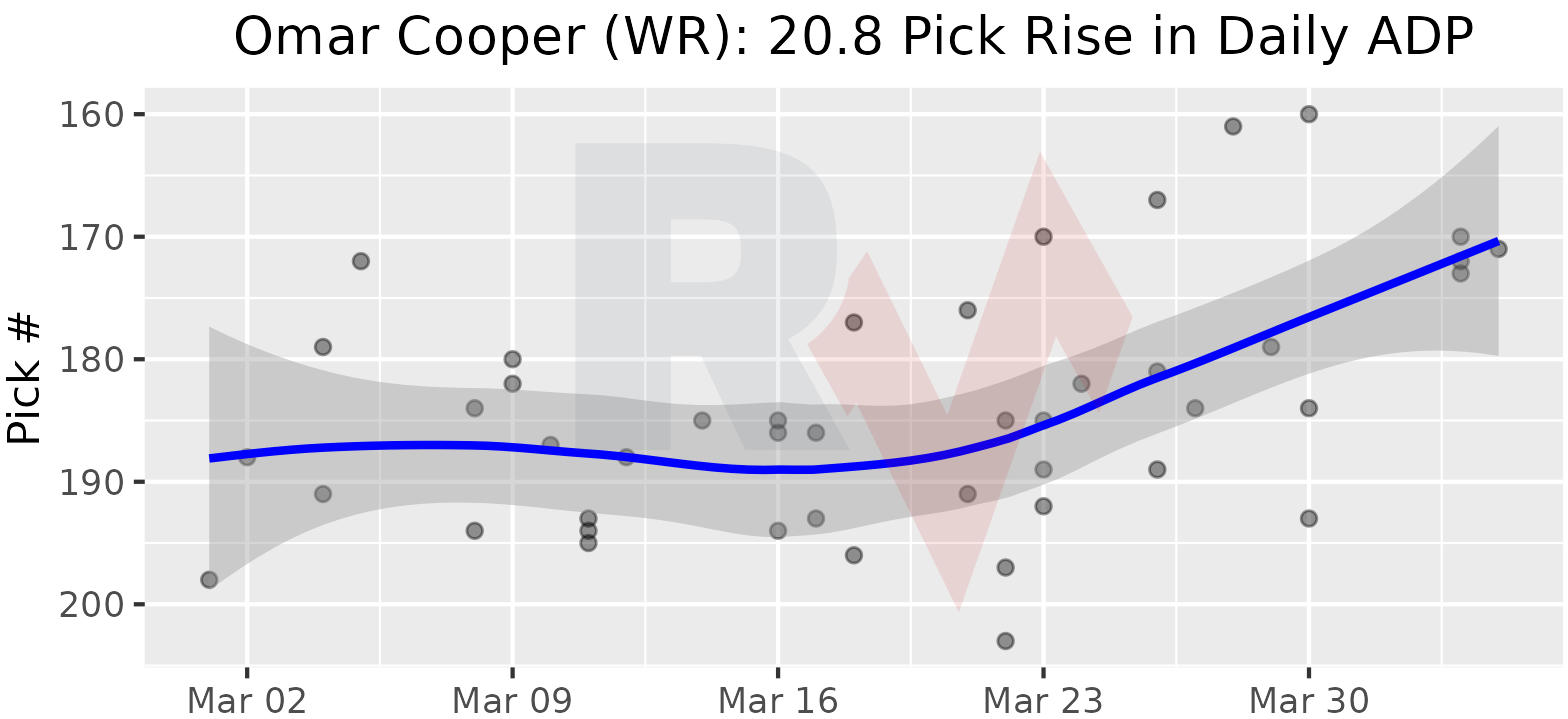
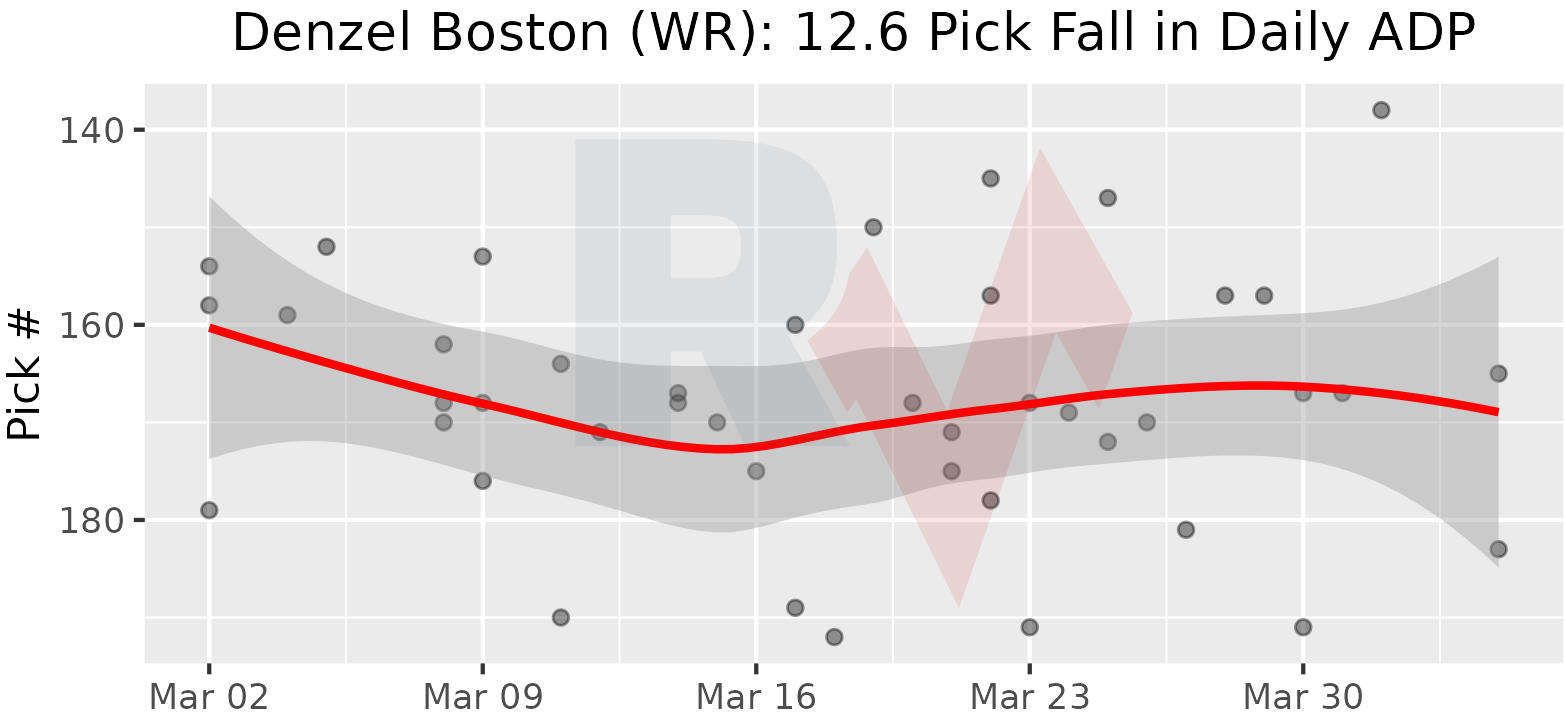
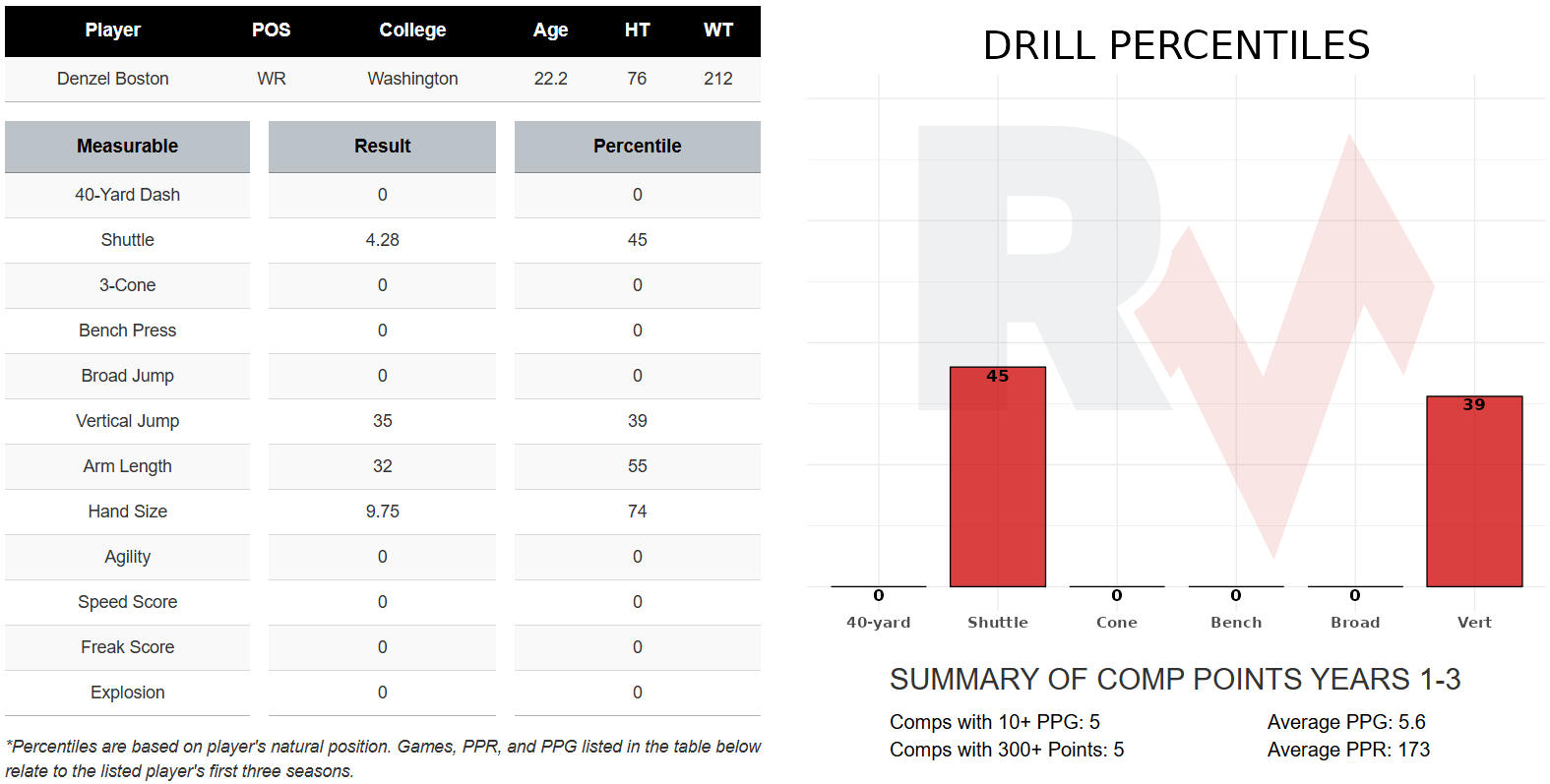
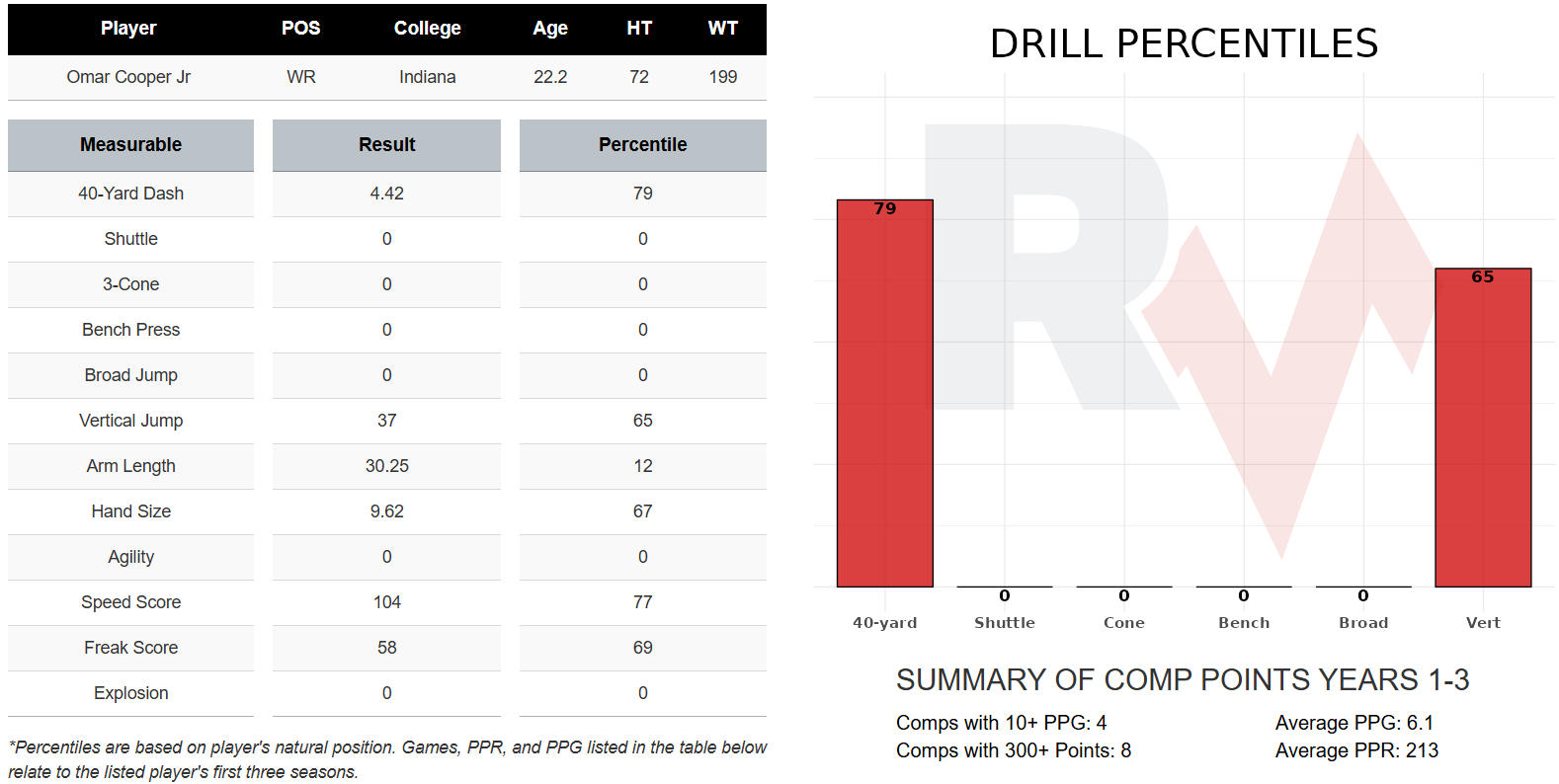
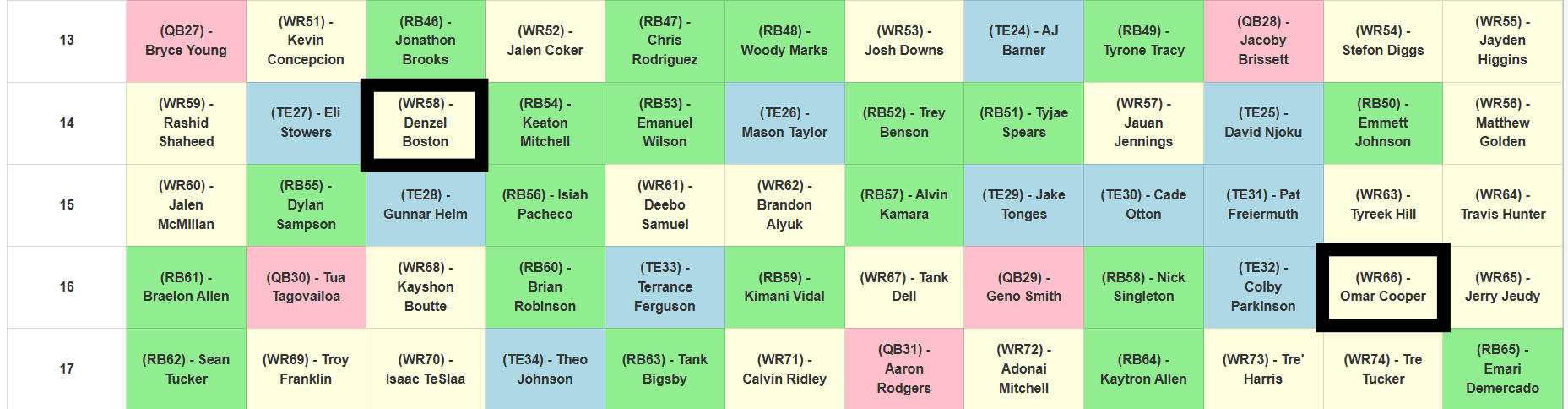
Out of all of this year’s top rookie wideouts, potential first-round picks Omar Cooper and Denzel Boston have seen the biggest ADP movement since the beginning of March. What may come as a bit of a surprise is that they’re heading in different directions:
Omar Cooper Jr. and Denzel Boston
While both of these rookie WRs have been earning Round 1 buzz, their stocks have headed in separate directions since the NFL Combine.
Even though Denzel Boston’s stock has fallen following some odd testing choices, he is still firmly ahead of Omar Cooper in best ball ADP.
Simply put, any WR who earns Round 1 capital will not make it to the double-digit rounds in post-draft best ball tournaments. Even if Boston or Cooper fall to the second round of the reality draft, they will not be available at these prices come May.
Both players have their question marks. Additionally, getting a player at a perceived ADP value does not guarantee they will become a successful fantasy asset. Still, the upside that Boston and Cooper possess more than justifies their selections in this range, especially compared to most of the other WR options who are on the board.
Although I am in favor of drafting both WRs at their current price tags, E-API handily favors one over the other:
K.C. Concepcion and Denzel Boston are now knocking on the door of that 2.0 club and join the ranks of 1.70 to 1.89 E-API guys like BrandonAiyuk (1.79), Chris Godwin (1.77), and Eric Decker (1.77).
Omar Cooper Jr. rises from a sub-1.0 Phenom Index to a respectable 1.47 E-API, but continues to lag behind Concepcion and (to a lesser extent) Boston analytically. While there are true success stories in this E-API range, including Amon-Ra St.-Brown (1.38), they tend to be slower-burn profiles like Robert Woods (1.47), Christian Kirk (1.47), and Alec Pierce (1.44). I’m increasingly off of Cooper at his expected cost, and would rather take shots on guys with similar E-API’s like Ja’Kobi Lane (1.47) and Brenen Thompson (1.37) if I can get them for a fraction of the draft capital.
While we must keep in mind the differences in targeting players in best ball versus dynasty, E-API is providing us with some solid signal that we should be targeting the falling Boston over the rising Cooper in our best ball drafts.
Volume 2 of the 2026 RotoViz Rookie Draft Guide is out now! Jam-packed with comprehensive player profiles, advanced stats, player comps, strategies, and rankings from the RotoViz staff, it is a must-have for every fantasy manager who wants to crush their best ball, dynasty, and redraft leagues in 2026!
Keep an eye out for Volume 3, which will drop after the 2026 NFL Draft!
We see the same superstars like Malik Nabers, Jaxon Smith-Njigba, Calvin Johnson, Demaryius Thomas, Allen Robinson, Dez Bryant, Ja’Marr Chase, CeeDee Lamband, well, you get the point. There’s a reason Phenom Index has returned as a RotoViz staple!
Please subscribe For Full Access to all RotoViz content and tools!
What’s included in your subscription??
Exclusive Access to RotoViz Study Hall
A treasure trove of our most insightful articles that will teach you the metrics that matter, time-tested winning strategies, the approaches that will give you an edge, and teach you how to be an effective fantasy manager.
Revolutionary Tools
Including the NFL Stat Explorer, Weekly GLSP Projections, NCAA Prospect Box Score Scout, Combine Explorer, Range of Outcomes App, DFS Lineup Optimizer, Best Ball Suite,and many, many, more.
Groundbreaking Articles
RotoViz is home of the original Zero-RB article and continues to push fantasy gamers forward as the go-to destination for evidence-based analysis and strategic advantages.
Lead Writer and Full-time Cat Dad. Sneakerhead, Record Collector, Beatmaker, Lord of the Rings Superfan, and Jeopardy Enthusiast in my free time. Follow me on X and Bluesky @thecatdadff
Kevin Szafraniec continues his deep dive into the AFC East by identifying the best and worst picks on the New England Patriots’ roster in 2026 best ball drafts. No NFL team’s turnaround was as dramatic as what we saw from the Patriots last season. New England went from the AFC East cellar in 2024 to playing in the Super Bowl one year later. The sweeping…...
Kevin Szafraniec kicks off his deep dive into the AFC East by identifying the best and worst picks on the Miami Dolphins’ roster in 2026 best ball drafts. The general consensus regarding the 2026 Miami Dolphins is that things will be bad. Real bad. The new regime in South Beach cleared house this offseason, taking on a league-high $179.2M in dead cap (per Spotrac), leading…...
Kevin Szafraniec finishes his deep dive into the NFC North by identifying the best and worst picks on the Minnesota Vikings’ roster in 2026 best ball drafts. Perhaps no team was more eager to put 2025 in the rearview than the Minnesota Vikings. Despite finishing the year with a respectable 9-8 record, the JJ McCarthy experiment was an unmitigated disaster. The quarterback singlehandedly decreased the…...
Kevin Szafraniec continues his deep dive into the AFC East by identifying the best and worst picks on the New England Patriots’ roster in 2026 best ball drafts. No NFL team’s turnaround was as dramatic as what we saw from the Patriots last season. New England went from the AFC East cellar in 2024 to playing in the Super Bowl one year later. The sweeping…...
Kevin Szafraniec kicks off his deep dive into the AFC East by identifying the best and worst picks on the Miami Dolphins’ roster in 2026 best ball drafts. The general consensus regarding the 2026 Miami Dolphins is that things will be bad. Real bad. The new regime in South Beach cleared house this offseason, taking on a league-high $179.2M in dead cap (per Spotrac), leading…...
Kevin Szafraniec finishes his deep dive into the NFC North by identifying the best and worst picks on the Minnesota Vikings’ roster in 2026 best ball drafts. Perhaps no team was more eager to put 2025 in the rearview than the Minnesota Vikings. Despite finishing the year with a respectable 9-8 record, the JJ McCarthy experiment was an unmitigated disaster. The quarterback singlehandedly decreased the…...