




The RotoViz staff highlights some of the tools and content our site offers that will help you crush your best ball drafts this summer.
For most people, Memorial Day represents the unofficial start of summer. And while some of us sickos were itching to jump into draft rooms as soon as best ball tournaments launched in January, the middle of the calendar represents a more socially acceptable time for the rest of the fantasy community to start getting ready for the upcoming NFL season.
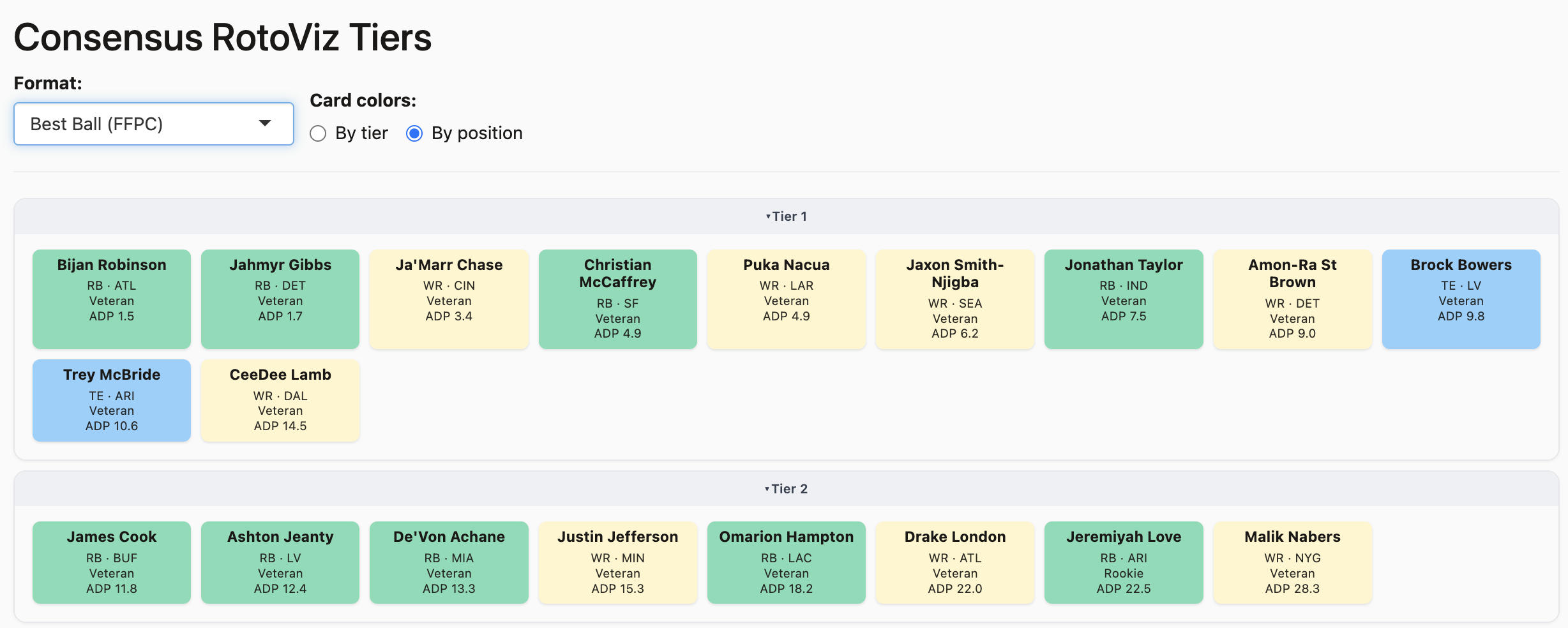
With best ball contests ramping up, we have had no shortage of content up on the site to help readers make the most of every draft. The headliner of the bunch was the unveiling of a new consensus tiers system that Jesse Cohen put together, which will provide RotoViz subscribers with a cornerstone for all of their fantasy formats moving forward. And if that weren’t amazing enough, Jesse added a dynasty trade calculator to the mix for good measure:
Give the People What They Want
As a RotoViz subscriber, I wanted more regular updates from Shawn, Blair, and Kevin. And a trade calculator.
So we built those things. We’re proud to introduce them.
Consensus RotoViz Tiers
The Consensus RotoViz Tiers replace the old site rankings. In addition to a new paint job, these tiers now represent the consensus view of our team, including Shawn, Blair, and Kevin. Users can switch between various dynasty and best ball formats and change the color scheme to distinguish players by tier or by position. The best ball formats are sorted by up-to-date FFPC and Underdog ADP within each tier.
These are the same tiers RotoViz subscribers are used to, with the same associated valuations. The new format enables more timely updates from the entire team while keeping the focus on what really matters from a decision-making perspective.
Dynasty Trade Calculator
The RotoViz Dynasty Trade Calculator is even more exciting.
It’s built on top of the Consensus RotoViz Tiers, translating the draft pick values associated with each tier into mathematically equivalent “trade points.” It then:
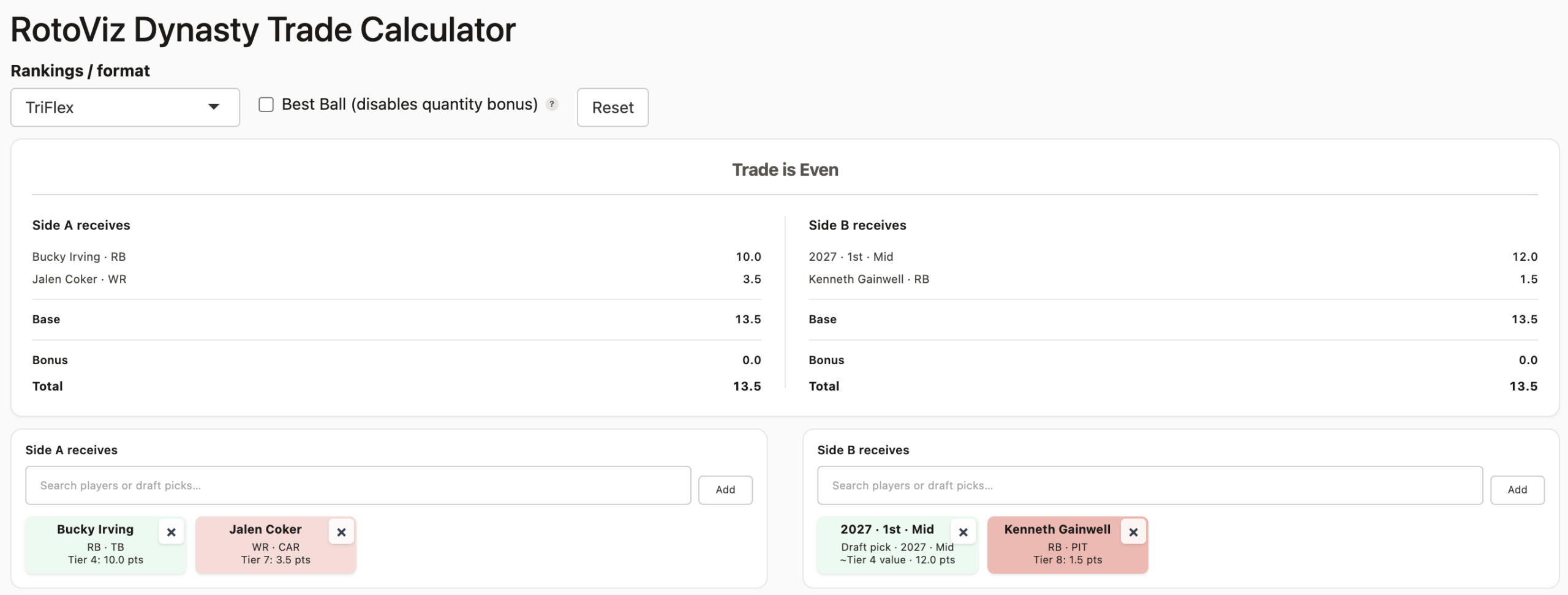
- applies a two-level bonus system to block gamification (spam trades don’t work here); and
- allows the user to completely adjust that bonus system and how draft picks are valued, enabling you to customize the valuations to your specific league while still leveraging the best minds in fantasy. (Don’t worry, I’ll keep lobbying them on behalf of Germie Bernard.) We hope you enjoy it.
Introducing the Consensus RotoViz Tiers and Dynasty Trade Calculator
Now that we have our individual player tiers in place, we can shift our focus to more macro strategies.
Recently, I have been combing the historical data available in the Best Ball Win Rate Explorer (WRE) and Roster Construction Explorer (RCE) in search of edges we can implement in our 2026 best ball drafts. The articles have focused on the FFPC slim format, which features 20-round drafts, tight-end premium scoring (1.5 points per TE reception and 1.0 PPR for all other positions), and starting lineups consisting of one quarterback, two running backs, two wide receivers, one tight end, and two standard flex spots.
Are you ready to battle for your share of the 2026 FFPC Best Ball Tournament’s $1.64M prize pool? New users get $25 off their first FFPC team of $35 or more by using promo code 25ROTOVIZ or by following this link!

After outlining historical win rates by draft slot, I went on to cover each position in their own separate article. To cap things off, I pulled it all together and applied the lessons from the series in a real-world draft.
It was only fitting that I drew the top spot when it came time to draft, which would force me to put all of the lessons I had learned to good use. Although some might consider getting the 1.01 a gift, we found that landing in the top spot of the draft order has historically led to the worst win rates of any draft slot by a wide margin:
You Do The Best With What You’re Given
While some might assume that coming out at the top of the draw would be advantageous, history actually tells us the opposite. In fact, the numbers show that selecting in the back half of the order may be ideal, as only half of the draft positions in the first six picks clear 8.3%.
It also comes as a bit of a shock that the first pick has by far the worst win rate of any draft slot, despite having their choice of the entire player pool to kick off the festivities. And it is not as if one or two down years are dragging down the sample, as the one spot has significantly underperformed in win rate during each of the past six years.
2020 FFPC BEST BALL SLIM WIN RATES BY DRAFT SLOT
2021 FFPC BEST BALL SLIM WIN RATES BY DRAFT SLOT
2022 FFPC BEST BALL SLIM WIN RATES BY DRAFT SLOT
2023 FFPC BEST BALL SLIM WIN RATES BY DRAFT SLOT
2024 FFPC BEST BALL SLIM WIN RATES BY DRAFT SLOT
2025 FFPC BEST BALL SLIM WIN RATES BY DRAFT SLOT
Digging a little deeper, only 16 of the 36 draft slots (44.4%) in the top half of the order have delivered a win rate above 8.3%, while 24 of the 36 draft slots (66.7%) in the back half of the order came in above expectation. If we divide the draft order into thirds, only nine of the 24 draft slots (37.5%) in the top four hit the baseline, versus 17 instances in picks 5-8 (70.8%) and 15 of the 9-12 spots (62.5%).







Even though I was starting behind the 8-ball, I did find some solace in knowing that the underwhelming win rates were due in part to the poor injury luck of players who landed at 1.01. I forged ahead in hopes that with some positive injury regression and a slew of historical edges on my side, I could overcome six years of misfortune that had plagued drafters in the one spot:
Being saddled with a poor draft slot would really put the strategies outlined in this series to the test. However, we must remember that five of the past six top picks have played 11 games or fewer, which has been the primary catalyst for the disastrous results we have seen. But with two legit superstar RB options vying for the 1.01 this year, it is easy to feel optimistic about the chances that at least one stays healthy and proves worthy of the top pick.
The Game Plan
I had some conflicting emotions about drawing the top draft slot:
Negatives
- Historically worst win rate
- Less likely to catch falling values than drafters in the middle of the order
Positives
- More time to work with the WRE and RCE between picks
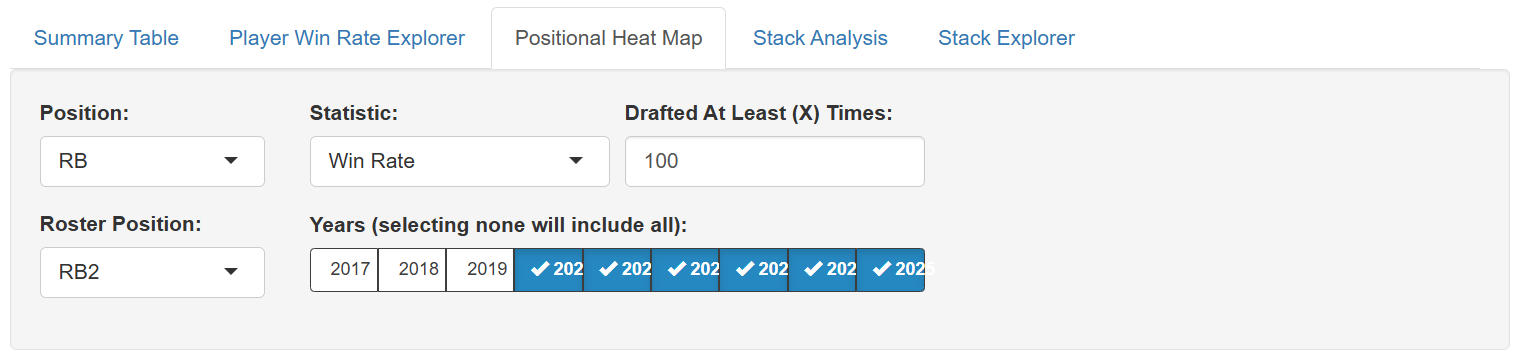
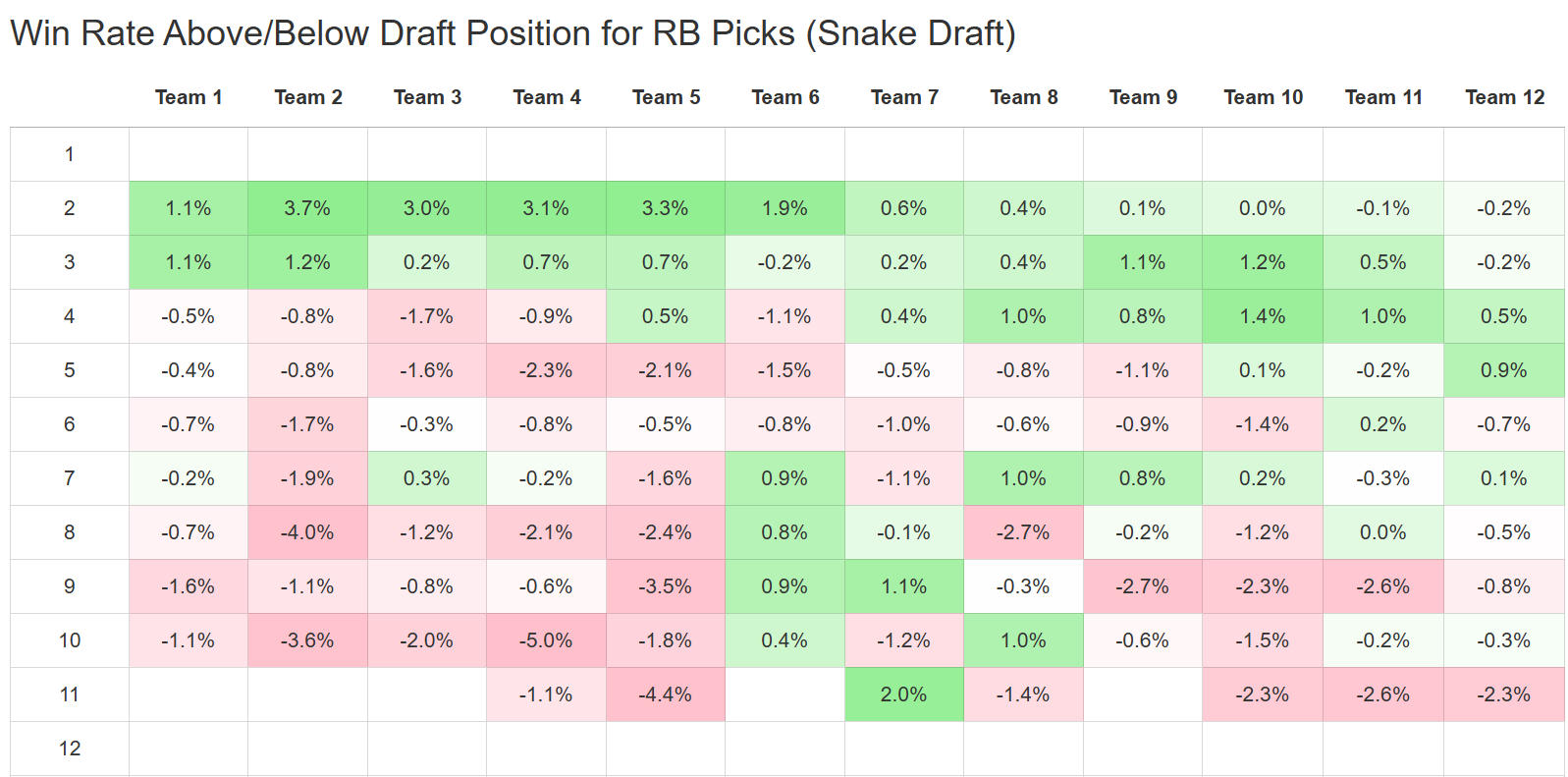
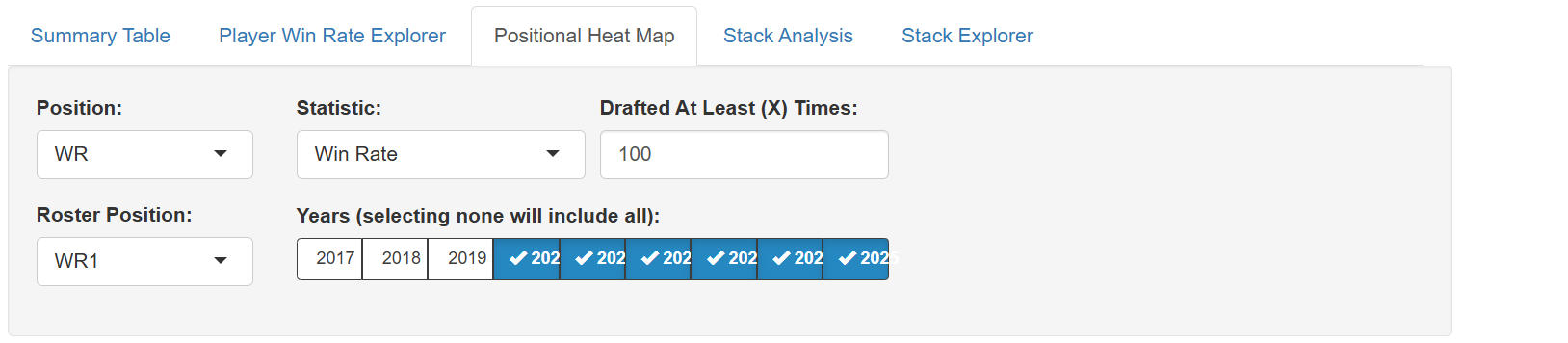
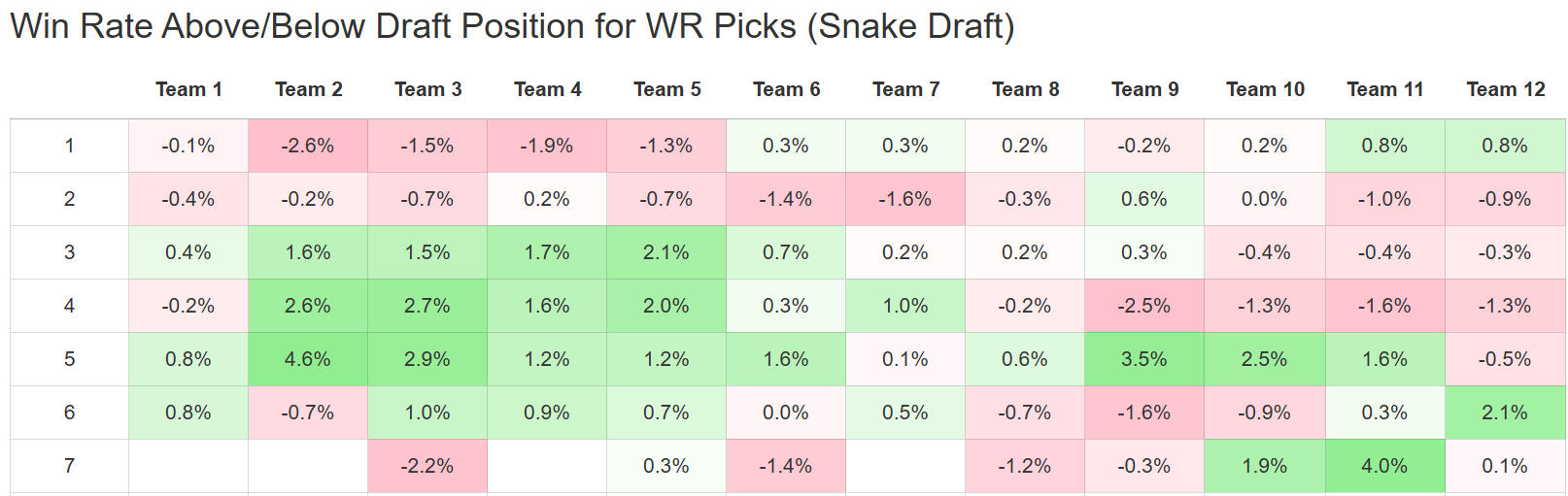
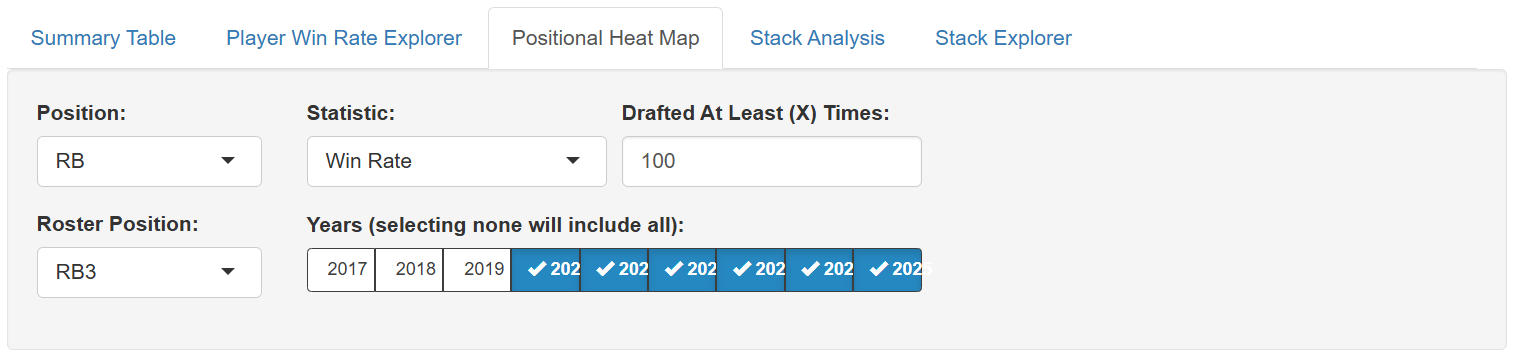
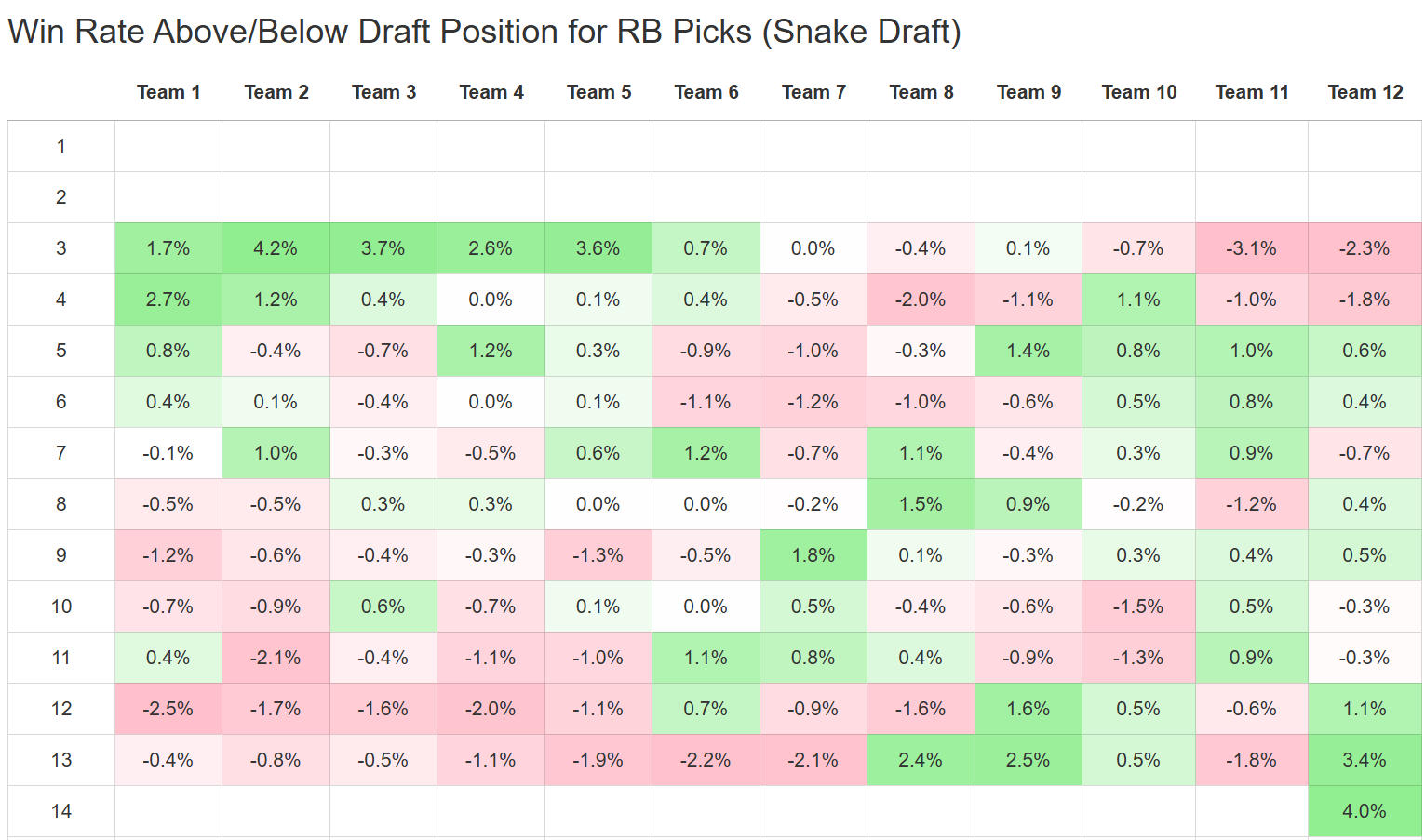
- Very easy to find my spot on the WRE positional heat map[1]
When we initially reviewed historical win rates in the WRE, one of the primary takeaways was the edge that drafting early RBs gave to most best ball teams. Therefore, it only made sense to start in the backfield once we added the RCE into the equation. Even though it may not seem like going RB at 1.01 is the optimal strategy when looking at the RCE, it is better than the alternatives, trust me. The outlook gets even better when we add our RB2 in Round 2:
I Need a Hero . . . Or Two . . . Or Three
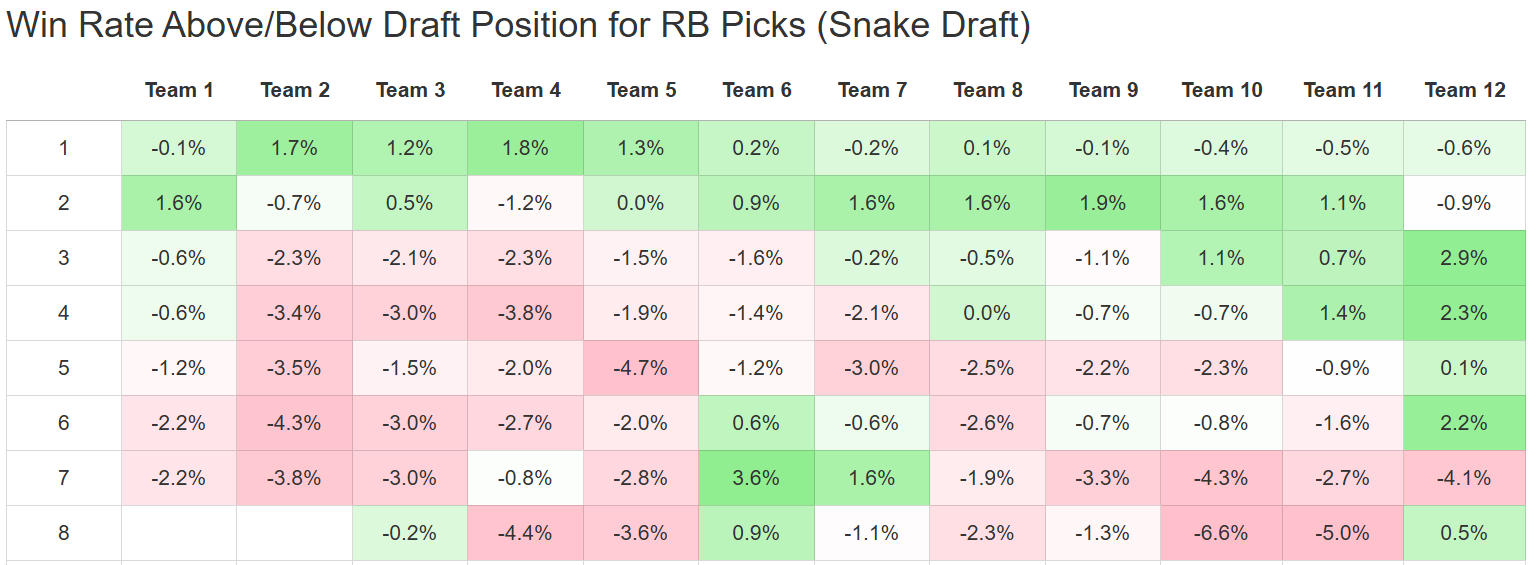
Last time around, we found out that drafting at the top of the order is far from an advantage. However, it was clear that RB had historically been the best route to take when we landed in the top six. Although selecting an RB at the back of the first has generally hurt win rates, drafters out of the 7-11 slots have a good track record when picking up their RB1 in the second round. And even though the 12th spot appears to have been left out in the cold, drafters who landed last in the order and have waited until the 3-4 turn to select their first back have seen some strong returns.
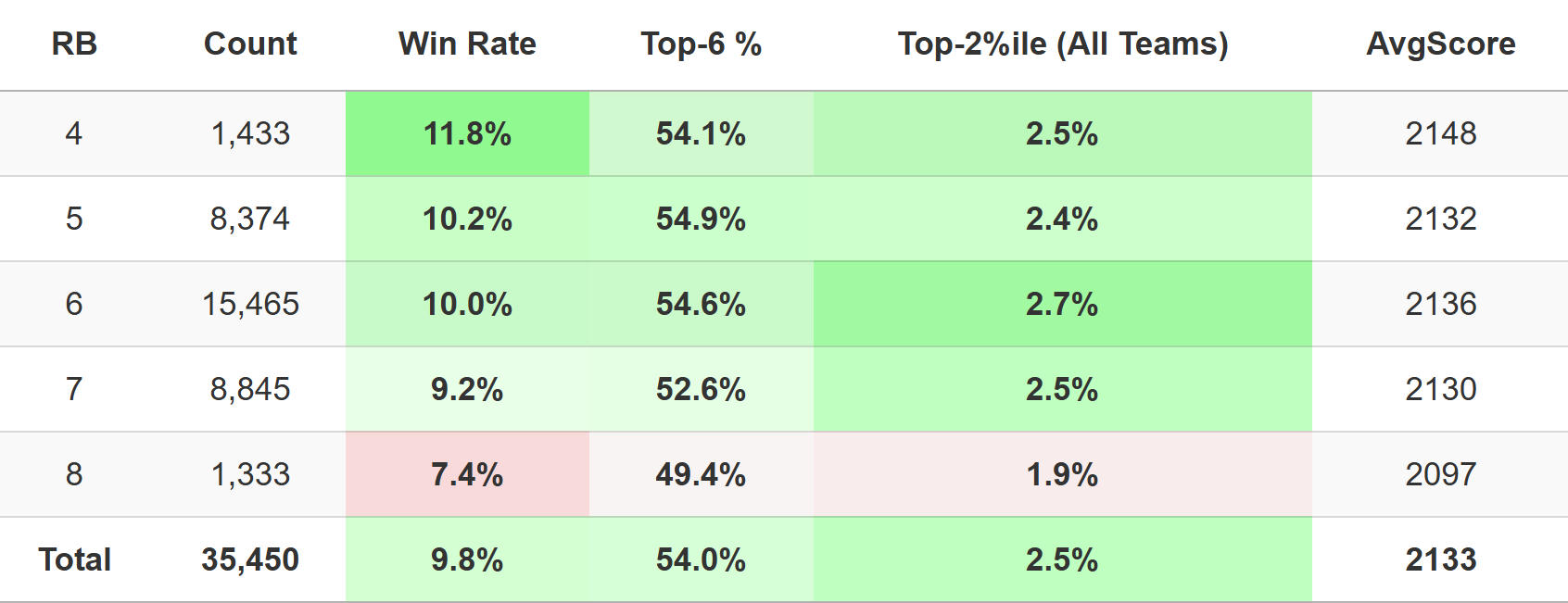
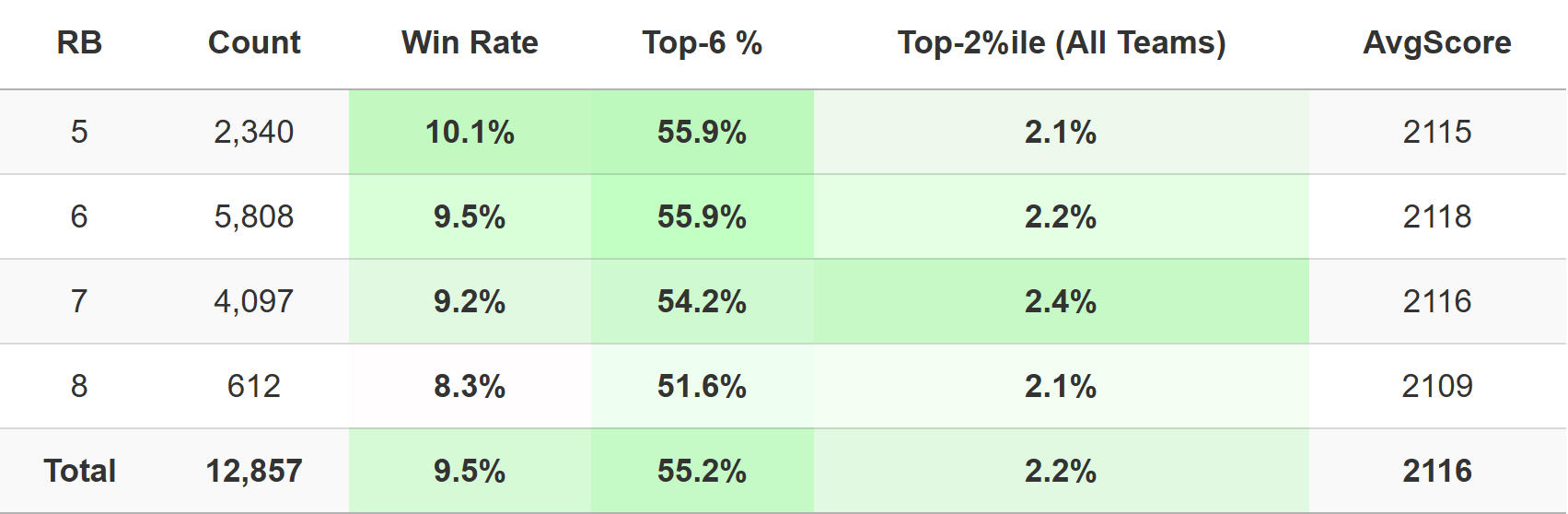
Overall, fantasy managers have found success going RB-RB at the top of drafts as long as they stay below eight total backs. If we’re prioritizing win rate and average points scored, stopping at four total RBs after kicking things off with two players at the position is ideal. Still, it is worth mentioning that the vast majority of drafters who have started drafts in this fashion have not had the risk tolerance to stop at four backs.
RB2 IN ROUND 2
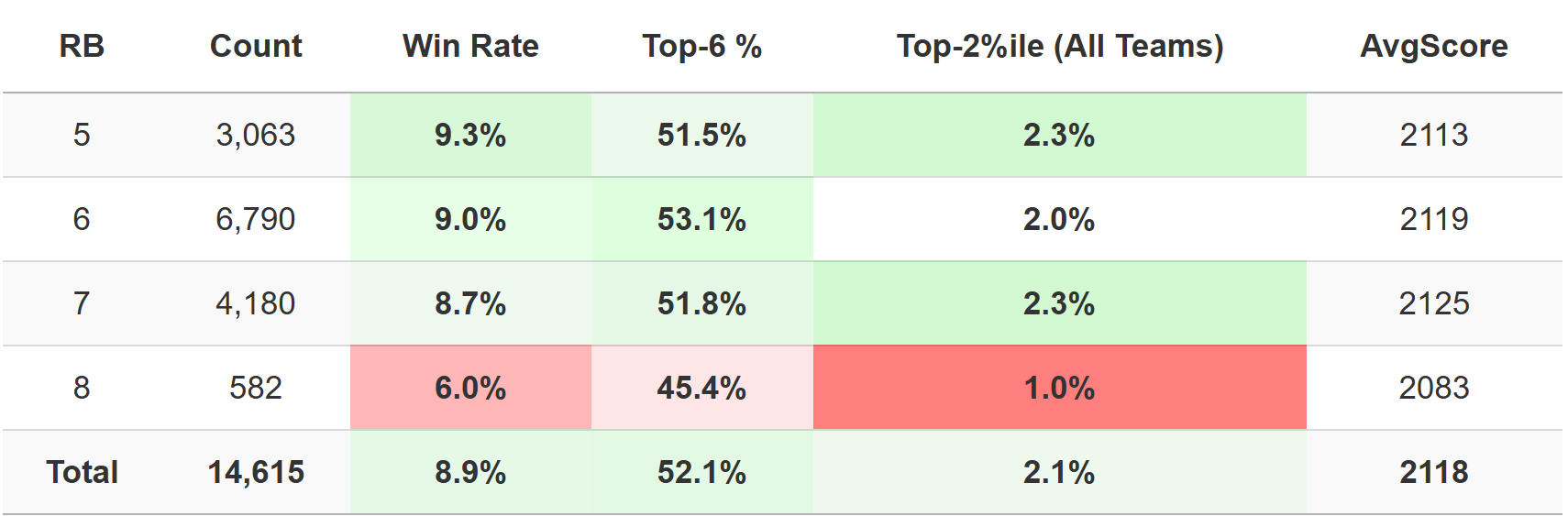
However, the data tells us that any combination of two RBs in the first three rounds can yield strong win rates, although going RB in Rounds 1 and 3 has generally been the least effective of the three options.
RB1 IN ROUND 2 — RB2 IN ROUND 3
RB1 IN ROUND 1 — RB2 IN ROUND 3
While all but the last three draft slots saw increased returns with an RB-RB approach, the front half of the order has found the most success with this approach. Meanwhile, drafters who were dead set on an RB-heavy start out of the 9, 10, and 11 holes achieved better results by waiting until the second and third rounds to start building out their RB rooms.

When we moved on to WRs, it became clear that taking a wideout at the 2-3 turn was the way to go:
When trying to decide on the best area of the draft to take your first wideout, history tells us that draft slot matters. The first five spots in the order have sacrificed their win rates further when selecting a WR with their first pick. Only one slot in the bottom seven sees a decrease in win rates compared to the baseline rate for each draft slot. Meanwhile, the numbers tell us we shouldn’t attempt to make up ground at WR with our second pick if we pass on the position in the first round.
Returns have been universally positive for drafters in the top half of the order who wait until Round 3 to select their first wideout. In fact, the results have largely been optimistic for the top slots if they wait until anywhere between Rounds 3 and 6 to take their WR1 off the board.
Sadly, we can’t say the same for fantasy managers at the back of the order. Those who landed in the 8-12 spots and opted to pass on wideout in the first round have generally seen the best results when they focus on other positions until at least Round 5, although there are a few positive outcomes that pop up sporadically before that.
Drafters who have chosen to wait on WR until Round 5 or later have generated some solid results, as win rates climb with each additional wideout that gets tacked onto the roster. But it is noteworthy that the average scores of these teams have decreased as more receivers are added, starting at seven-WR builds and working down the line.
WR1 AFTER ROUND 4
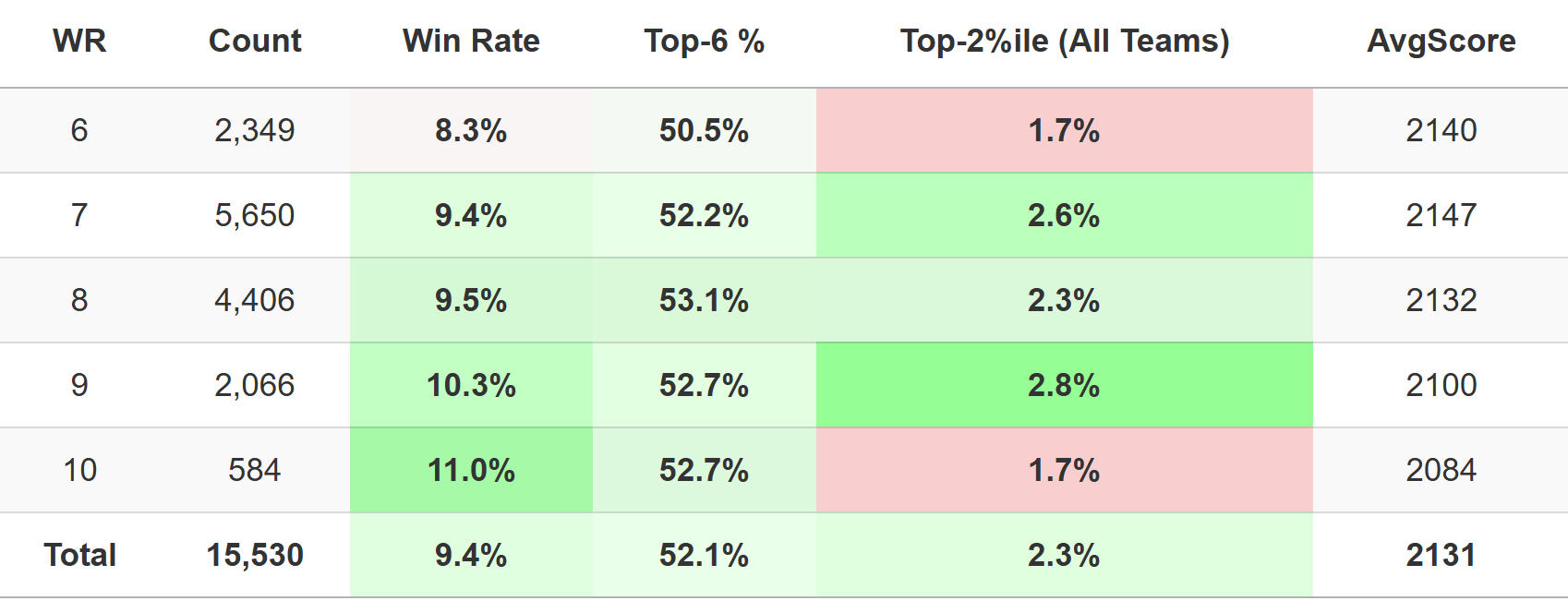
Heading back to my real-world draft, I was able to accomplish my early-round goals relatively easily, although I did have to reach to get an RB-RB start that truly excited me:
My first three picks were relatively straightforward in the eyes of the WRE, at least in terms of the positions I should be targeting. My hope was that one of the RBs who generally go in the mid-second would fall to me, but that was a bit of a pipe dream. My backup plan was to bypass the veteran thumpers for a more versatile option in Breece Hall.
After making a pretty big reach to keep my RB-RB start intact, I decided it was best to defer to the wisdom of the crowds by adding Nico Collins as my WR1 at the top of Round 3. I like Collins’ price tag considerably more this year compared to his 2025 price tag at the 1-2 turn. Still, I have George Pickens and A.J. Brown in the same tier, and either could have been an acceptable substitute for Collins. . . .


I accomplished my goal of kicking off the draft with two RBs and one WR in the first three rounds.
RB2 BEFORE ROUND 4 — WR1 BEFORE ROUND 4
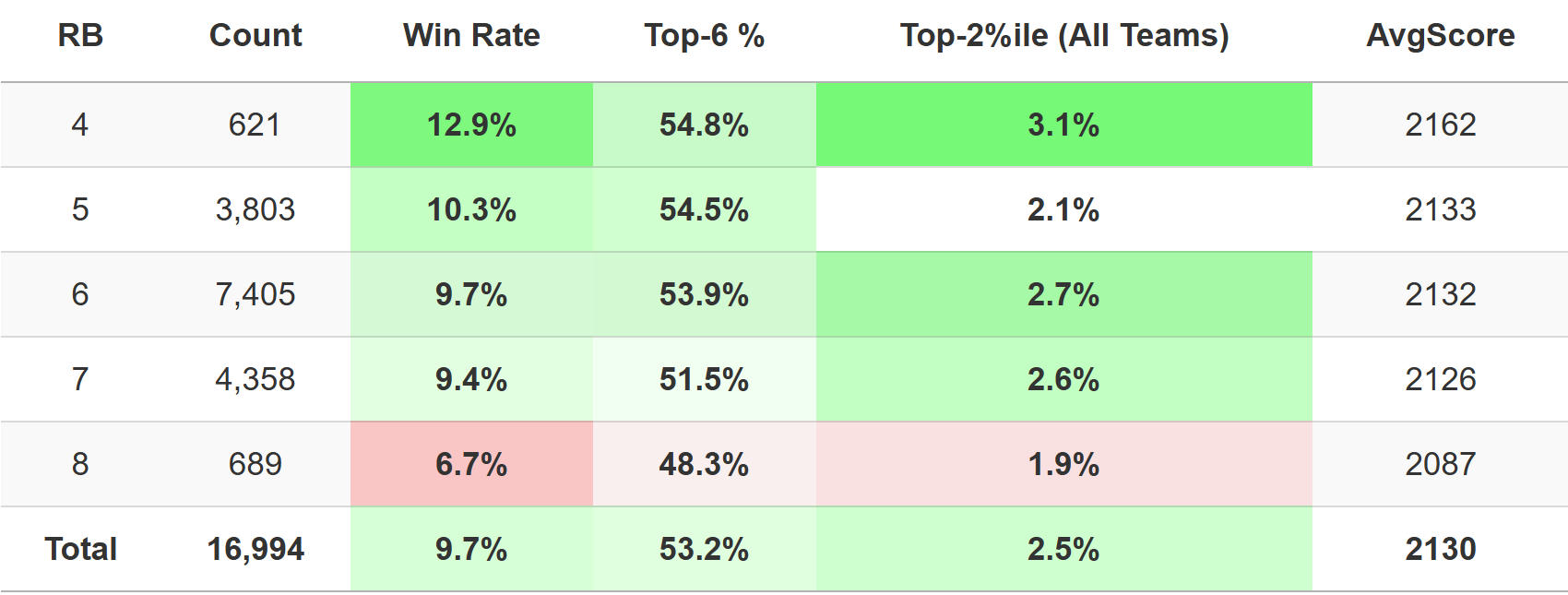
And if I want to get specific — and a little arbitrary since I was drafting at the turn — here’s what the RCE says about this start.
RB2 IN ROUND 2 — WR1 IN ROUND 3
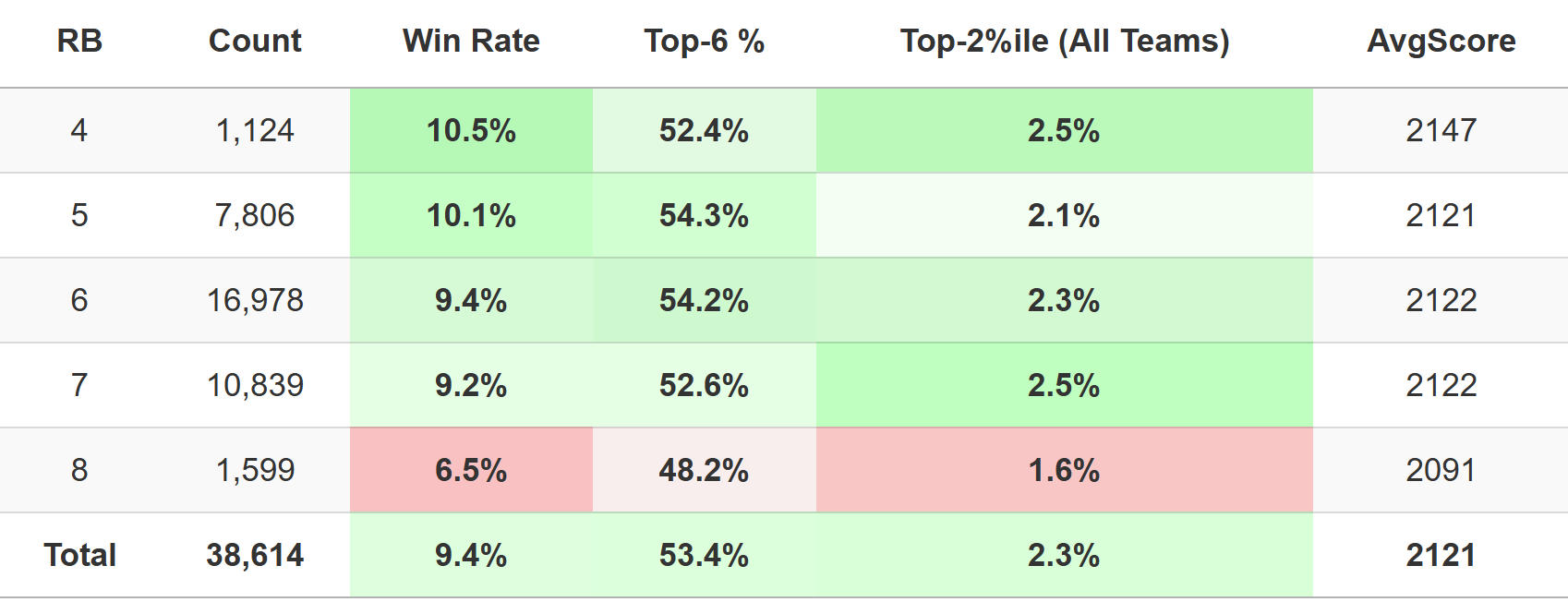
Once I made it out of the first three rounds, my focus shifted to the TE position:
A few draft slots have been able to gain leverage when selecting their TE1 in the first three rounds. However, many of the best results come in Rounds 4-6. Of the 36 draft slots in the first three rounds, 25 of them (69.4%) have hurt their win rate when drafting their TE1. Conversely, only 11 draft slots (30.6%) have decreased their win rates when taking their top TE in picks 37-72.
On average, fantasy managers who took their TE1 in Rounds 4-6 added 0.7% to their draft slot’s historical win rate. Teams that selected their TE1 in the first three rounds have seen their win rates decrease by an average of 0.5%. That is not to say we should take the position off our board entirely until we get to the fourth round, only that we should be confident in the players we are paying up for.
The RCE further emphasizes that waiting until the Round 4-6 range to grab our TE1 is the best approach in most cases. Additionally, the strong win rates that we see from five-TE builds appear to be an edge we can exploit, as long as we’re comfortable with the uncertainty that comes along with smaller sample sizes.
TE1 BEFORE ROUND 4
TE1 IN ROUNDS 4-6
We continue to see nice win rates in four- and five-TE constructions for drafters who hold off on the position all the way up to Round 11. However, it is important to note that things worsen with each passing round.
TE1 AFTER ROUND 6
TE1 AFTER ROUND 10
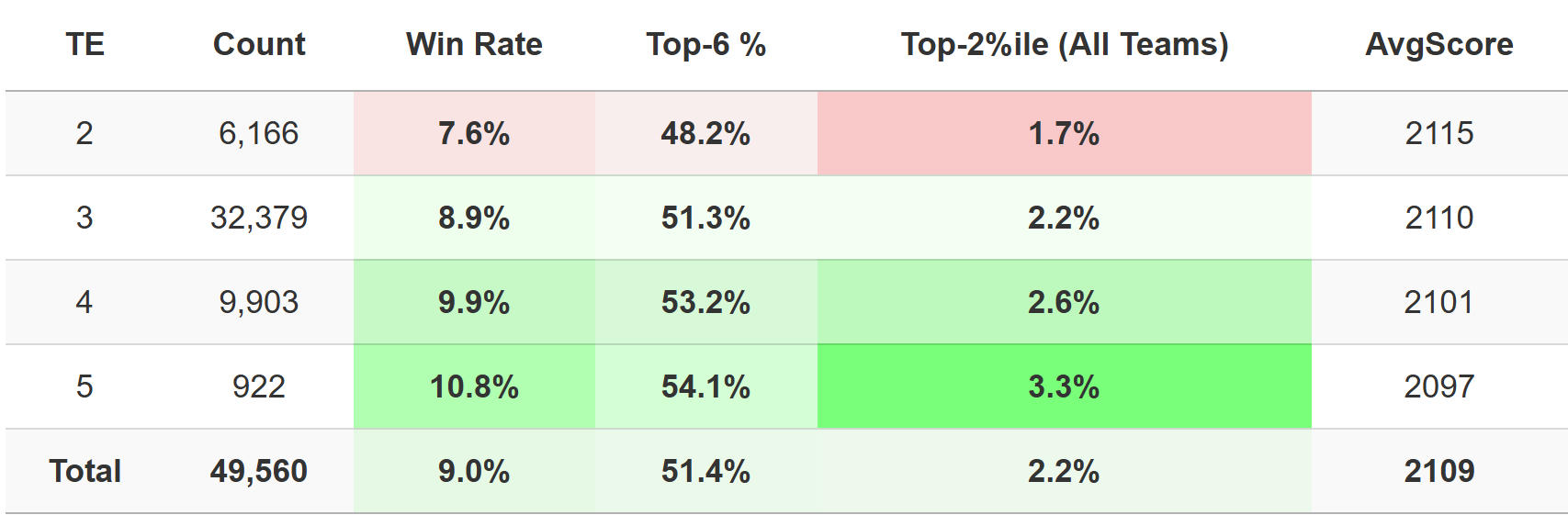
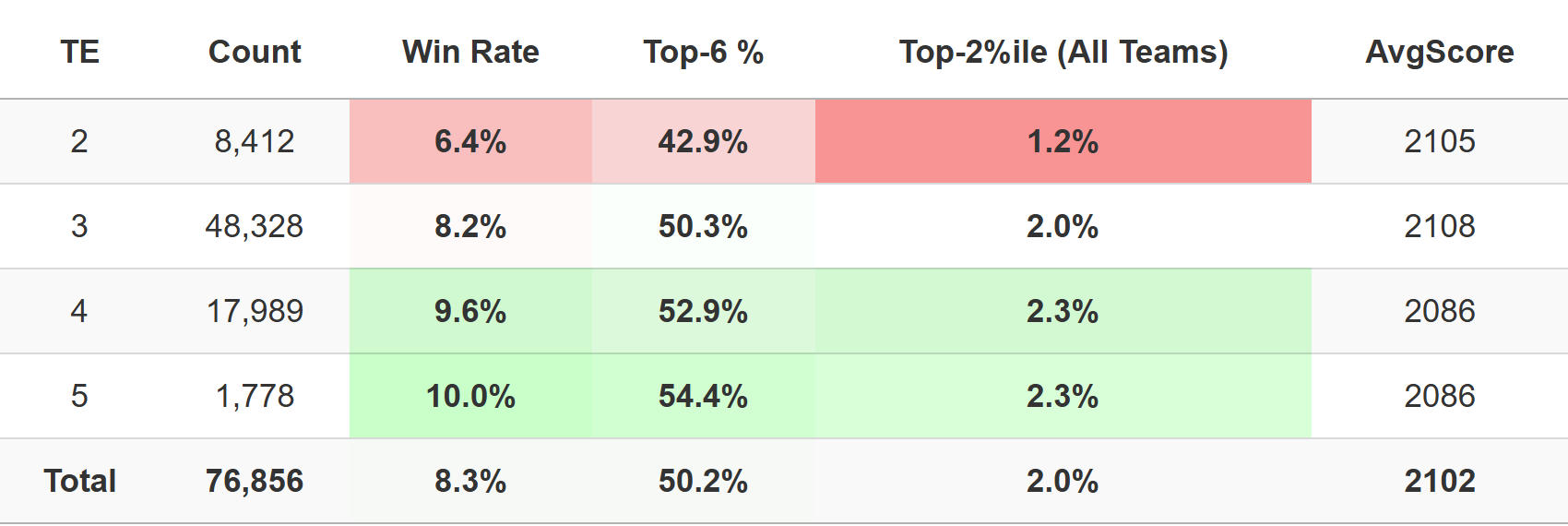
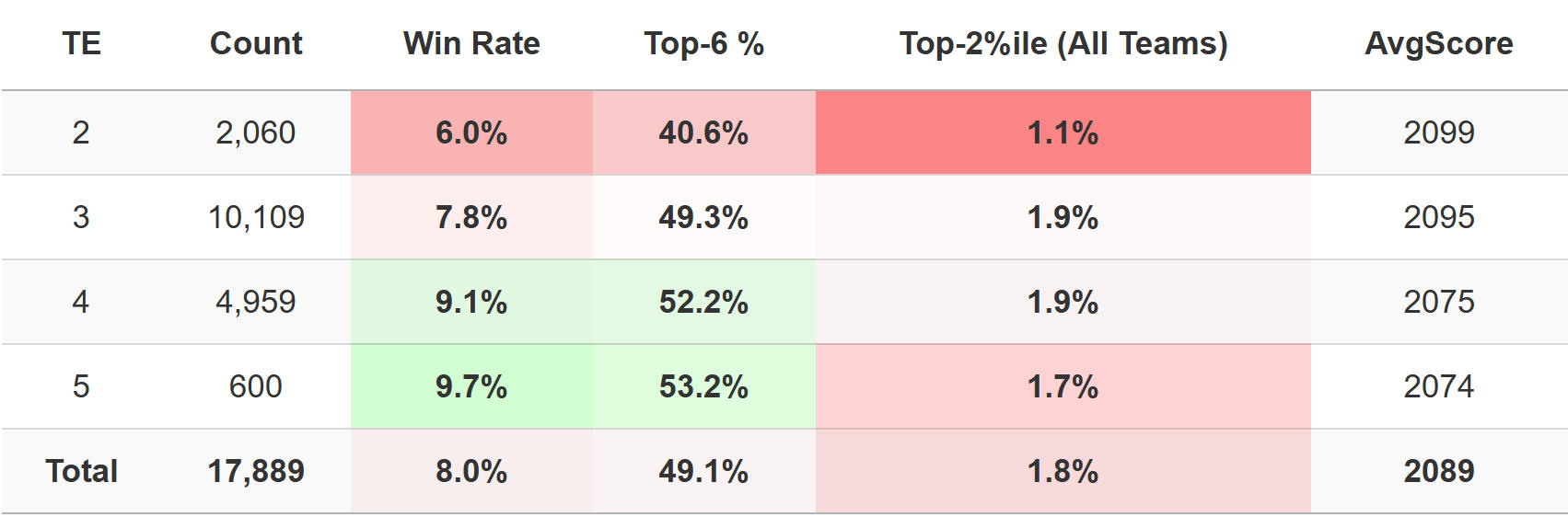
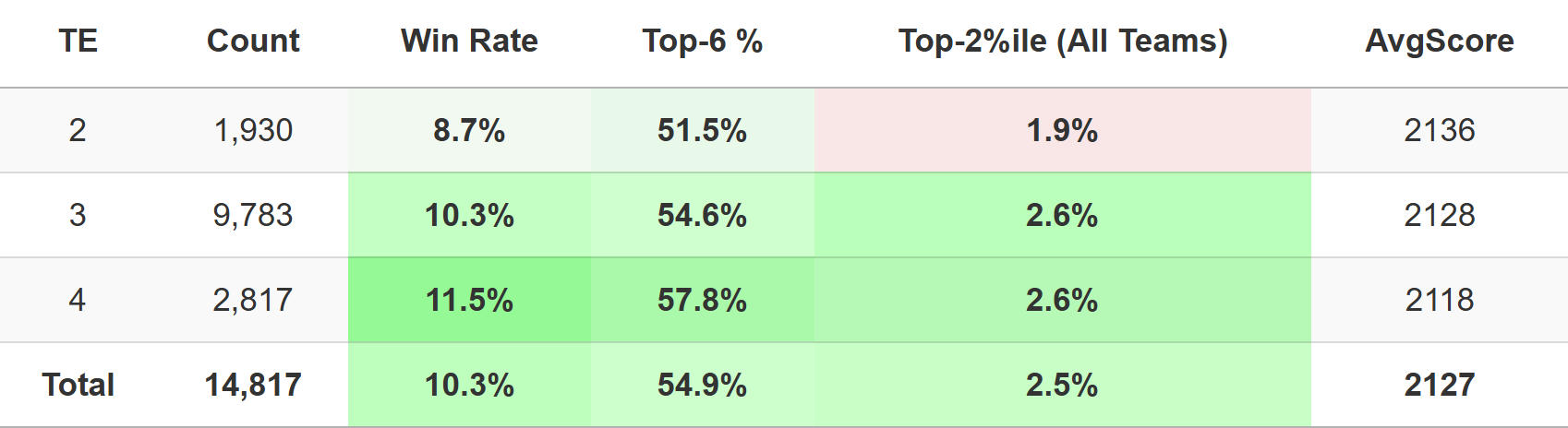
Before moving on to TE2s, you know we have to check out the effect that RB-heavy starts have had on these win rates. Drafters who selected two RBs and one WR in the first three rounds and then tacked on their TE1 between Rounds 4 and 6 saw some impressive returns.
RB2 BEFORE ROUND 4 – WR1 BEFORE ROUND 4 – TE1 IN ROUNDS 4-6
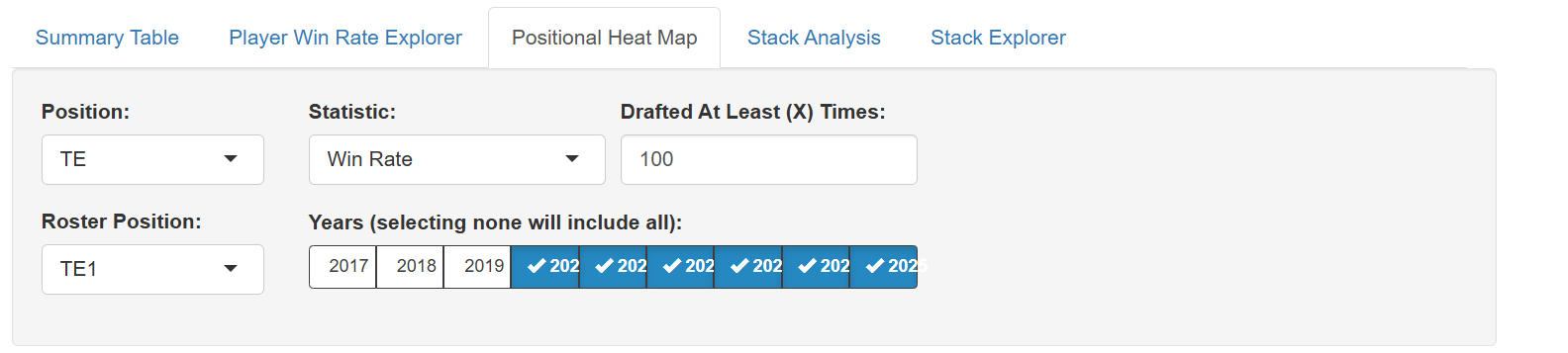
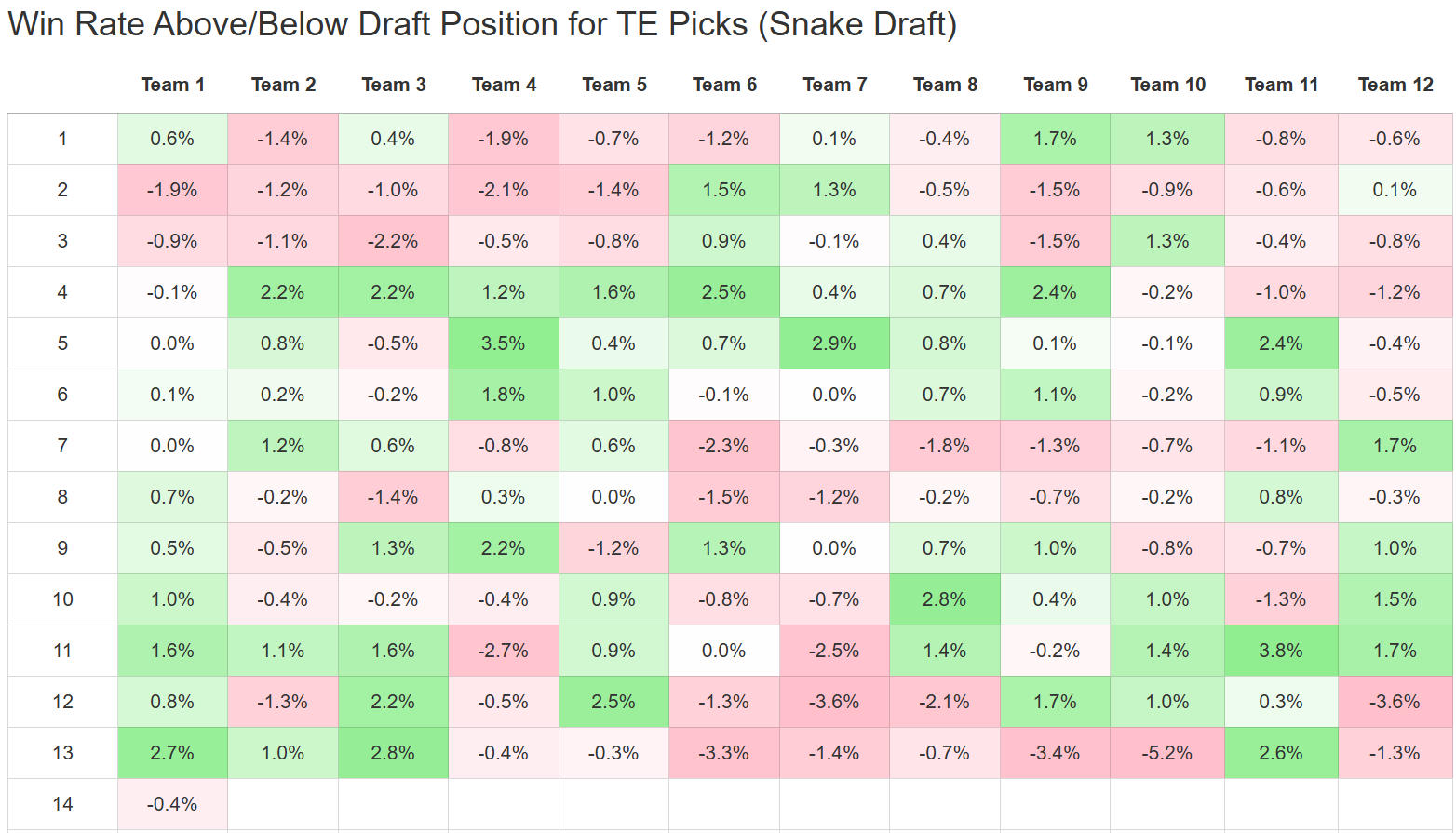
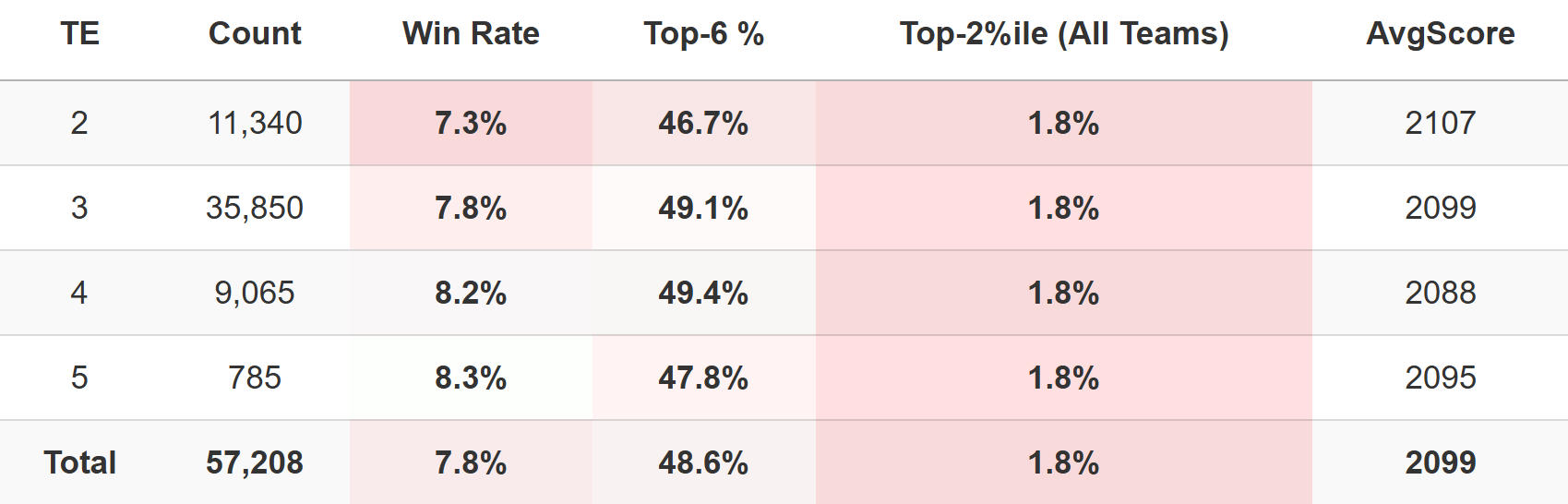
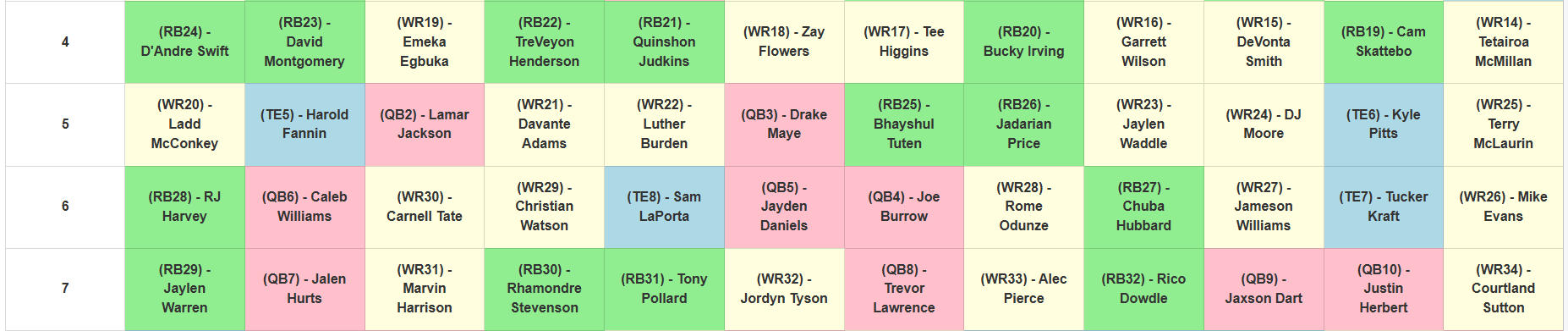
When it came to the practical application of this information, things didn’t work out in my favor. I found myself in a room that was prioritizing the TE position, which led to my second reach in the first five rounds:
My primary goal for the next three rounds was to secure my TE1. Looking over ADP prior to the draft, Harold Fannin Jr. was my clear target at the 4-5 turn.
But when Fannin came off the board with the first pick in the fifth, I knew I would be forced to either reach at the position or pray someone falls to me at the 6-7 turn. Given how the draft was going and the complete lack of TE options in the seventh round, I concluded that I was either going to have to reach at the 4-5 turn or ultimately fail to hit one of my benchmarks.
Still, the potential of a Zay Flowers-Lamar Jackson stack was starting to entice me until it was snatched away at the last second. Instead, I added Emeka Egbuka as a Week 16 bring-back for Robinson and then reached a full round on Tucker Kraft as a Week 17 bring-back for Collins. While I could have continued to build out the Atlanta side of things by adding Kyle Pitts — whose ADP is ahead of Kraft’s — I simply like Green Bay’s TE1 better. The thought did also cross my mind to double-tap TE with Kraft and Sam LaPorta, but ultimately I decided that would be getting a little too cute.

Moving forward, I had my eyes set on maximizing the QB window, which we found to be alive and well in the QB installment of the series:
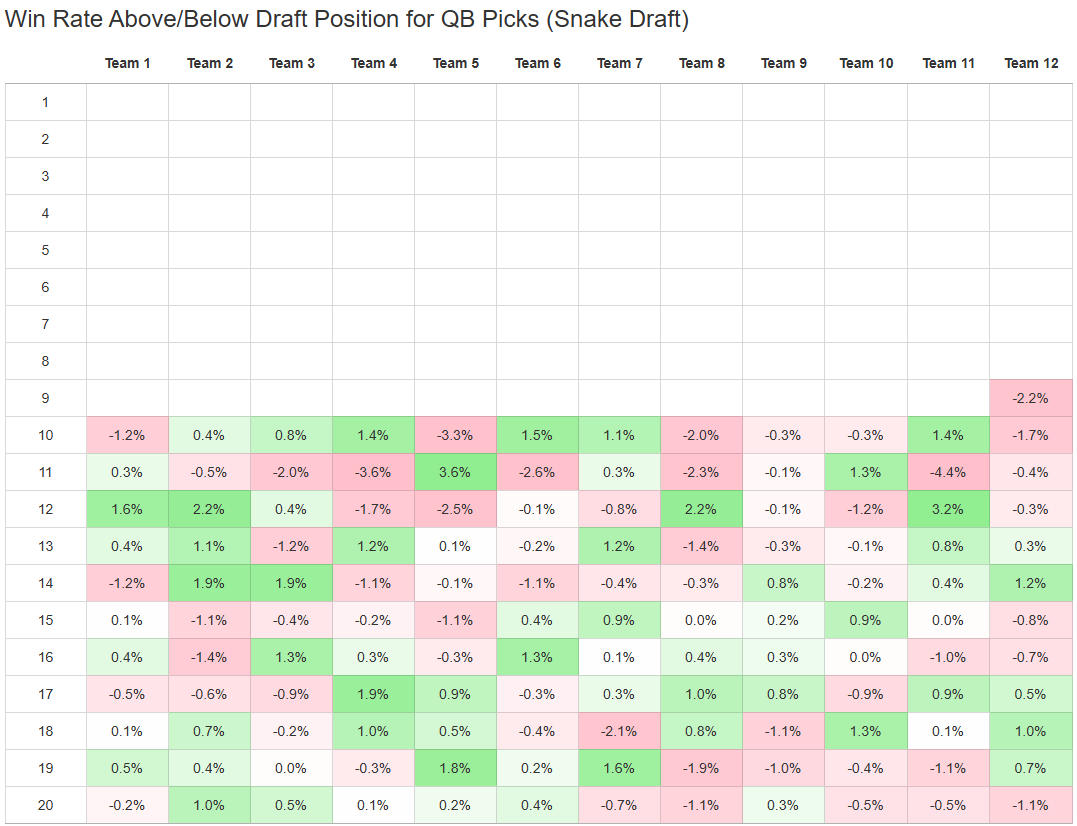
When choosing the right area of the draft to take our first QB, we do see a couple of outliers in the top 24 picks, but drafting a QB1 in the first two rounds has generally been a losing proposition.
In case you are wondering, only 420 teams out of a possible 183,624 have gone QB at the 1.01 over the past six years. While this approach is generally a bit of a fantasy football faux pas, the misstep has actually helped boost the historical win rates of the No. 1 slot due to some of the injury misfortunes for the top picks. I broke down this string of bad luck during my initial dive into the WRE:
Last season, Ja’Marr Chase became the only top overall player in any year of the sample to finish with a win rate over 4.0% [at 5.7%]…During McCaffrey’s three seasons as fantasy’s top overall pick, he averaged 4.7 games per season. Jonathan Taylor’s 2022 was limited to 11 games, while Justin Jefferson’s 2023 stopped at 10 games.
However, it is still important to understand that selecting a signal caller first overall has only boosted win rates in the No. 1 slot to 5.7% from the historical win rate of 4.2%. So, in other words, these drafters still finished significantly below the baseline of 8.3%.
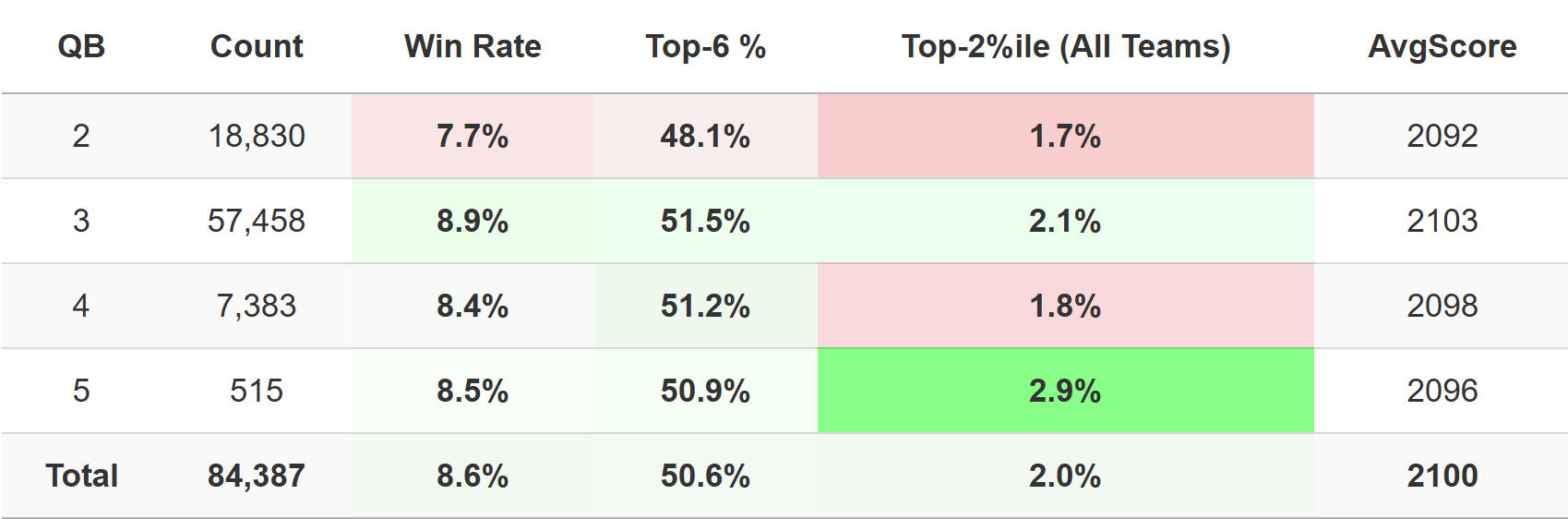
No matter how far down the line we move, two-QB builds never climb out of the cellar. Every other construction is able to deliver win rates above expectation when selecting their QB1 after Round 6, although the relatively small sample of five-QB builds ought to temper our enthusiasm for that strategy.
QB1 AFTER ROUND 6
If we are dead set on a three-QB construction, selecting our QB1 after Round 8 provides the best win rates but sacrifices a few points off the average score.
QB1 AFTER ROUND 8
But the good times are short-lived, as drafters who have waited until the 11th round or later to select their QB1 have witnessed win rates below baseline across the board.
QB1 AFTER ROUND 10
There is still a sliver of hope for drafters who get boxed out at QB until the 12th round or later, as long as they are willing to add four signal callers to their rosters.
QB1 AFTER ROUND 11
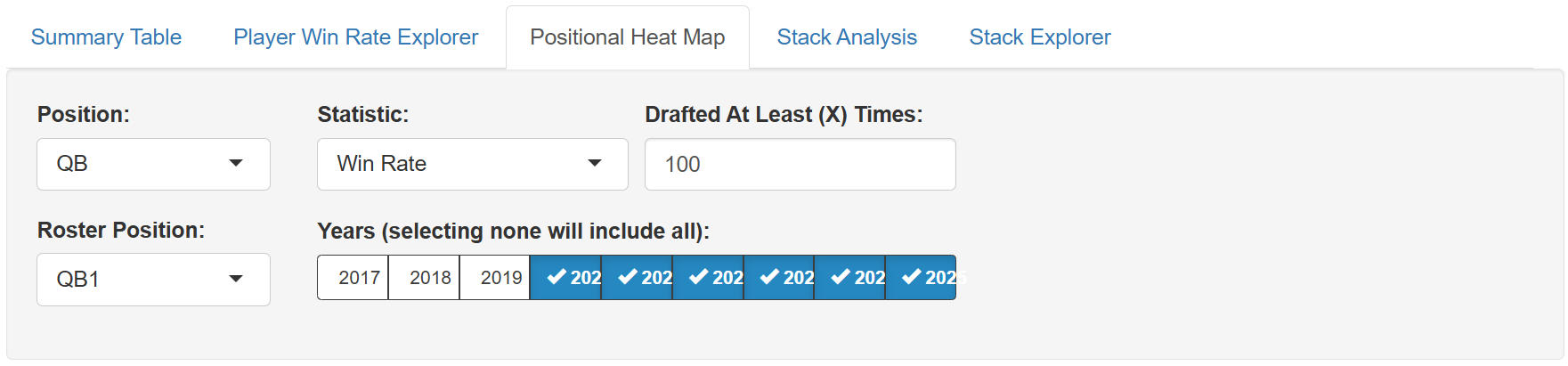
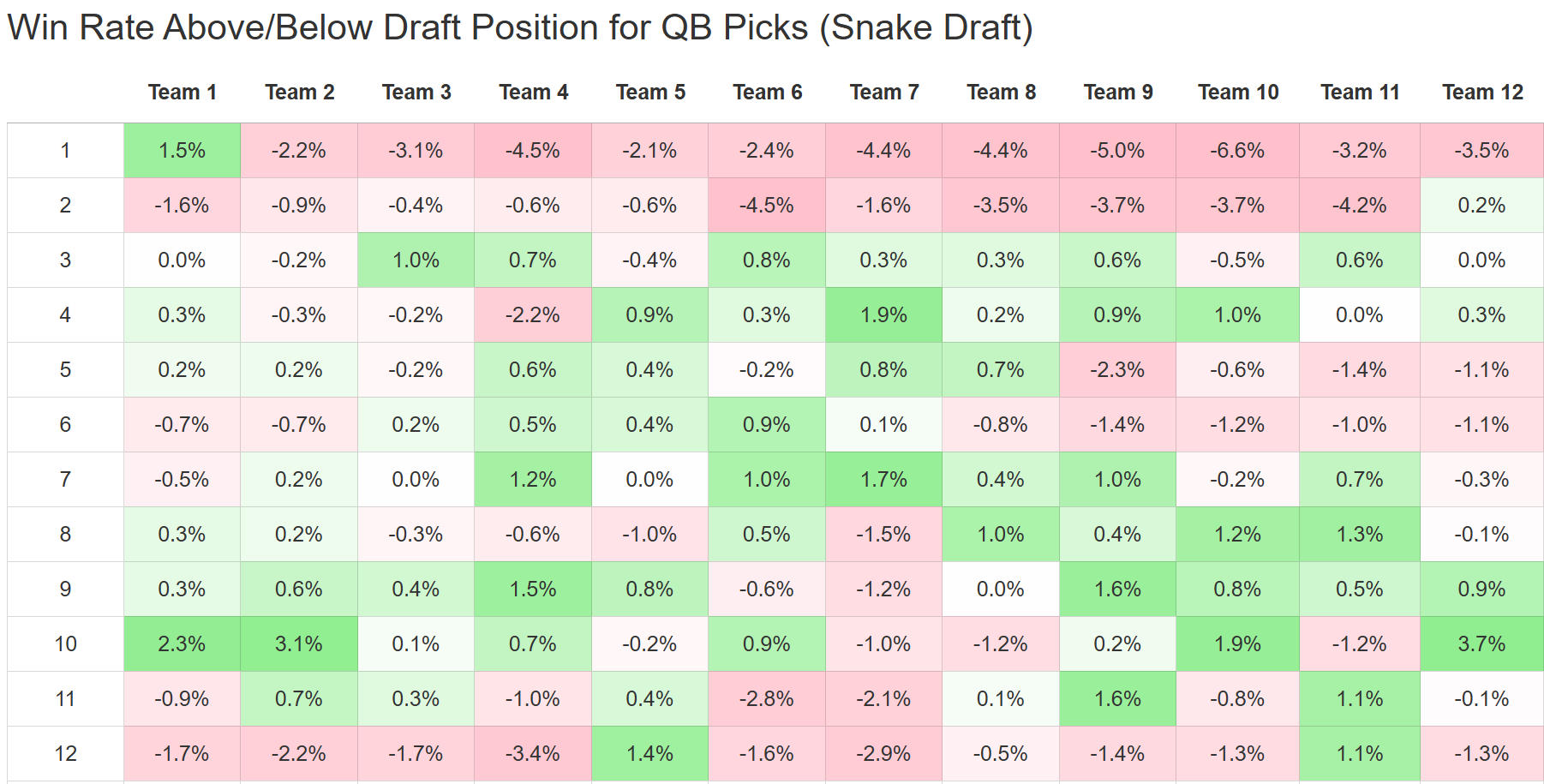
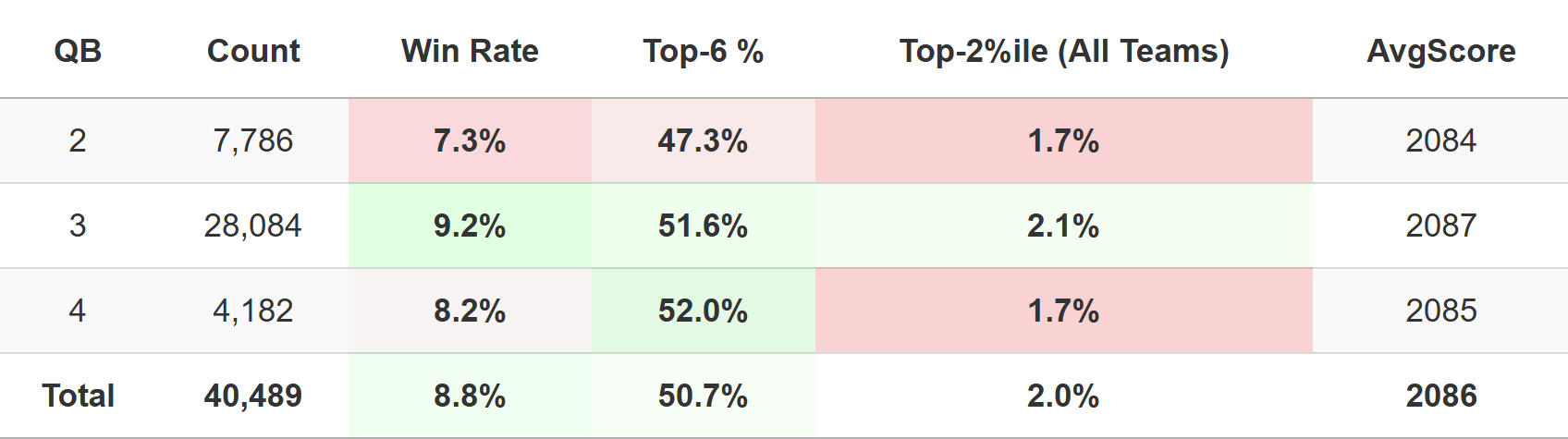
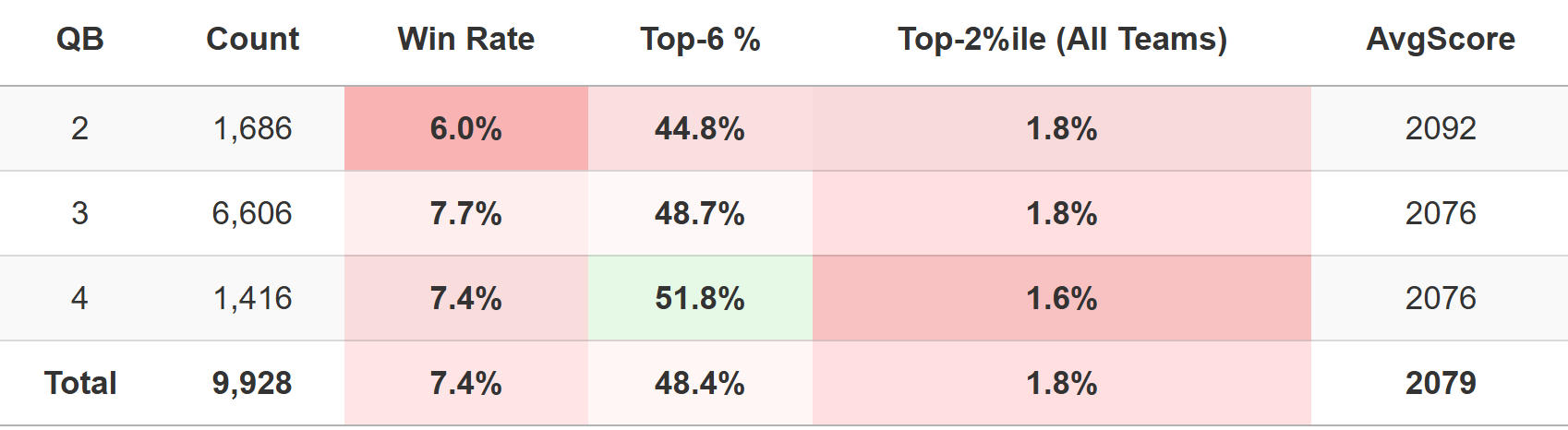
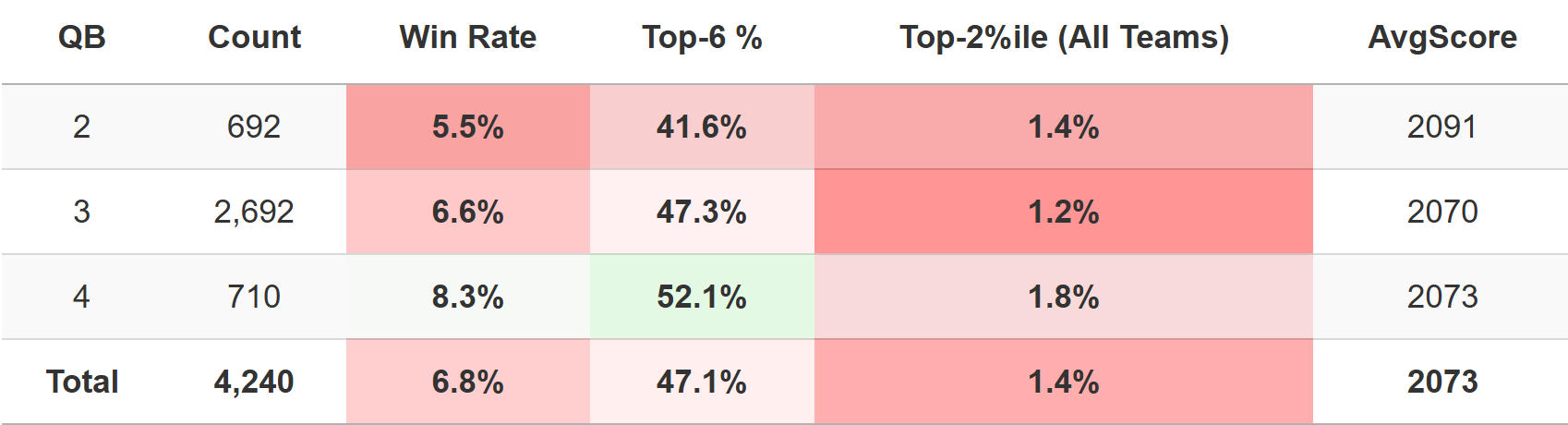
When it came to my draft, I was able to add three QBs in the window, with two of them coming at a solid discount:
My primary goal for the next section of the draft was to fill out my QB room with at least two signal callers before Round 14. I can’t deny I had an itch to take an RB at the 8-9 turn, despite the WRE warning against it.
Luckily for me, fate intervened when Kenneth Gainwell came off the board one pick before I was on the clock.[2] In the end, I opted to stack Patrick Mahomes with Travis Kelce. While Mahomes was a strong selection in the eyes of the RCE, the tool would have preferred if I waited until at least the next turn to take my TE2. But given the stacking opportunity that presented itself coupled with the dwindling supply of TEs, it made more sense to add to the position now. Additionally, I felt like I had a decent shot of back-stacking Xavier Worthy and adding some bring-backs with Chargers pass catchers later on.
I was happy that Tyler Shough fell eight spots past ADP to me at the end of the 10th round. Baker Mayfield was also available, but I preferred the ADP discount and rushing upside that Shough brings to the table. Then I got to scratch my RB itch and satisfy the WRE at the same time when I reached half of a round on Jonathon Brooks as my RB3.
Coming around to the next turn, I leaned into the WRE and my exposure to the Packers-Texans Week 17 matchup by getting a sliding C.J. Stroud nearly a round past ADP.


Even though I was in a decent spot through 13 rounds, that doesn’t mean I wasn’t susceptible to some bad habits that put me at a disadvantage. While I know it probably would’ve made more sense to cover stacking before jumping into a draft, I didn’t immerse myself in the subject until after I finished up my positional series. But looking back over the past couple of years with the new information available, I realized that I have probably been going a bit overboard with my stacking approach:
Wide Receivers
It seems intuitive that drafters should want to pair a QB with his top wideouts. Depending on which metrics you look at, it can be argued that stacking a QB with his WR1 or his WR2 has brought the best historical results. But it is a bit unexpected to see a significant drop-off when pairing signal callers with their WR3s. Things get even worse when we factor in WR4s.
The answer to this riddle isn’t that we should simply stop drafting WR3s altogether. There are currently 90 wideouts who rank in the top 240 players in FFPC ADP. This means, on average, the majority of NFL teams should have three WRs selected in every best ball draft.
But just because the fantasy community is drafting a player as his team’s WR3 doesn’t mean they’re getting it right. We generally have a much better idea of who the top two WRs will be on a team’s depth chart heading into the season than of which players will occupy the WR3 spot.
Additionally, if we bypass superior players to complete a stack, we might be doing a disservice to our build as a whole. The takeaway here shouldn’t be “don’t stack WR3s or WR4s under any circumstances,” but rather that we should be drafting WR profiles we are confident in, stacked or otherwise.
When we take things a step further, the results worsen.
Considering that QB solo stacks featuring a WR1 or WR2 both have some solid returns, it is interesting that all but the top-2% rates fall when we combine the two strategies together. Meanwhile, the results get even worse when we swap out one position or the other for the WR3.
Once again, I would not completely shy away from stacking multiple WRs from the same team with their QB if I believe in the players, but this data is a valuable reminder that we don’t need to go overboard when stacking up offenses. Admittedly, I have fallen victim in the past to adding too many pieces of the same offense to my rosters, and this thought process was even present in the draft article from my previous series.
Monopolizing the Skill Positions
We should remember that many of these stacks still include QBs; it’s just that removing that distinction helps boost the overall sample sizes to levels where we can get some sort of signal from them.
Few drafters went all-in on a team’s top three wideouts, but when they did, the returns were not good. However, grabbing the top two WRs along with the top TE did produce some inflated win rates, although the rest of the stats in the WRE suffered.
Meanwhile, combining an RB with two receivers was generally a bad idea across the board.









We should always remember not to view historical data as hard-and-fast rules we must adhere to under all circumstances. But it does provide us with guidelines that should help break ties and reveal some of our own blind spots that could be hindering our draft approach.
Lastly, I wanted to remind everyone that the tools that were featured in this article are only a small sampling of what we have to offer at RotoViz. If you’re not already a subscriber, come check out everything we can offer you in 2026. I hope everyone has a safe and happy Memorial Day weekend, and I’m excited to see you all in the best ball streets this summer!


