


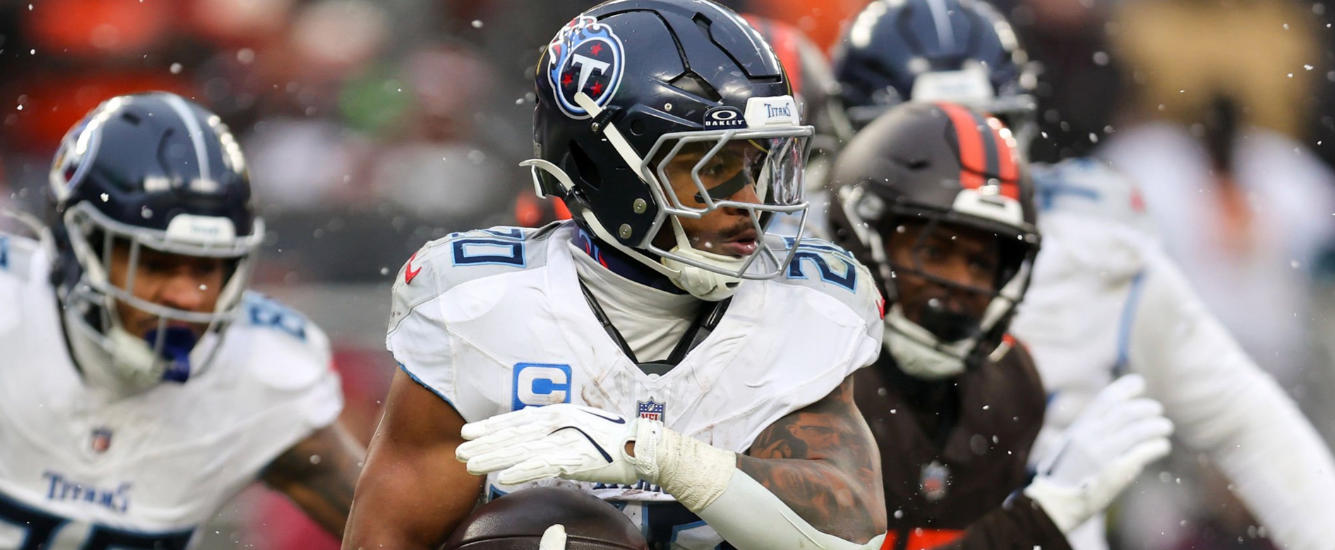

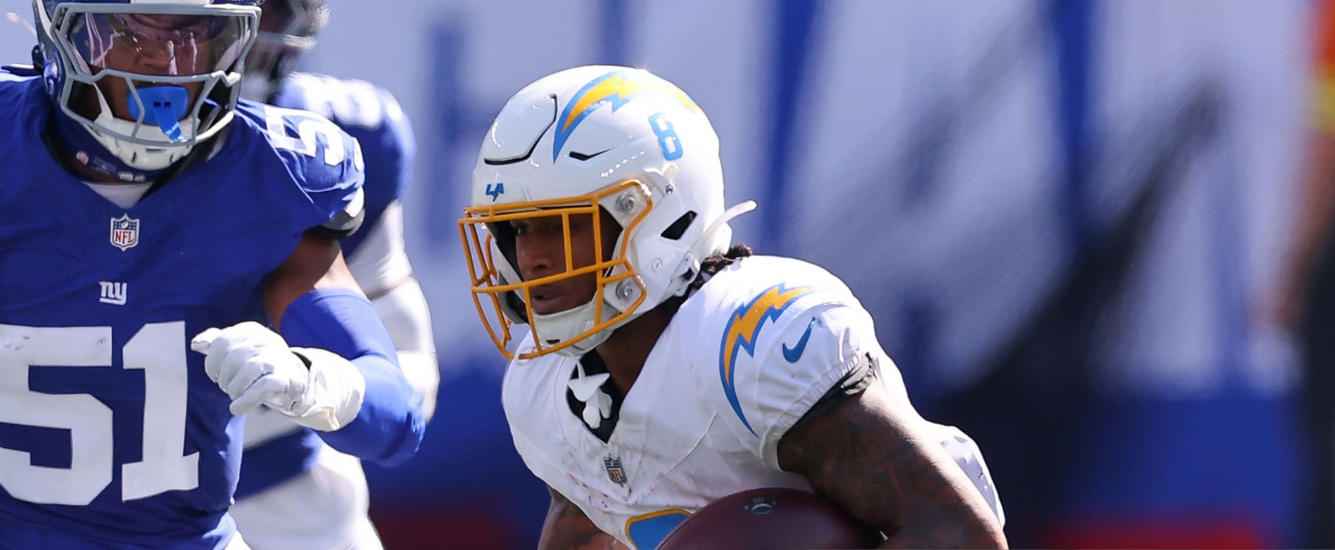
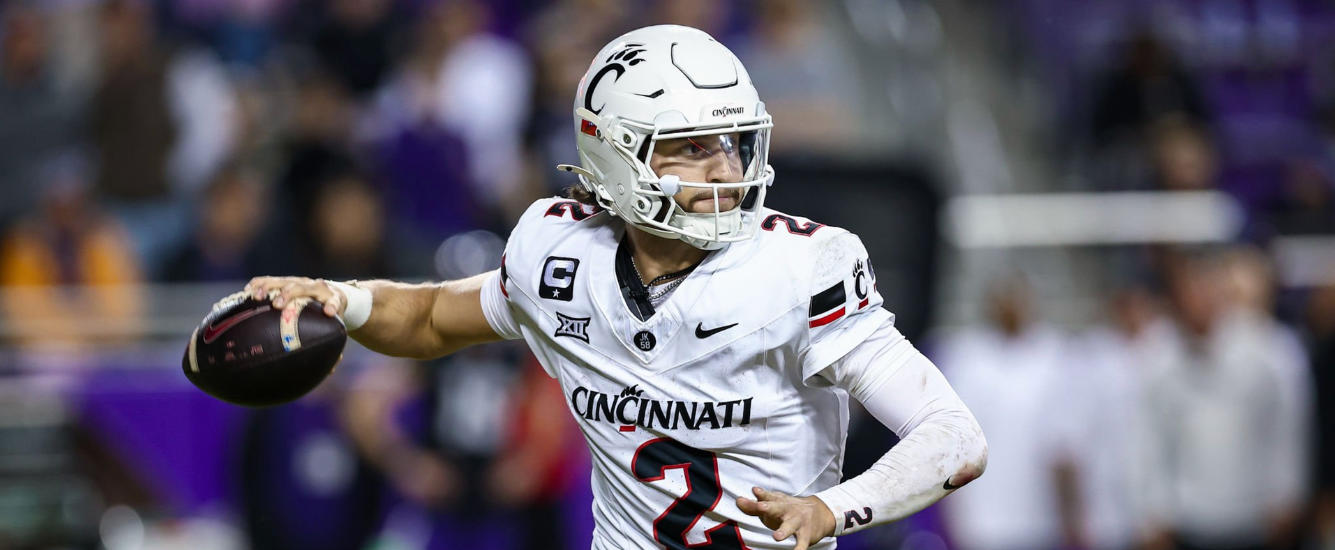


The RotoViz staff highlights some of the dynasty assets they will be looking to buy or sell ahead of the FFPC’s roster cutdown deadline on March 31.
Nothing can make a fantasy manager feel more alive than some high-volume trading. That is why now is an opportune time to purchase an FFPC dynasty orphan and begin building your empire while the trade market is hot.
Are you new to dynasty? No worries, the RotoViz team is here to help you every step of the way. We crank out dynasty content year-round, featuring insight from some of the most innovative minds and biggest rising stars in the industry. Our site also features frequently updated dynasty rankings and an expansive suite of tools, so you’re never alone when crafting blockbuster trades.
Are you itching to start wheeling and dealing? Pick up a dynasty orphan at the FFPC today! With teams starting as low as $1, there’s no reason not to pick one up. New FFPC users can save $25 off their first team of $35 or more by using code 25ROTOVIZ or by following this link!
Recently, we have featured a position-by-position breakdown of dynasty buys and sells so readers are prepared for the intense trade activity that is currently taking place in FFPC dynasty leagues. Here’s a brief overview of a few of the finer points to keep in mind when putting together trade offers in your FFPC leagues:
When formulating dynasty trades, it is always a solid practice to have a finger on the pulse of public perception. This train of thought makes the use of crowdsourced trade calculators, in tandem with a set of more personalized rankings, a good way to harvest solid value in deals. For this exercise, I used Keep Trade Cut to gauge current market values, but there are a number of resources available to fantasy managers who want to go another route. When it came to the other side of the equation, I relied on the RotoViz Triflex Dynasty rankings.
To maintain apples-to-apples comparisons, I will present each player’s value in terms of rookie picks. One observation that became apparent early on is that fantasy managers are (rightly) valuing rookie picks for 2027’s potentially generational draft class considerably higher than selections for this year’s less intriguing crop of prospects. For this reason, each player’s market value is laid out in terms of both 2026 and 2027 rookie draft capital.
For the purpose of this article series, I will be focusing specifically on the FFPC RotoViz Triflex Format. These leagues differ from the more traditional offerings on FFPC by featuring starting lineups that include three wide receivers and two flex spots, in addition to a superflex slot, while omitting kickers and defenses. As is the case with all FFPC leagues, Triflex scoring settings are tight-end premium. Another wrinkle to account for when trading away future picks in managed leagues is the backdraw for the 1.01, which is held among the six teams that fail to make the playoffs. The best ball iterations of the Triflex format are strictly points-based, running from Weeks 1-17, with the top scorer being crowned champion.
A Brief Introduction
For years, Shawn Siegele has been writing articles focusing on how to create a permanent championship window in dynasty leagues through the art of perpetual reloading. For anyone who is not well-versed in the strategy, it is worth going back and combing through Shawn’s dynasty workshops, past and present.
While I will not revisit all the finer points of Shawn’s articles from the past six years, one idea that is consistently at the forefront of my mind is that we should be crafting deals in which the two managers involved in the trade win and the other 10 managers in the league lose. These types of transactions will help build better working relationships with our fellow managers and lead to more fruitful trade discussions over the long term.
Now that we’ve laid some groundwork, it’s time to dive into some of the players that dynasty managers should be looking to buy and sell before the roster cutdown deadline arrives. This installment of the RotoViz Review will focus solely on the highest valued buy and sell from each position, as determined by their position in our dynasty rankings.
Quarterbacks
Naturally, we kicked off the series with quarterbacks. However, I was not ready for the surprise that awaited me when attempting to find players at the position whom I would be eager to sell:
I felt it was important to kick things off with the sells because some unexpected trends cropped up when working through this exercise. As someone who generally pushes QBs in all superflex leagues, I found it odd that the values I placed on most players at the position largely aligned with those of the fantasy community at large.
To be fully transparent, this revelation did come as a bit of a hit to my ego, considering I would prefer to think of myself as more of a free thinker rather than someone who is simply marching along with the masses. Upon further review, I did some slight tinkering, but still felt like many of the values I placed on the individual players were a true representation of fair compensation.
If we look merely at where players fell in the rankings, irrespective of the trade value assigned to them, here are a few QBs who could offer some value for managers who are on the selling end of a trade:
- Justin Herbert (KTC: QB7, RV: QB9)
- Jalen Hurts (KTC: QB10, RV: QB14)
- Baker Mayfield (KTC: QB19, RV: QB22)
- J.J. McCarthy (KTC: QB31, RV: QB37)
I know, most of these gaps are not massive. The most exploitable difference would have to be Hurts. Moving Herbert could also result in a decent win. And while we’re on the topic, there is only one quarterback in the entire NFL who I would consider close to “untouchable” at this point, which we will get into a little later on. As long as you are accomplishing your roster-building goals, there should be few instances when you are not open to moving any player for the right price.
Jayden Daniels Tops the List of QBs Dynasty Managers Should Be Targeting as Roster Cutdowns Approach
When it came to the buys, things were a bit easier. Earlier this week in our premium newsletter, [1] I featured my breakdown of headliner Jayden Daniels’ trade value. To reward our newsletter subscribers for their patronage, I will move down to the next QB buy in the article:
Jaxson Dart
RV Triflex Rankings Value: 2 R1
2026 Rookie Draft Market Value: 1.02 and 3.05
2027 Picks Market Value: 1 R1 and 1 R2
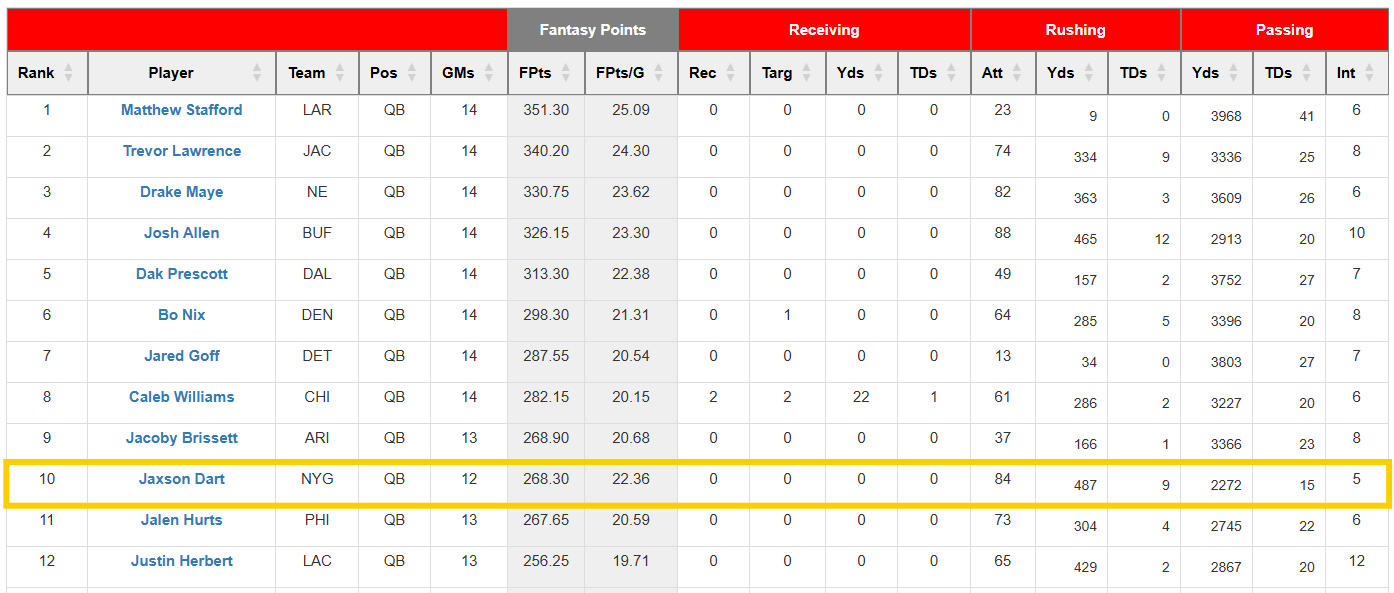
Earlier this year, I detailed Dart’s rookie season, as well as his prospects heading into Year 2. The highlight of his profile was undeniably his ability in the run game, while his skills as a passer were still a work in progress:
Dart’s rookie season was a textbook example of how rushing can be the great equalizer for fantasy QBs. From Week 4 onward, Dart’s 14.0 expected points per game (EP/GM) as a passer ranked 27th in the league. His efficiency as a passer was equally as bad, with his -0.2 fantasy points over expectation per game (FPOE/GM) tying for 28th at the position. Meanwhile, Dart’s 6.1 rushing EP/GM in that same timeframe cleared Josh Allen by a full point for the league lead. His 2.5 FPOE/GM on the ground only trailed Allen’s 3.4 FPOE/GM.
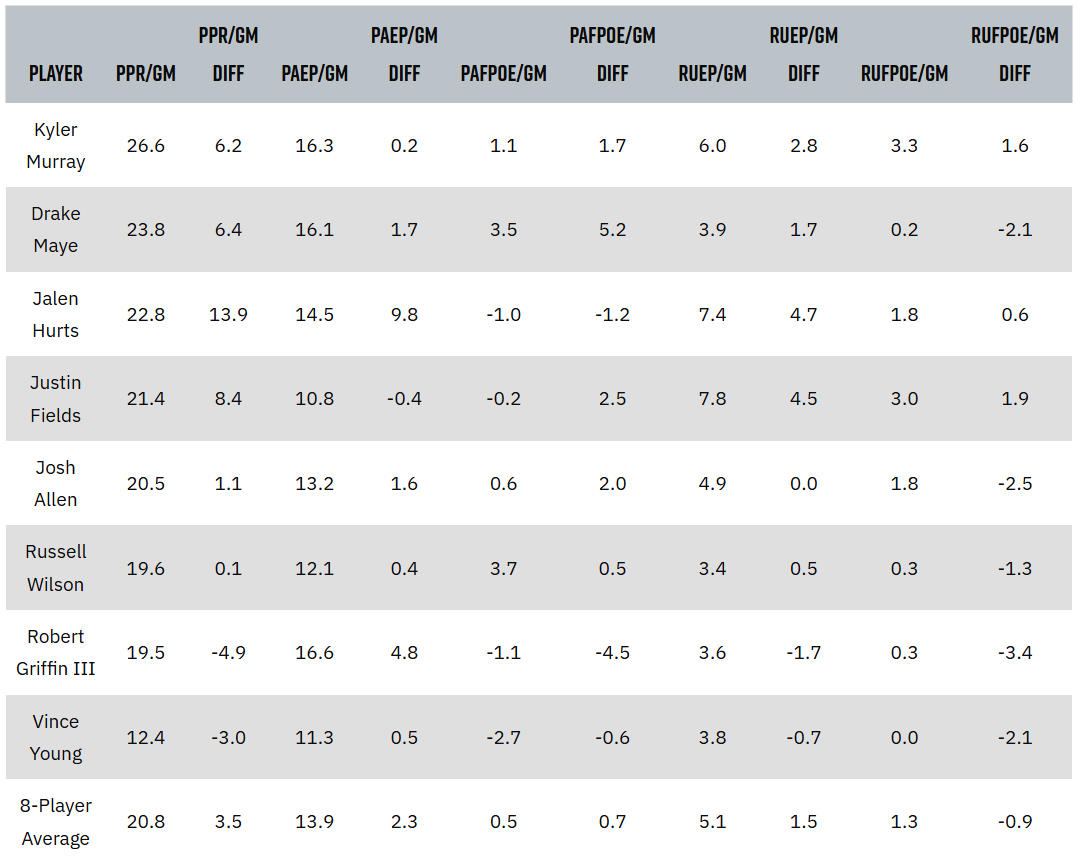
Meanwhile, his Year 1 comps from the RotoViz Screener featured more hits than misses. After thinning the list down to the eight players who most closely resembled Dart’s skill set and team situation, we were left with a pretty interesting list of players:
If we look solely at the QBs who were able to clear 25.0 rushing yards per game as rookies, we are left with nine players.However, the one player I believe should be removed from the group is [DeShone] Kizer, who was not in line to start for Green Bay after being traded by Cleveland during the offseason heading into his second year. This leaves us with a list of eight QBs who I feel reasonably confident came into the league with a similar skill set to Dart and also found themselves in a comparable situation heading into Year 2.
We get a fairly strong sample from the players above, with each appearing in at least 13 games in their second season in the league. The average growth these players experienced is encouraging for Dart’s 2026 outlook. In fact, the only area where the group did not experience an uptick was in their per-game rushing efficiency. However, the combined 3.8 points of additional EP/GM and an additional 0.5 FPOE/GM in the passing game more than make up the difference. While it is not featured on the table above, the group also increased their completion percentage by an average of 3% in their second seasons, which would be a welcome improvement for Dart after the Giants’ rookie only completed 57% of his passes in 2025.
Considering the career trajectories of the names above, there is a solid chance we see Dart’s fantasy value continue to increase in 2026. The biggest concern would be a catastrophic injury, which is not entirely ruled out given Dart’s reckless playing style. Still, there are currently more positives than negatives working in his favor. The return of Malik Nabers should be a huge aid in his development as a passer, and hopefully, the new Giants’ coaching staff will prove to be the same.
The only player in this year’s draft class who currently resides in the same tier of my dynasty rankings as Dart is Love. With the Notre Dame running back coming in eight spots ahead of Dart, I would not be willing to part with the 1.01 to acquire the Giants’ QB. However, the 1.02 would be firmly on the table, and adding the 3.05 in a weak draft class would be a small price to pay for the upside that Dart adds.
While I would be a little more cautious when floating my 2027 picks in a deal for Dart, I’m not entirely opposed to it. At this point, the general consensus may be a little too cocksure of how loaded next year’s class will be, particularly when it comes to high-end QBs. While we want to play into this mindset during negotiations, a manager with a strong team should not be entirely opposed to the idea of moving their 2027 picks to acquire a young prospect like Dart. Considering how well QBs generally hold their dynasty value early in their careers, there is a strong chance he could be moved for a similar haul next offseason if need be.
Running Backs
While some dynasty managers may assume that we should simply buy young assets and sell old ones, there is considerably more nuance to playing the trade market. One pillar of perpetual reloading is selling players at the top of their market. For the top running back sell candidate, there is reason to believe that he may have already reached his peak after only one year in the NFL:
Quinshon Judkins
RV Triflex Rankings Value: 2 R2
2026 Rookie Draft Market Value: 1.04
2027 Picks Market Value: 2 R2
It’s mind-blowing to me that Judkins holds enough value to potentially be traded for the 1.04 in this year’s rookie draft. Honestly, I would be elated to receive any of the top six picks in 2026 in return for Judkins, as this would assure me either a top-three wide receiver or the best running back, quarterback, or tight end in the class. If you can coax a 2027 R1 out of another manager, even better.
On a positive note, I have been pleasantly surprised by how quickly Cleveland has been able to retool their offensive line this offseason. Since the start of March, the Browns have added Tytus Howard in a trade with the Texans and signed Zion Johnson and Elgton Jenkins in free agency. All told, Cleveland shelled out $118.5M in contracts to their recent acquisitions, which will hopefully pay immediate dividends. This is not to mention that the Browns still possess two first-round picks this year — No. 6 and No. 24 overall — and it is believed that a lineman is still in play at either selection.
However, the rest of the Browns’ offense remains a complete disaster, making it difficult to envision them functioning effectively during Todd Monken’s first year on the job. A QB room consisting of DeShaun Watson, Shedeur Sanders, and Dillon Gabriel is in the running to be the NFL’s worst. Cleveland’s receiving corps falls into the same bucket, with Harold Fannin Jr. providing the lone bright spot.
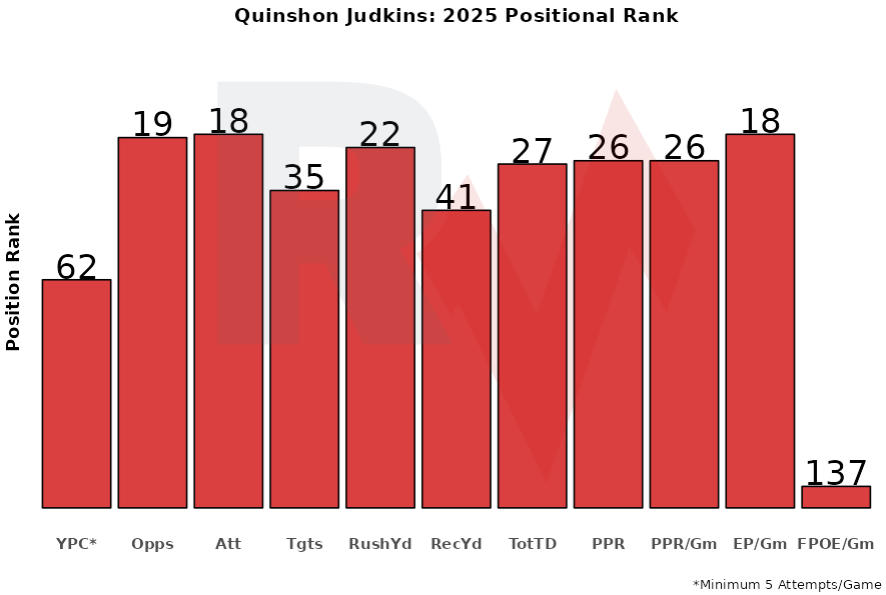
Judkins lacks the receiving profile that generally produces fantasy stars, something I covered when reviewing his rookie season:
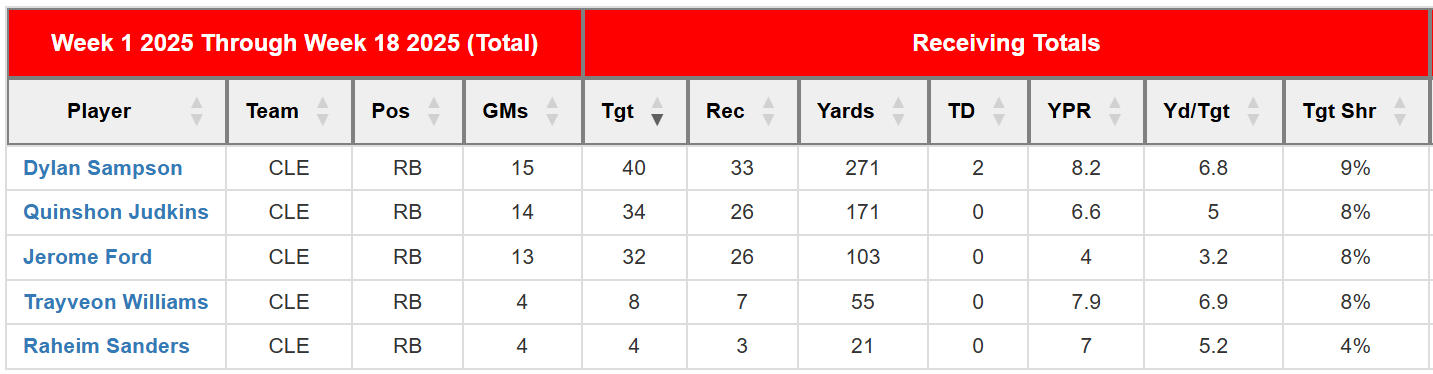
One glaring weakness in Judkins’ profile was a lack of usage as a receiver. However, Judkins was not alone in this regard. No Browns back reached a double-digit target share in 2025, which seems like a coaching oversight considering Cleveland started two rookie pocket passers for the majority of the season. Fellow rookie Dylan Sampson narrowly edged Judkins for the backfield lead in target share, but we will need to see wholesale changes in the offense before counting on either player to become a force in the passing game moving forward.
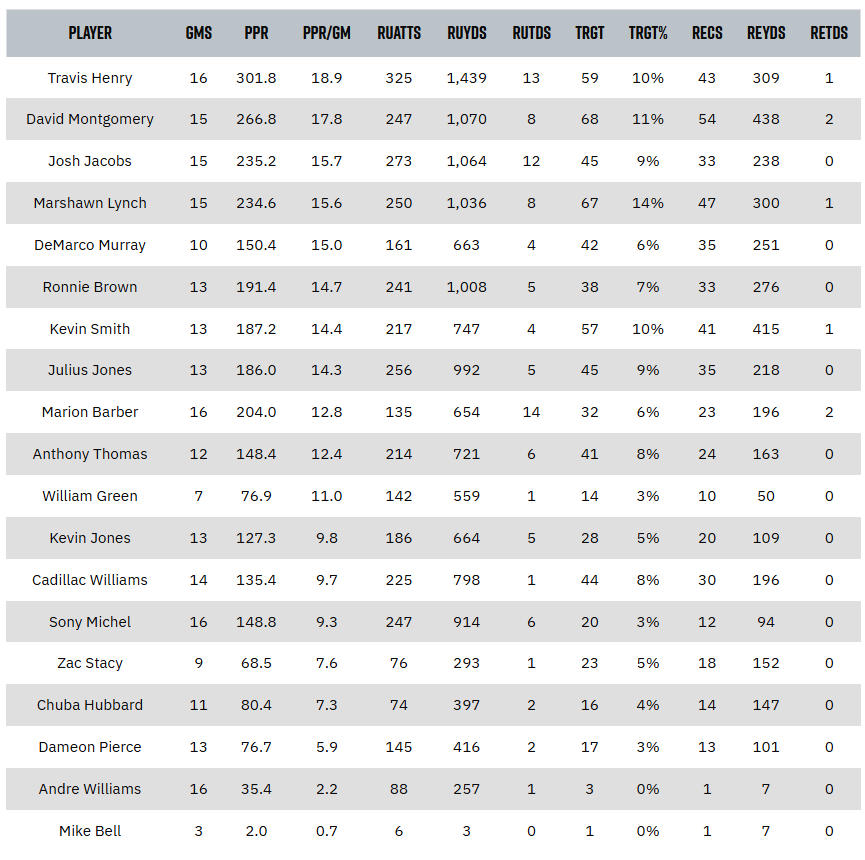
Meanwhile, Judkins’ rookie-year comps’ performances in Year 2 do not ensure that he will be taking a step forward in 2026:
It should be considered a positive that five of Judkins’ comps averaged 15.0 PPR/GM or better in their second seasons after only two players hit that mark as rookies.
However, the group averaged 0.9 PPR/GM less in Year 2. They also saw an average decrease of 1.0 expected points (EP) as rushers, while making half of the deficit back in receiving EP. While the group as a whole saw improvements in fantasy points over expectation (FPOE) per game as both rushers and receivers, they still sat in the negative overall in both metrics. Only five of the 19 backs posted positive FPOE as rushers in their second seasons, while six finished with positive efficiency as receivers.
While Judkins should earn a healthy workload for the Browns this season, he is not the type of back that has a smooth path to fantasy stardom. If I can swap him out for any of Jeremiyah Love, Fernando Mendoza, Makai Lemon, Carnell Tate, Jordyn Tyson, or Kenyon Sadiq, I’m taking the opportunity to do so.
Dynasty Managers Need to Act Now to Take Advantage of These 6 Mispriced Running Backs
While we shouldn’t be afraid to sell a young player who may be overvalued, this is also the same demographic we will generally be looking to acquire. So, it should come as no surprise that my top RB target is also heading into his second season. However, the big difference between this Year 2 back and Judkins is that the former has the dynamic skill set to offer overall RB1 upside:
Omarion Hampton
RV Triflex Rankings Value: 2 R1
2026 Rookie Draft Market Value: 1.02 and 3.02
2027 Picks Market Value: 1 R1 and 1 R2
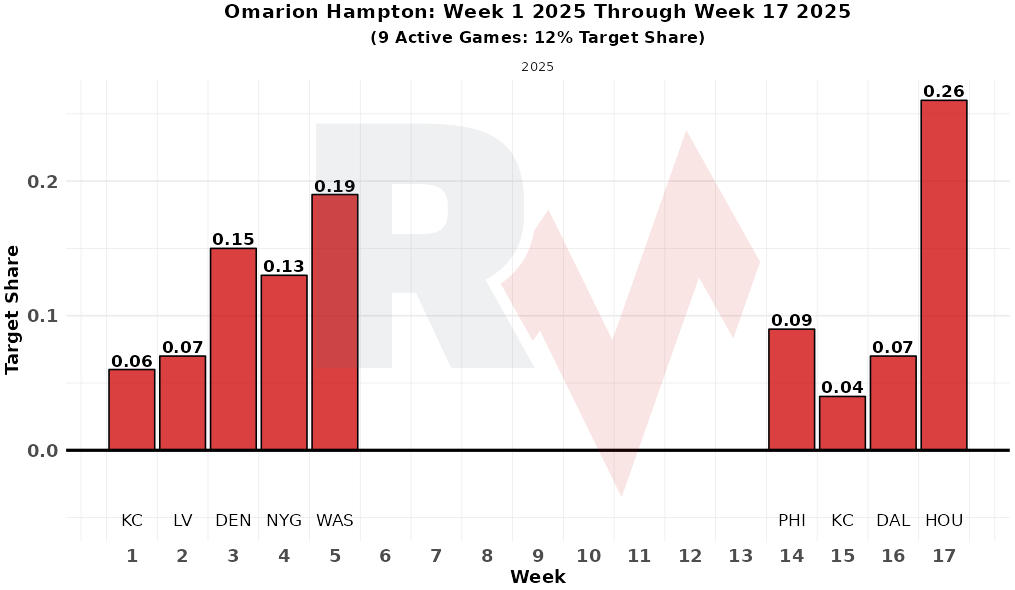
Hampton is another player whose Year 1 profile I dove into during our rookie review series. Despite an NFL debut that was hindered by multiple injuries, Hampton still averaged 15.1 PPR/GM. I laid out some of the finer points of his rookie year in my write-up from February:
After Omarion Hampton became one of only a handful of college running backs to earn Round 1 draft capital in the past decade, hopes were high that he would become an NFL bell cow out of the gate. He kicked off his career with two underwhelming performances,but once Najee Harris went down in Week 3, a switch flipped for Hampton.
Over the next three games, the Chargers’ rookie averaged 21.8 PPR per game before suffering a fractured ankle that landed him on IR until Week 14. But prior to going down, Hampton was putting on a show. He averaged 5.6 yards per carry across 43 attempts. Not only a force on the ground, Hampton displayed his receiving acumen as well, garnering a 16% target share and averaging 6.0 targets for 5.7 receptions and 40.7 yards per game through the air.
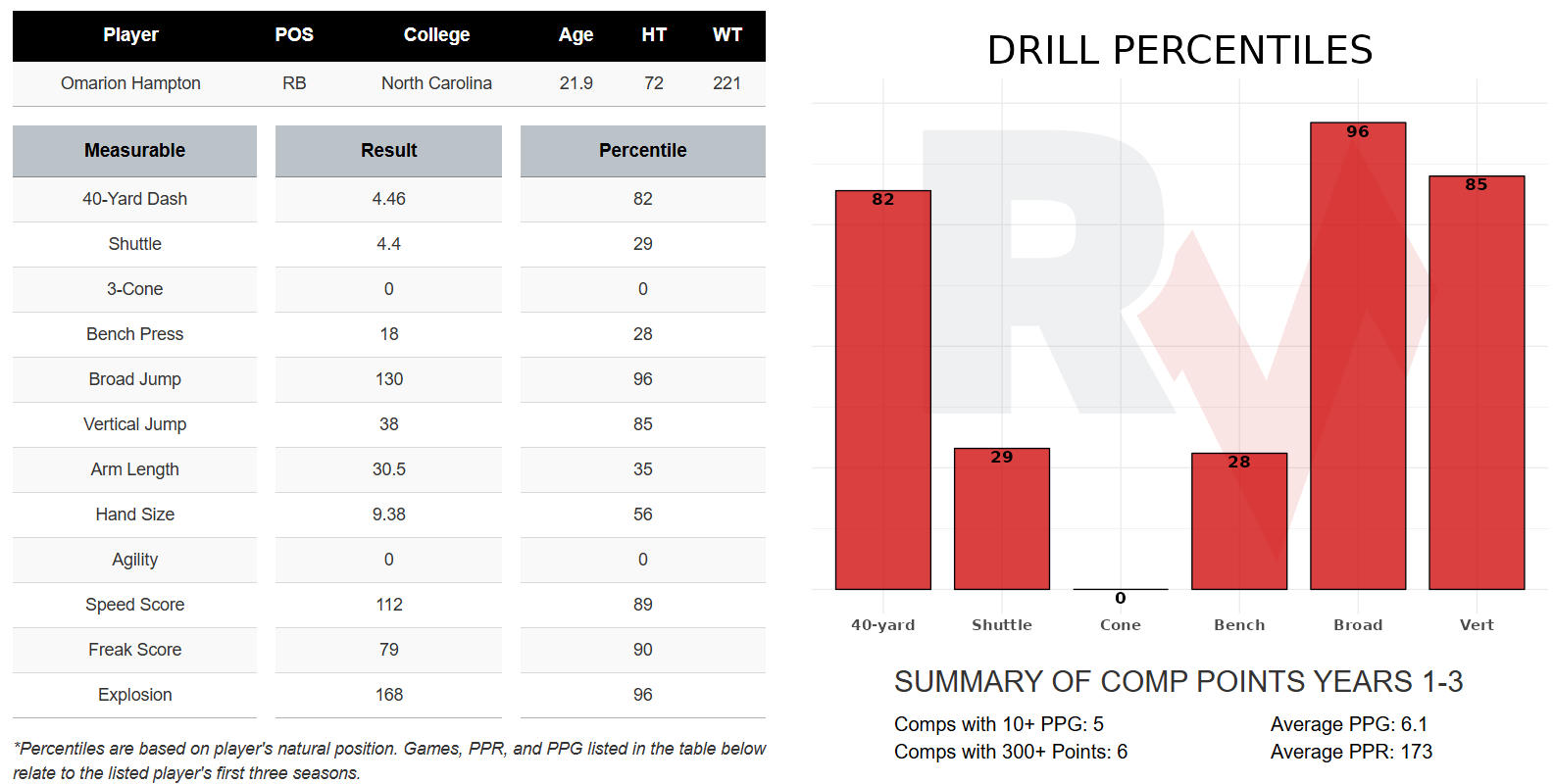
Early in the year, Hampton’s impressive combine results were already transferring over to the field, resulting in him looking like a superstar in the making.
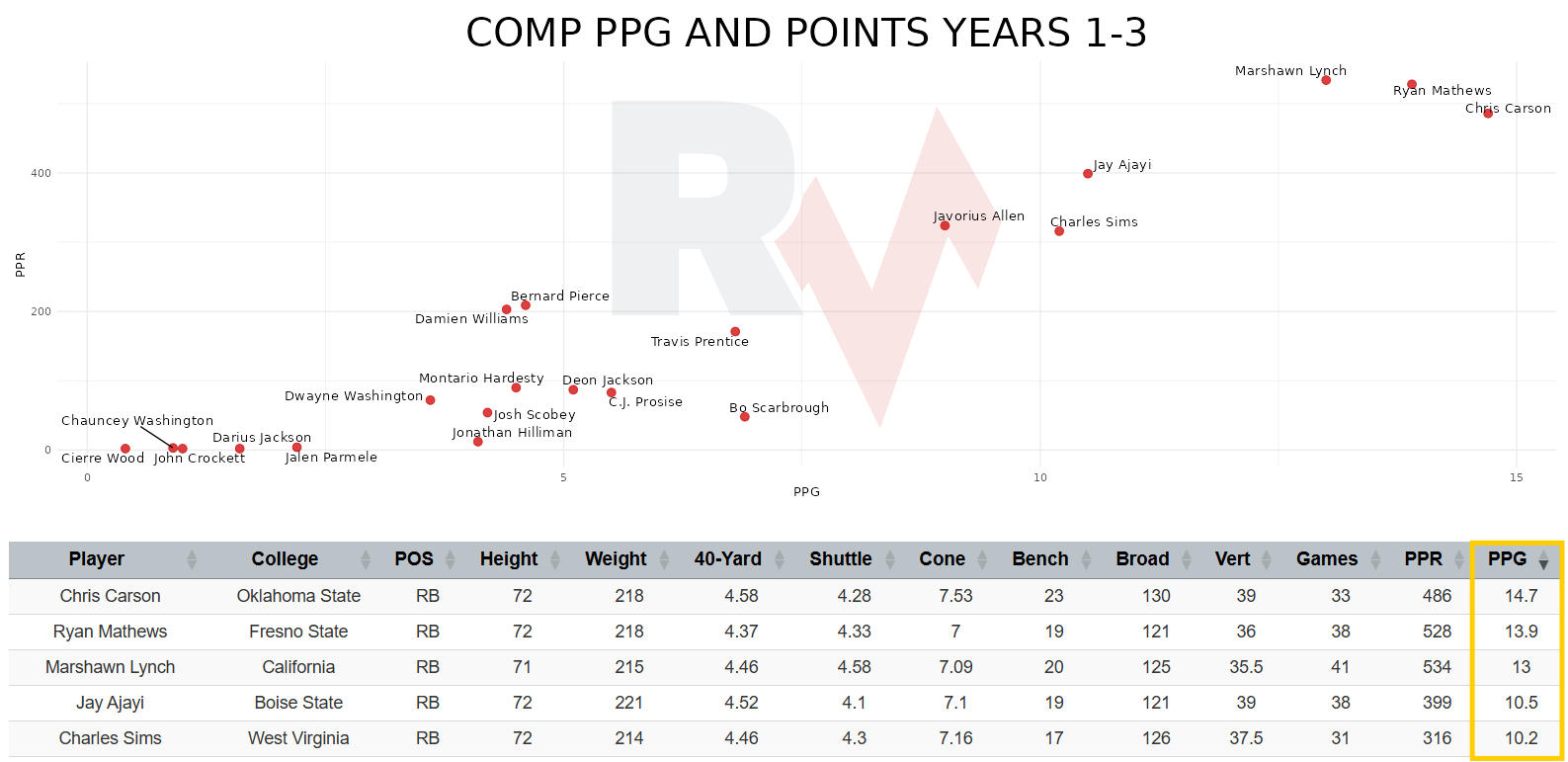
And when we look at Hampton’s high-end comps from the Workout Explorer, his 15.1 PPR/GM as a rookie is the best of the bunch.
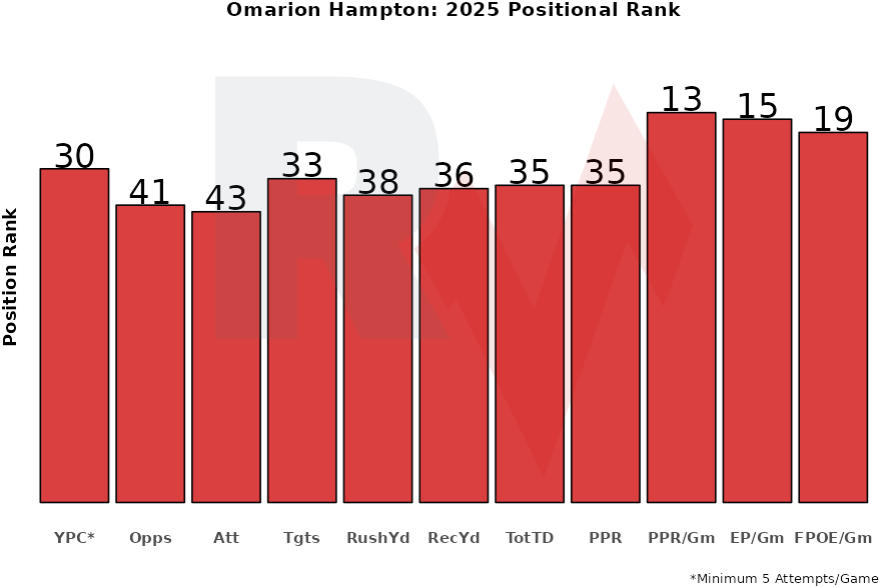
In fact, Hampton finished as a borderline RB1 on a PPR/GM basis, while also finishing 19th at the position in fantasy points over expectation (FPOE) per game.
Even after Hampton sat out for eight weeks, he averaged 14.7 PPR/GM over the final four games of his rookie season. Despite playing fewer snaps than Kimani Vidal over that span, the rookie doubled up Vidal in touches — 70 to 35 — outscoring the second-year back 58.7 PPR points to 18.3.
To recap:
Draft Capital? Check.
Athleticism? Check.
Receiving Ability? Check
Efficiency? Check.
Another thing Hampton has going for him is an upgraded supporting cast, both on the sidelines and on the field:
Hampton also has several other positive factors working in his favor, specifically the addition of Mike McDaniel as offensive coordinator and the (hopefully) healthy returns of bookend tackles Rashawn Slater and Joe Alt.
Back in 2023, McDaniel was the architect of the league’s top offense (sixth in rushing, first in passing) before the wheels started to fall off in Miami the following year. An argument can definitely be made that McDaniel brought out the talent he had available to him, but once injuries, a thin roster, difficult personalities, and declining play surfaced all at once, it became difficult to cover up the cracks in Miami.
The Chargers faced plenty of injury struggles in 2025, especially across their offensive line. But if Slater (eighth in PAR among left tackles in 2024) and Alt (fifth in PAR among right tackles in 2024) can return to form, and McDaniel builds a run game that plays to the strengths of the Chargers’ roster, it is reasonable to project Hampton to build upon his already impressive per-game numbers from 2025.
While the two-year, $9.3M signing of Keaton Mitchell in free agency is noteworthy, the 191-pound former Raven does not have the size to be more than a complementary piece to the workhorse potential that Hampton brings.
For dynasty managers in need of RB help, Hampton is an intriguing option. He truly possesses overall RB1 upside, which is something that is not available in the 2026 class outside of Jeremiyah Love. Unless you currently own the 1.01, chances are slim that you will have a shot to land the Notre Dame star. However, I believe Hampton offers essentially the same upside, and it may not take much more than an early 2026 R1 to get a deal done. If that proves to be the case, I’m happy pushing my chips in on Hampton.

Wide Receivers
Another important characteristic of successful dynasty managers is knowing when to cut bait, even when the player in question was formerly a personal favorite. While I will continue to hope that the top sell candidate from the wide receiver edition of the series succeeds, it’s probably time for me to admire him from afar:
Garrett Wilson
RV Triflex Rankings Value: 1 R1
2026 Rookie Draft Market Value: 1.03
2027 Picks Market Value: 1 R1+
Moving Wilson for the 1.03 would almost guarantee that you have a chance to select either Carnell Tate or Makai Lemon in this year’s rookie draft. When the 2026 season starts, Tate (born in 2005) and Lemon (2004) will both be at least four years younger than Wilson (2000). The rookies could also find themselves in more favorable fantasy environments than the Jets’ passing game.
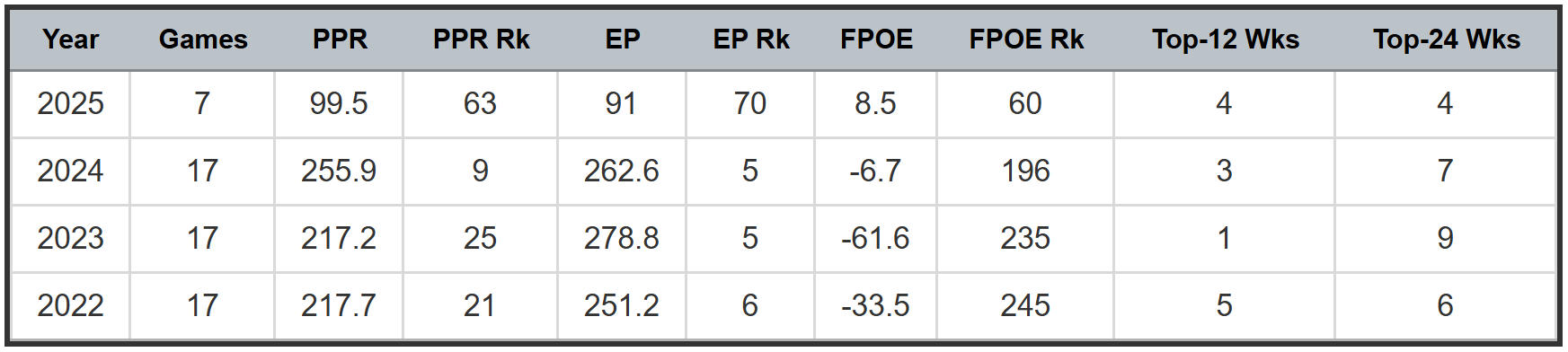
Wilson faced yet another lost season in New York in 2025, but there were some signs of progress. Most notably, he finished the season with positive fantasy points over expectation (FPOE) for the first time in his career.
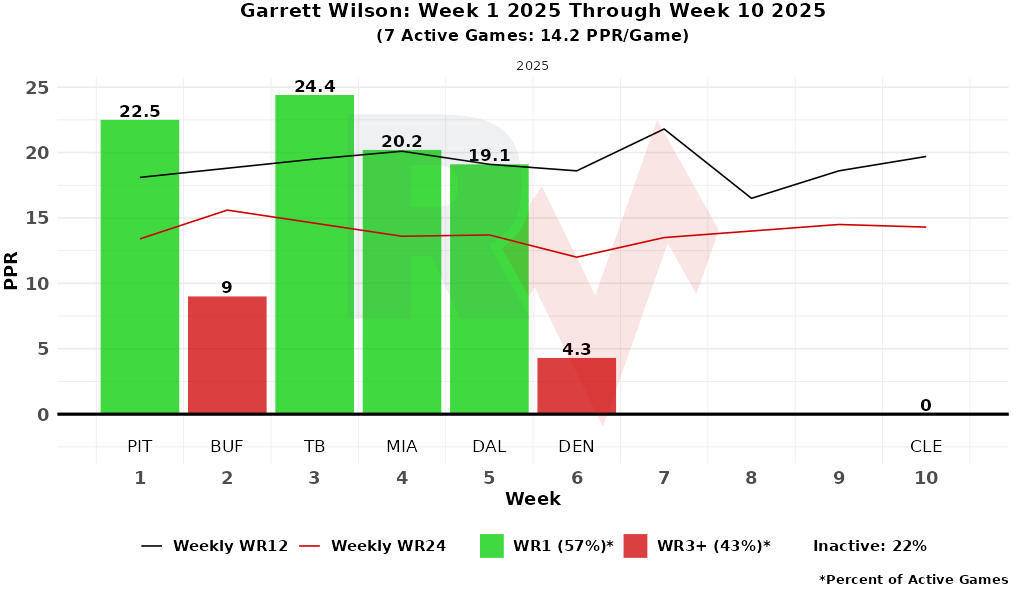
Wilson got off to a quick start, ranking as the PPR WR5 through five weeks. Unfortunately, disaster struck against the Broncos in Week 6, when a knee sprain forced him to miss games for the first time in his NFL career. He attempted to return in Week 10 but was ultimately shut down for the year shortly thereafter.
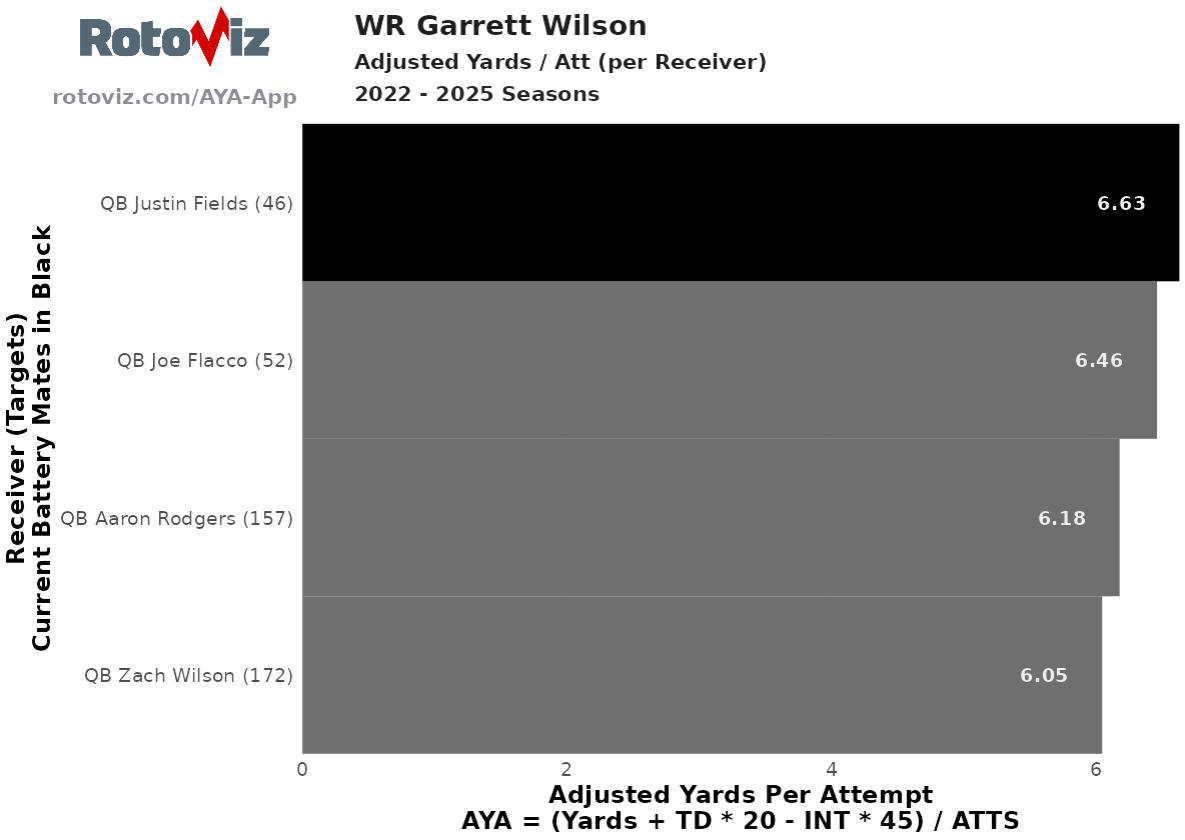
Despite Wilson having the best adjusted yards per attempt (AYA) of his career catching passes from Justin Fields, his numbers were still a bit underwhelming. This has been a consistent trend across his career, and it is fair to wonder if this is simply the player he will always be.
Now, Geno Smith comes to town as a new band-aid for the Jets’ depth chart, presumably until they can select their QB of the future in the 2027 draft. While it is fair to expect Smith to be an upgrade over the QB play the Jets had in 2025, how much of an upgrade is debatable.
To be clear, I do like Wilson as a player. But there is a decent chance that the Jets’ 2026 season goes off the rails in a hurry. By the time Wilson enters 2027 with another potential franchise signal caller, he will already be 27 years old. And unless that QB proves to be an instant success — assuming he is even a success at all — Wilson could be heading out of his prime before he ever gets the chance to fully deliver on his potential.
This mindset makes Wilson a pretty straightforward sell. There is a near certainty that moving Wilson for a 2026 R1 will allow dynasty managers to pick up a WR prospect who has just as much upside as Wilson had coming out of Ohio State. Gambling on a 2027 R1 plus a sweetener could end up being even more profitable.

It’s Time to Go Big or Go Home When Trading For Wide Receivers in Our Dynasty Leagues
However, one down season obviously isn’t a career death sentence. Things get increasingly optimistic for a rebound when circumstances out of a player’s control lead to a decline in production. With this in mind, I’m expecting a big bounceback for the entire Minnesota receiving corps now that they have a (presumed) functional QB in place:
Justin Jefferson
RV Triflex Rankings Value: 3 R1
2026 Rookie Draft Market Value: 1.01
2027 Picks Market Value: 1 R1, 1 R2, and 1 R3
This one is pretty simple: we want to buy elite talents when we can get them at a discount.
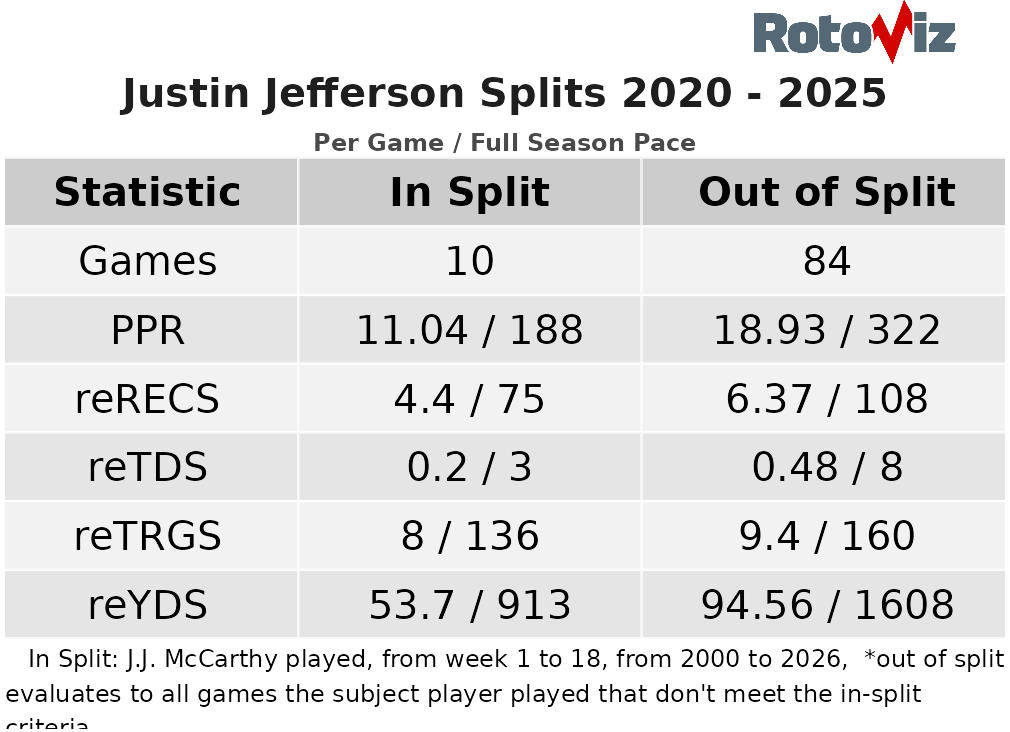
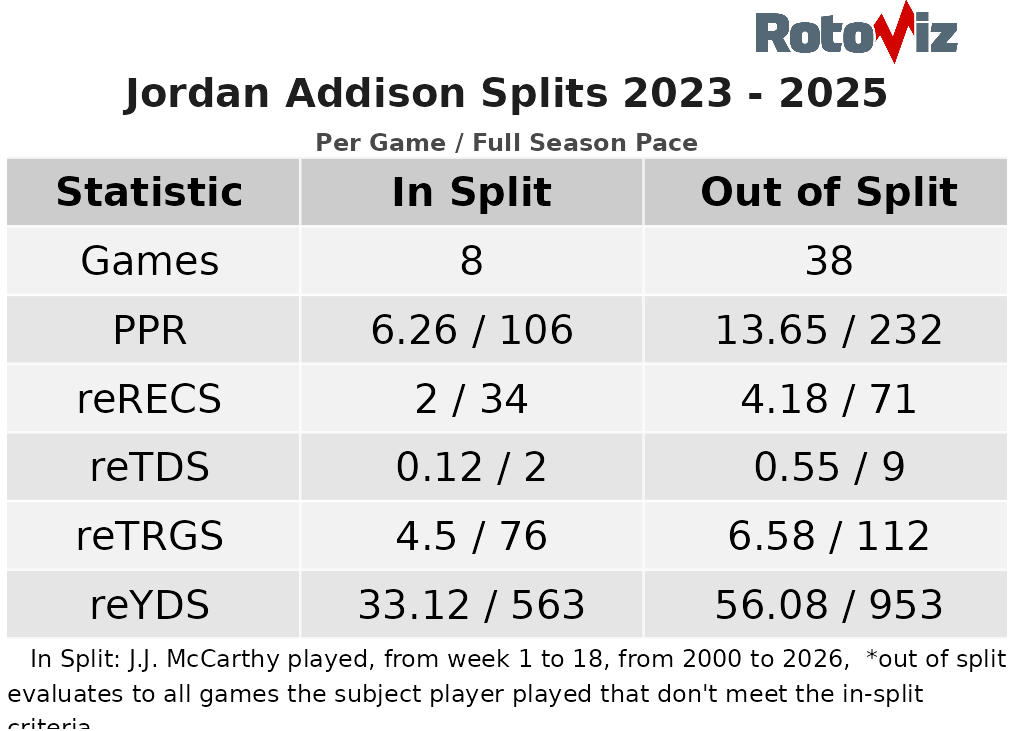
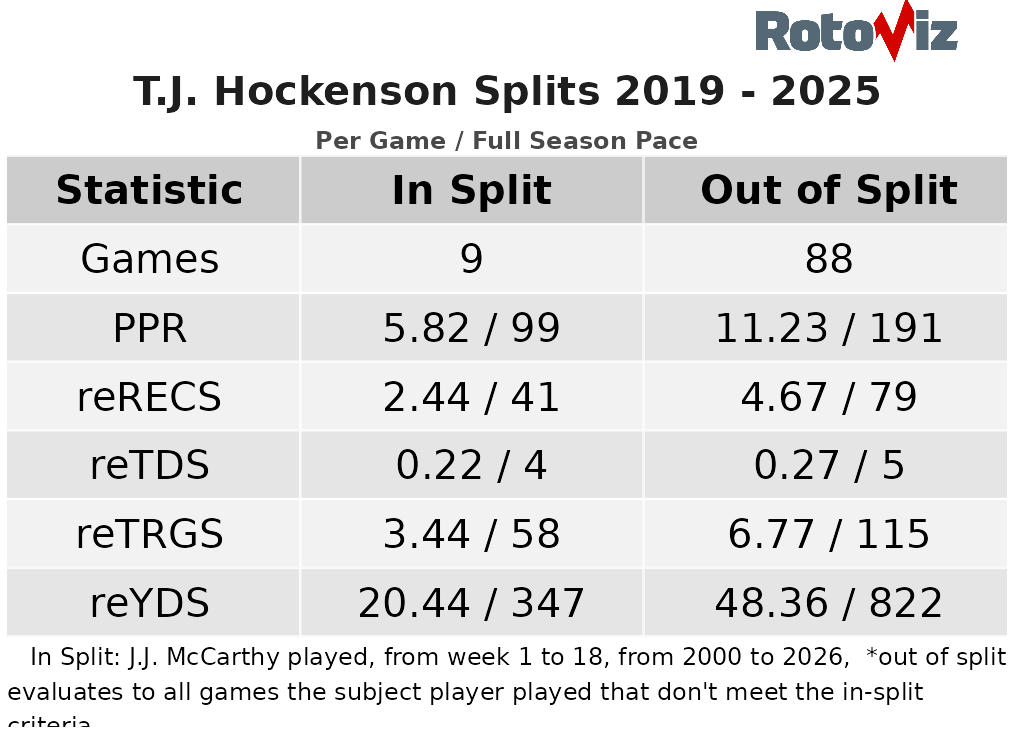
J.J. McCarthy absolutely throttled the fantasy value of the entire Minnesota passing game last season. While the marriage between the Vikings and Kyler Murray isn’t guaranteed to work out, I felt confident in declaring it a massive upgrade when covering the signing earlier this month:
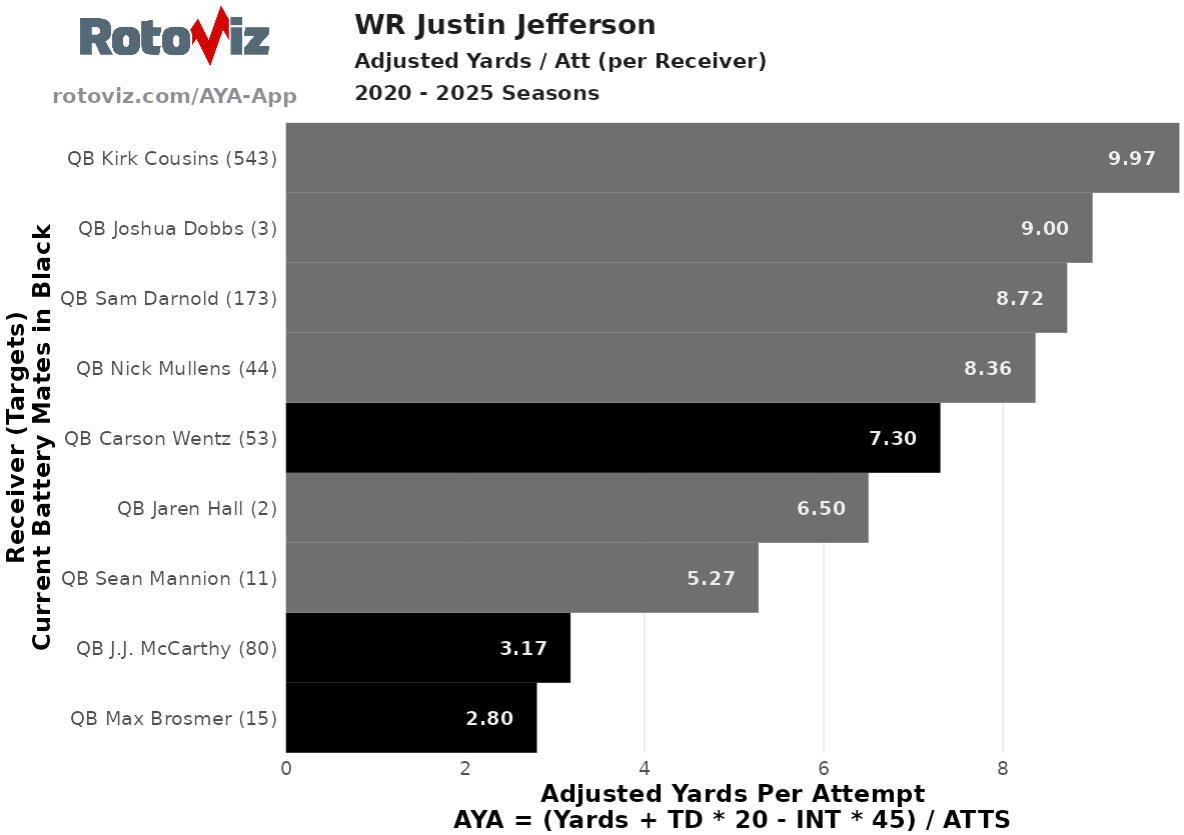
[Kevin] O’Connell has worked plenty of magic during his time in Minnesota, resuscitating the career of Sam Darnold while also squeezing every last bit of talent out of career journeymen like Nick Mullens, Joshua Dobbs, and Carson Wentz. But in 2025, O’Connell met his match in McCarthy, who single-handedly neutered the fantasy value of one of the league’s most talented receiving corps.
On average, the Vikings’ top three pass catchers scored 6.9 fewer PPR/GM with McCarthy compared to their career averages without him. To tie a bow on just how bad McCarthy was last year, if we look at the 46 QBs who attempted more than 100 passes last season, the second-year QB finished in the bottom five in completion percent (58%; t-third), catchable target rate (74%; t-fifth), on-target rate (60%; t-fourth), and pressure-to-sack rate (25%; t-second). But one interesting tidbit that may be getting lost in the shuffle was that McCarthy’s 8.6 aDOT was the second-highest in the group, which draws into question whether O’Connell continued to urge his QB to attack downfield or if the young signal caller made that decision on his own. Wentz’s 7.3-yard aDOT (t-23rd) across his 157 pass attempts last year would point to the latter being true.
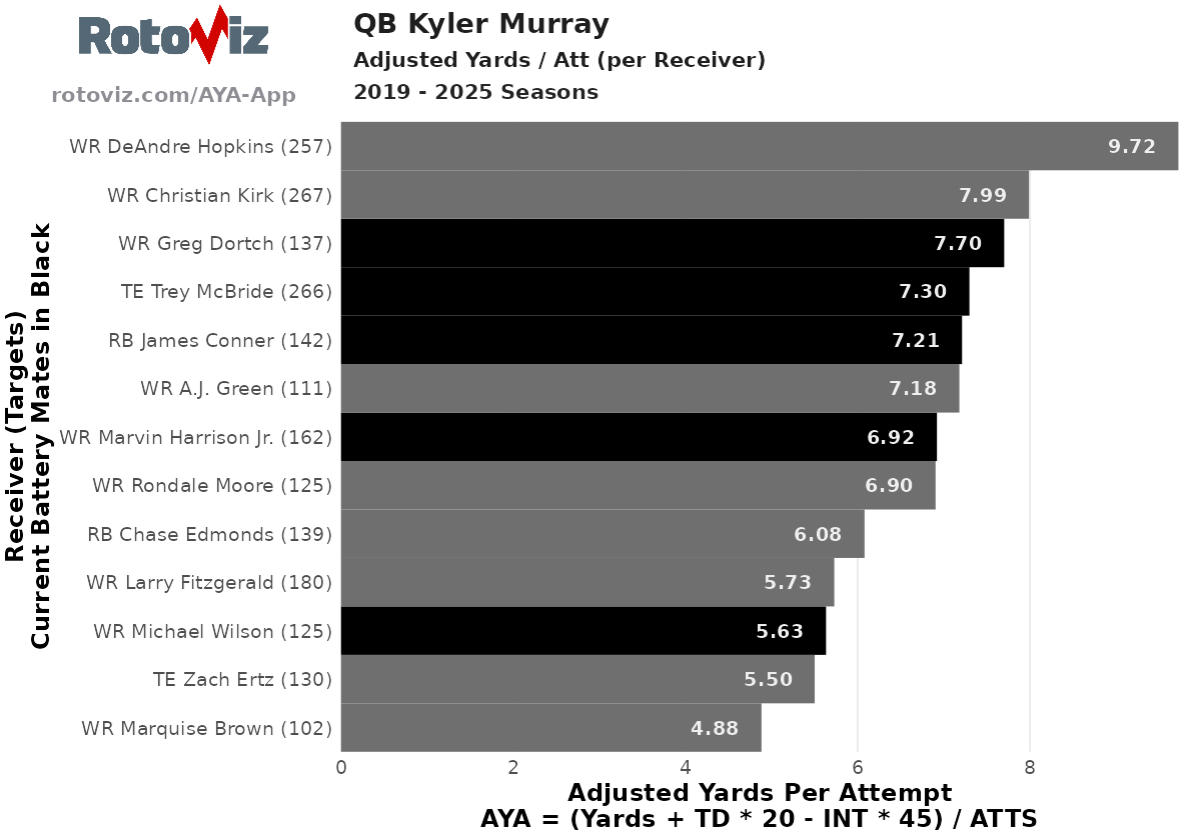
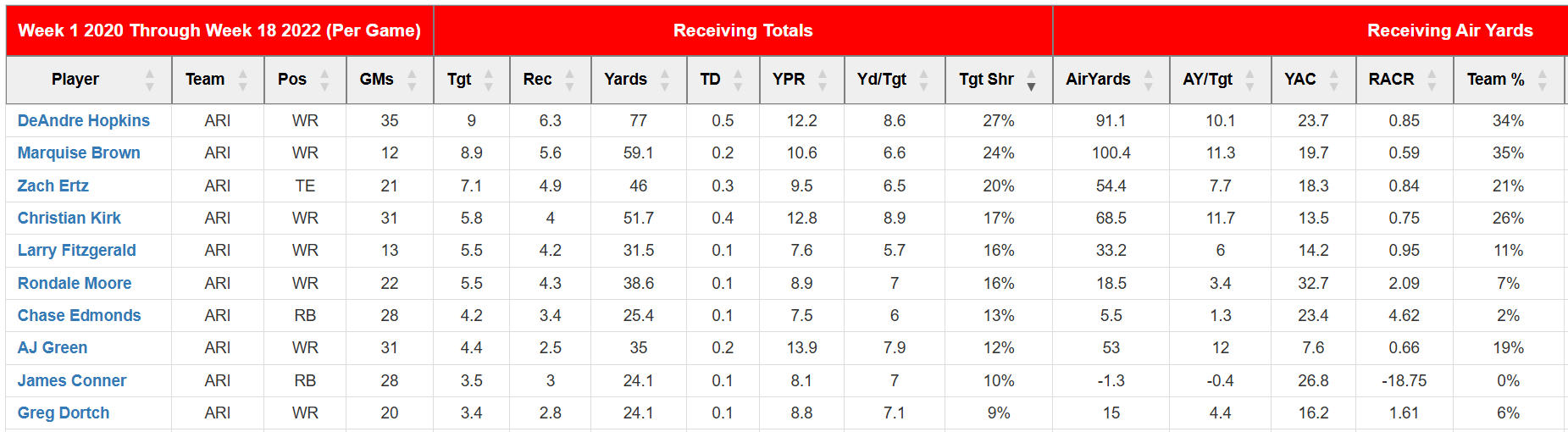
Moving on to Murray’s fit in Minnesota, his arrival should be seen as a net positive for all of the Vikings’ receivers. Justin Jefferson, in particular, could be set to see a return to glory. The only true superstar WR Murray ever had at his disposal in Arizona was DeAndre Hopkins. From 2020 through 2022, Hopkins earned a 27% target share while creating the most efficient connection Murray has had with any receiver during his career.
It is important to note that Zach Ertz, Hollywood Brown, Christian Kirk, and Larry Fitzgerald all shared the field with Hopkins at different points of his Arizona tenure, so it is not as if he was the only game in town.
Even with the uncertainty Jefferson faced earlier this offseason, I struggled to push him out of the top tier of my dynasty rankings. I eventually settled on him as the top player in Tier 2, but took the first opportunity to push him back into the top tier once Murray landed in Minnesota.
Prior to 2025, Jefferson never finished lower than ninth among WRs in PPR/GM. If we remove his 2020 rookie season from the equation, that number rises to fifth. Unfortunately, we found out in 2025 that Jefferson is not QB-proof despite kicking off his career on a GOAT-level trajectory. However, the silver lining is that it is difficult to imagine the Vikings ever making the same mistake again.
Jefferson will turn 27 in June. It is still realistic to believe that he can offer fantasy managers at least three to four more years of elite production. With that in mind, the current cost to acquire him should be money well spent.
Tight Ends
It is also important to note that it is not always imperative to move a “sell” at all costs. Sometimes, team context matters more than moving a player. And that was precisely the case when addressing the highest-rated sell candidate in the tight end installment of the series:
Tucker Kraft
RV Triflex Rankings Value: 1 R1
2026 Rookie Draft Market Value: 1.04
2027 Picks Market Value: 2 R2
I love Kraft’s talent, and that has been the case ever since he arrived in Green Bay. And while his knee injury doesn’t necessarily scare me, the Packers’ passing offense does.
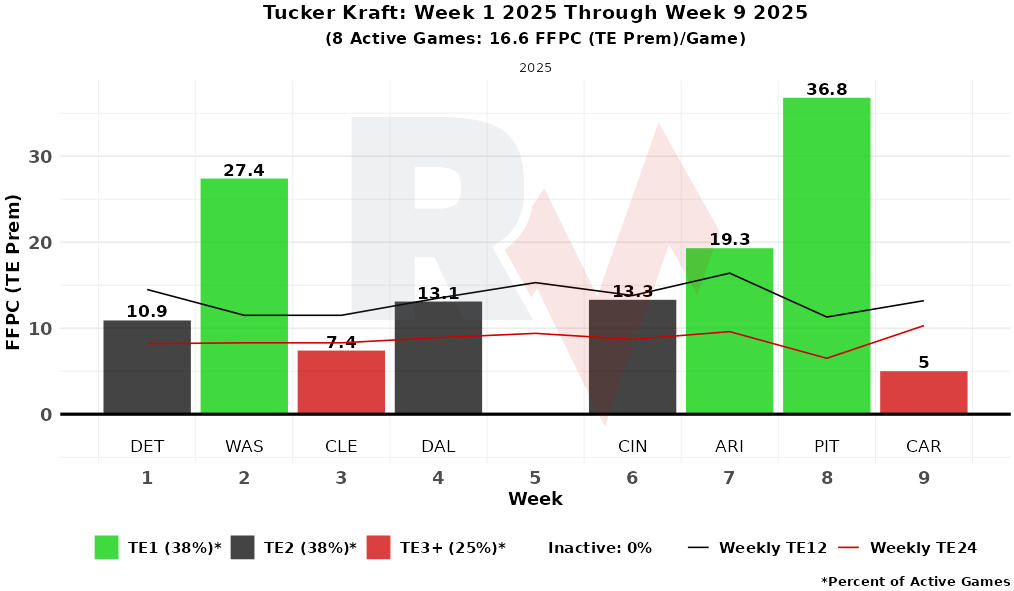
Kraft was on an absolute rampage last season before tearing his ACL in Week 9. Prior to going down, Kraft ranked as the TE4 in TE-premium scoring and was averaging 18.3 fantasy points per game.
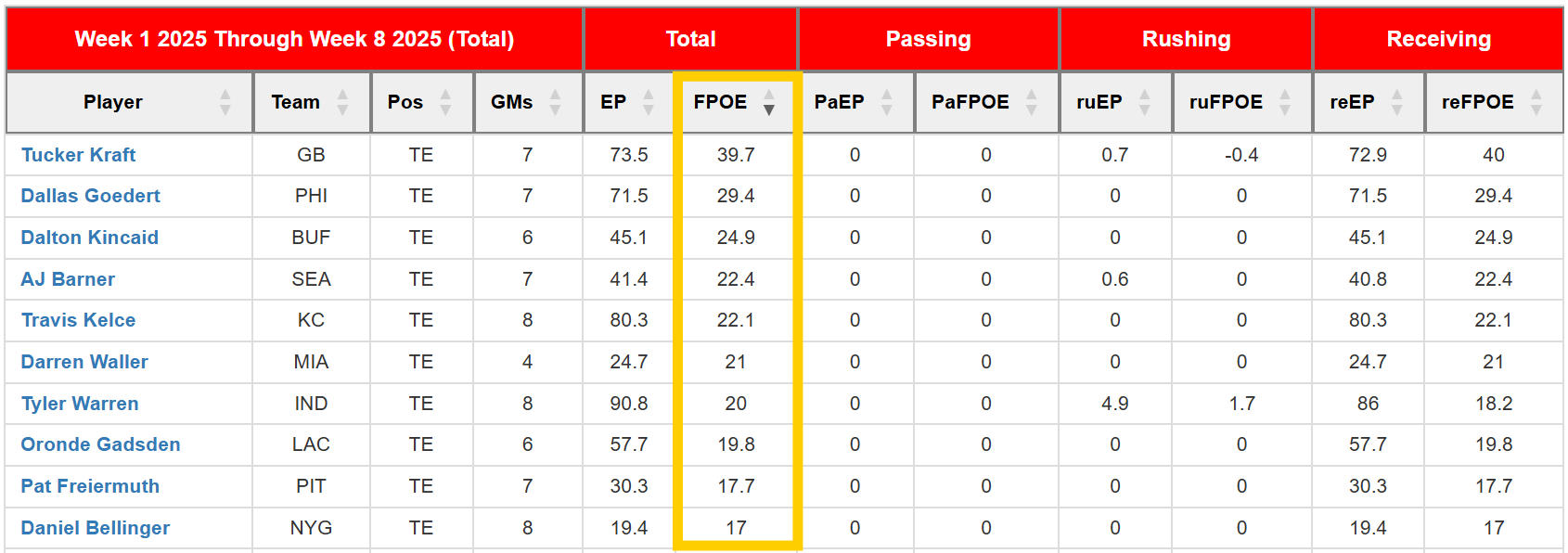
Not only that, Kraft was leading the position in fantasy points over expectation (FPOE) by a healthy margin and still finished third overall despite missing the final nine games of the season.
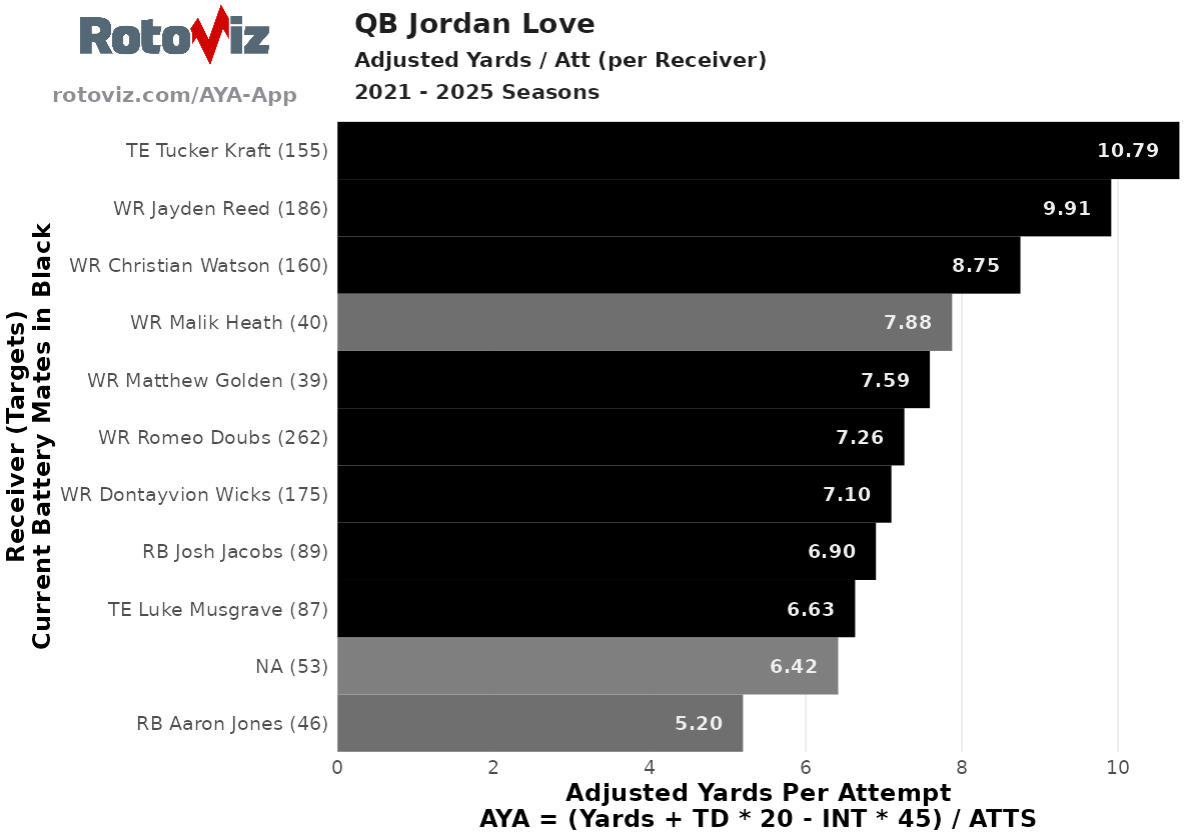
This level of efficiency is nothing new for Kraft. Jordan Love has had greater success throwing to Kraft on a per-attempt basis than any other receiver he has played with in Green Bay.
Once again, the Packers’ low-volume passing offense will have no shortage of mouths to feed in 2026. Even with Romeo Doubsmoving to New England, Matthew Golden and Jayden Reed are ready to step in for him. Additionally, much of Kraft’s 2025 success came with both Reed and Christian Watson out of the lineup, a scenario that is unlikely to happen again.
For a player who is facing as much uncertainty as Kraft is, the 1.04 in this year’s rookie draft is a pretty appealing return. And for dynasty managers who were able to add Kraft at a discount over the past few years, his current market price should represent a significant return on investment. But I will not be quick to part with Kraft if I am already thin at TE. Additionally, I would be apprehensive about moving him for 2027 picks, unless the deal included an R1.
Good Is the Enemy of Great: Dynasty Managers Must Show No Fear When Targeting Elite Tight Ends
When the opportunity to add an elite talent presents itself, you take it. I believe the current trade market allows dynasty managers to acquire a franchise cornerstone at a considerable discount. Namely, dynasty’s TE1, Brock Bowers:
Brock Bowers
RV Triflex Rankings Value: 3 R1
2026 Rookie Draft Market Value: 1.01 and 2.05
2027 Picks Market Value: 2 R1
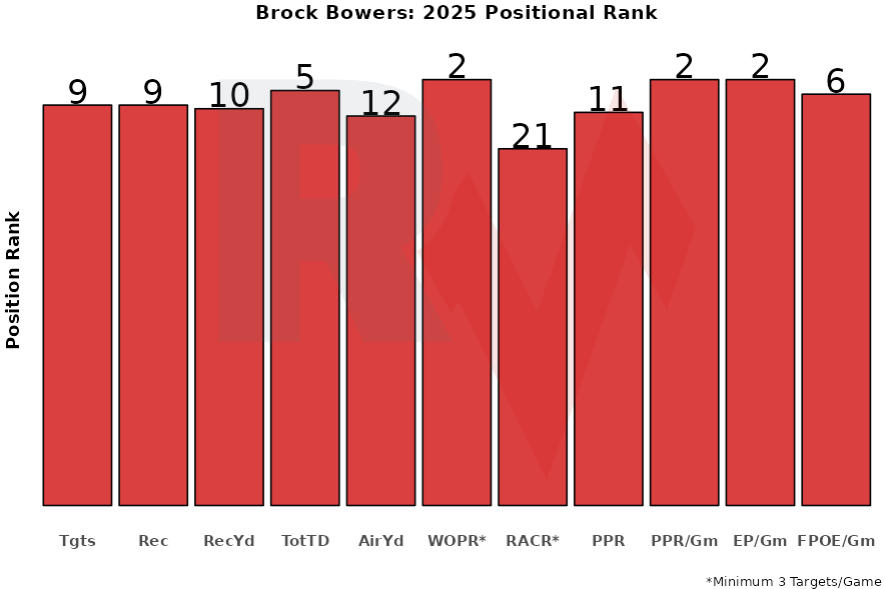
Even coming off a down year, Bowers still holds the TE1 spot on both KTC and in our rankings. Despite trying to play through a knee sprain that eventually shut him down for the year, Bowers was still one of the most productive and efficient TEs in the entire league last season.
Now he gets multiple presumed upgrades, with Klint Kubiak taking over on the sidelines and Fernando Mendoza tentatively scheduled to lead Las Vegas on the field. The Raiders have already spent big to upgrade the line in free agency by signing center Tyler Linderbaum, and more help is on the way with the healthy return of left tackle Kolton Miller. A more effective run game could turn Ashton Jeanty into a true superstar, which would mean less defensive attention focused on Bowers.
For as good as Bowers was as a rookie, he is only scratching the surface of his potential. It may not be long before he is near-untouchable in TE-premium leagues, which makes acting now vital. As I mentioned earlier, bundling a high-profile asset like [Tyler] Warren — who is actually seven months older than Bowers — would be a good start. According to KTC, pairing the Colts’ TE with the 1.05 should theoretically be enough to land Bowers. That’s a price I would be willing to pay for a shot at a decade of elite production at the TE position.
Footnotes
| ↑1 | If you are not signed up for our newsletter, please head to the bottom of the RotoViz homepage to sign up. Along with having the RotoViz Review delivered directly to your inbox, you will also receive access to tons of content that is usually only available to subscribers of the site. |
|---|


