




The RotoViz staff share their player takes and draft strategies for the 2026 season while working through superflex best ball drafts.
Studying the past is one of the best ways to understand what might happen in the future. Here at RotoViz, we have a suite of tools spilling over the brim with information to help fantasy managers study trends — both past and present — across a wide range of formats and platforms.
Recently, I set my sights on the historical trends that have led to success in the FFPC Superflex Best Ball Tournament. For those who may be unfamiliar with the format, each draft consists of 20 rounds, and starting rosters feature one quarterback, two running backs, two wide receivers, one tight end, one traditional flex spot, and one superflex spot. Scoring settings are TE-premium, meaning TEs are awarded 1.5 points per reception while every other position operates under normal PPR scoring.
Are you ready to battle for the $100,000 grand prize in the 2026 FFPC Superflex Best Ball Tournament? New users get $25 off their first FFPC team of $35 or more by using promo code 25ROTOVIZ or by following this link!

Using the Best Ball Win Rate Explorer (WRE) and Roster Construction Explorer (RCE), I was able to go back to the beginning of the contest and study the builds, stacks, and positional data that have brought the most (and least) success both in the aggregate and to each individual draft slot.
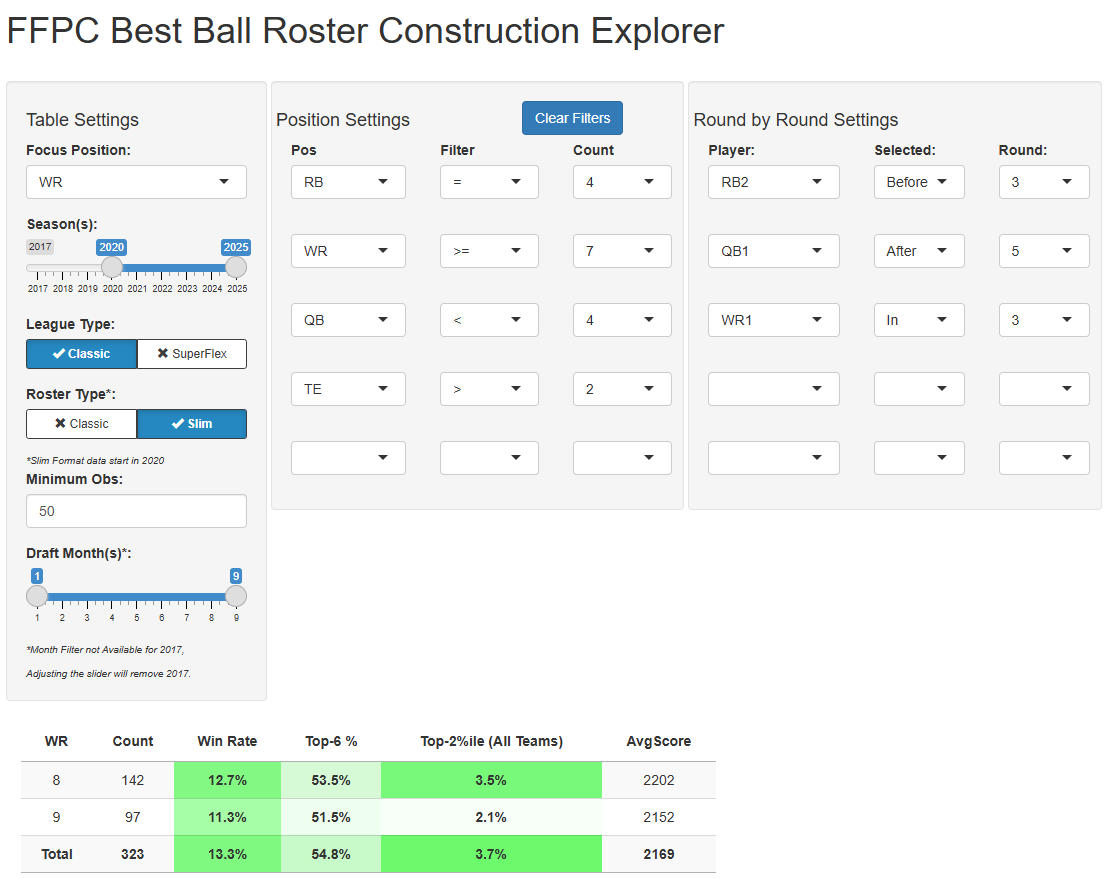
But just because a specific strategy has generally worked in the past, that doesn’t mean it will translate to the unique ADP environment that 2026 is giving us. So with that in mind, I put the research I had done to practical use in two separate FFPC Superflex Best Ball Tournament drafts to see what these principles would look like when applied to the current best ball environment.
What resulted were two builds that largely pushed back on how drafters generally approach superflex best ball drafts. At RotoViz, we’re no strangers to going against the grain, so constructing unique rosters was right in my wheelhouse.
On a related note, Blair Andrews recently pushed back against the conception that Week 17 is all that matters in best ball tournaments. In fact, he argued that it’s quite the opposite, while still approaching the subject with an air of humility and humor:
We were among the first to highlight the importance of playoff weeks in best ball tournaments, before Underdog was even a thing. Since then, it has become commonplace to prioritize Week 17 — the final week — to the point that many say, with some exaggeration, “Week 17 is all that matters.”
The idea of prioritizing Week 17 in Best Ball Mania 7 is to treat it as a one-week, 667-entry tournament. In such a tournament, you’d build a team with a lot of in-game correlation. Your quarterbacks would be stacked with (at least) one of their pass-catchers along with (at least) one of their Week 17 opponents. The hope is that the game you’ve decided to stack will shoot out, and you will be in a position to benefit from the enhanced scoring environment in the week where the prizes are biggest and correlation matters most.
This approach makes perfect sense for a one-week tournament. However, for a season-long tournament, it is suboptimal. It is a strategy designed to maximize your chances of winning the grand prize if your team makes it to Week 17. It is not a strategy designed to maximize your team’s expected value. I offer the following opinion in the same spirit as The Dissenting Costanzan: “here’s another possible way to look at things; let’s keep the conversation going.” Of course you may also choose to read my Costanzism in another way: “every instinct I have in every aspect of life . . . it’s all been wrong.”
Costanzan Instincts and the Logic of BBM7
We can’t rule out the possibility that every instinct I have is wrong, but my instinct about the structure of Best Ball Mania 7 (and other best ball tournaments), and about the importance of each round, makes some logical sense. My contention is that the regular season is far more important than any individual playoff week, and once we reach the playoffs, each subsequent week actually diminishes in importance. In short, each round depends on the rounds before it, but that dependency goes only one way and effectively ensures that the rounds that come first chronologically are also the most important.
Week 17 depends on Week 16; therefore, the results of Week 16 directly impact the expected results of Week 17. However, Week 16 depends on Week 15. Therefore, Week 15’s results impact both Week 16 and Week 17. Regular-season results, in turn, impact all playoff rounds. In other words, you can increase your expected Week 17 win rate by increasing your Week 16 advance rate, and so on, back to the regular season. But you cannot increase your Week 16 advance rate by increasing your Week 17 win rate.
While Blair’s article focused on the structure of Underdog’s Best Ball Mania 7 tournament, a similar playoff structure exists in the FFPC Superflex tournament.
In the excerpt above, Blair briefly mentions the edge that stacking and correlation can have in the playoff weeks of a large-scale tournament. But history tells us that it is possible to stack too much. When reviewing stacking data for the single-QB version of the FFPC Best Ball Tournament, I found that in recent years I had fallen into this pattern of behavior far too often.
It turns out that the path to success may be even narrower in the superflex version of the contest, especially when stacking up quarterbacks and wide receivers:
The subpar returns we see from QB1s being paired with their wideouts are pretty shocking. Only stacks featuring WR3s hit baseline win rates, although the rest of the numbers in these combinations fall short of the average returns.[1] This is in stark contrast to single-QB contests, where both WR1 and WR2 stacks led to favorable outcomes across the board.
The poor results mostly worsen when we add a second wideout to the mix. However, WR3s continue to offer some semblance of hope when combined with WR1s or WR4s, although the sample size of the latter stack in particular isn’t large enough to trust.
Before we go flying off the rails in declaring that stacking up QBs and WRs is completely overrated, we must still consider the power that the right QB-WR pairing can have in the playoff weeks of best ball tournaments. While advancing out of your 12-team league is necessary, supercharging your lineup with Week 17’s top passing game could be the move that results in a massive payday. So in that regard, it may be worth taking a slight dip in win rate if it increases your chances of coming out on top when the stakes are the highest.





Armed with a wealth of historical data, I headed into my two drafts with some firm guidelines in place. The idea was to follow the suggestions of the WRE and RCE as rigidly as possible. During the first go-round, I mostly stuck to the script. In my second draft, I was a little looser in my approach but generally deferred to the tools.
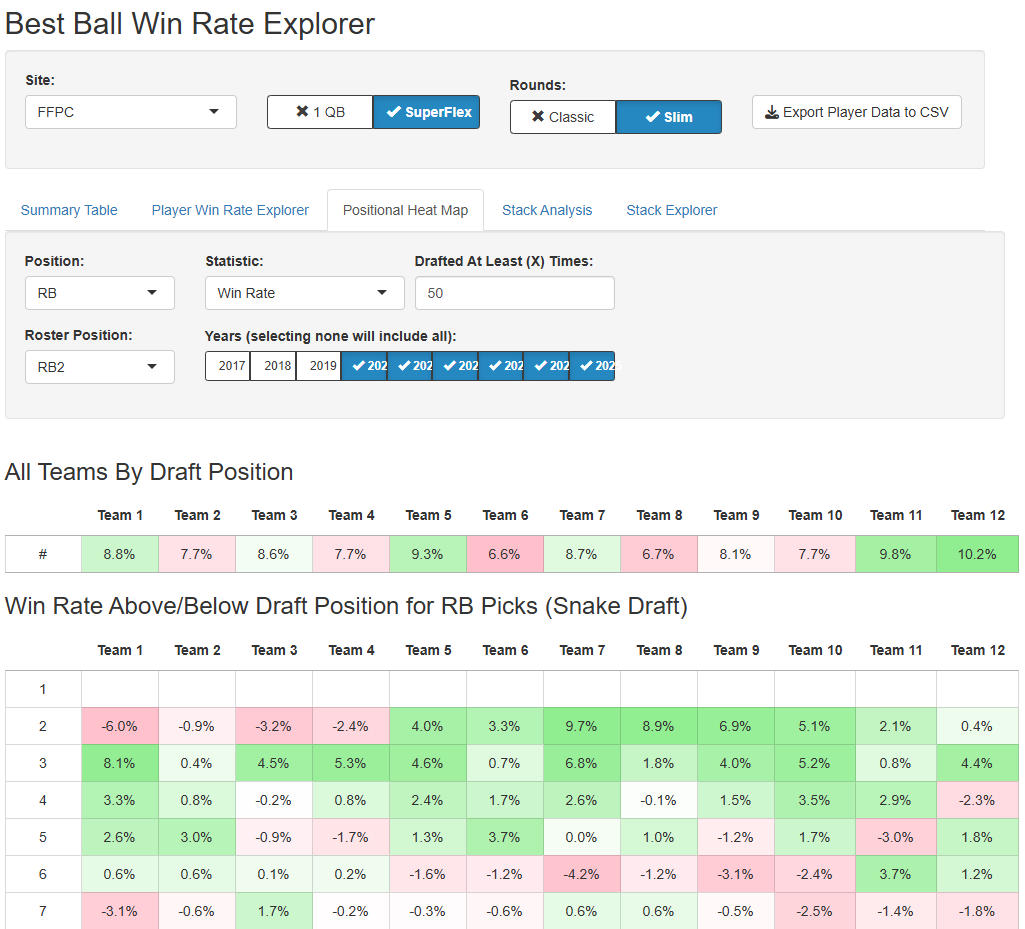
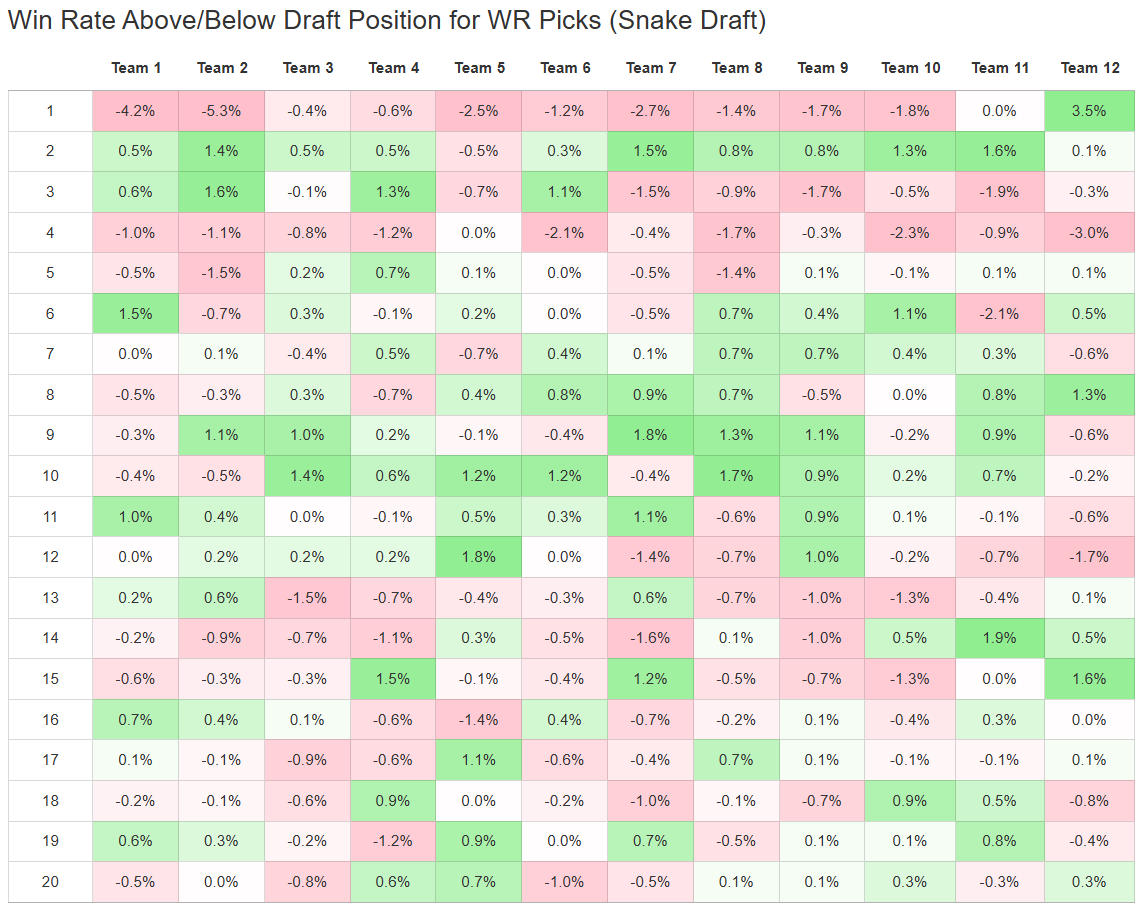
Both drafts took place on the same day, and I drew the five slot in the first and the six slot in the second. Despite being only one draft spot apart, the historical win rates of the two slots vary dramatically:
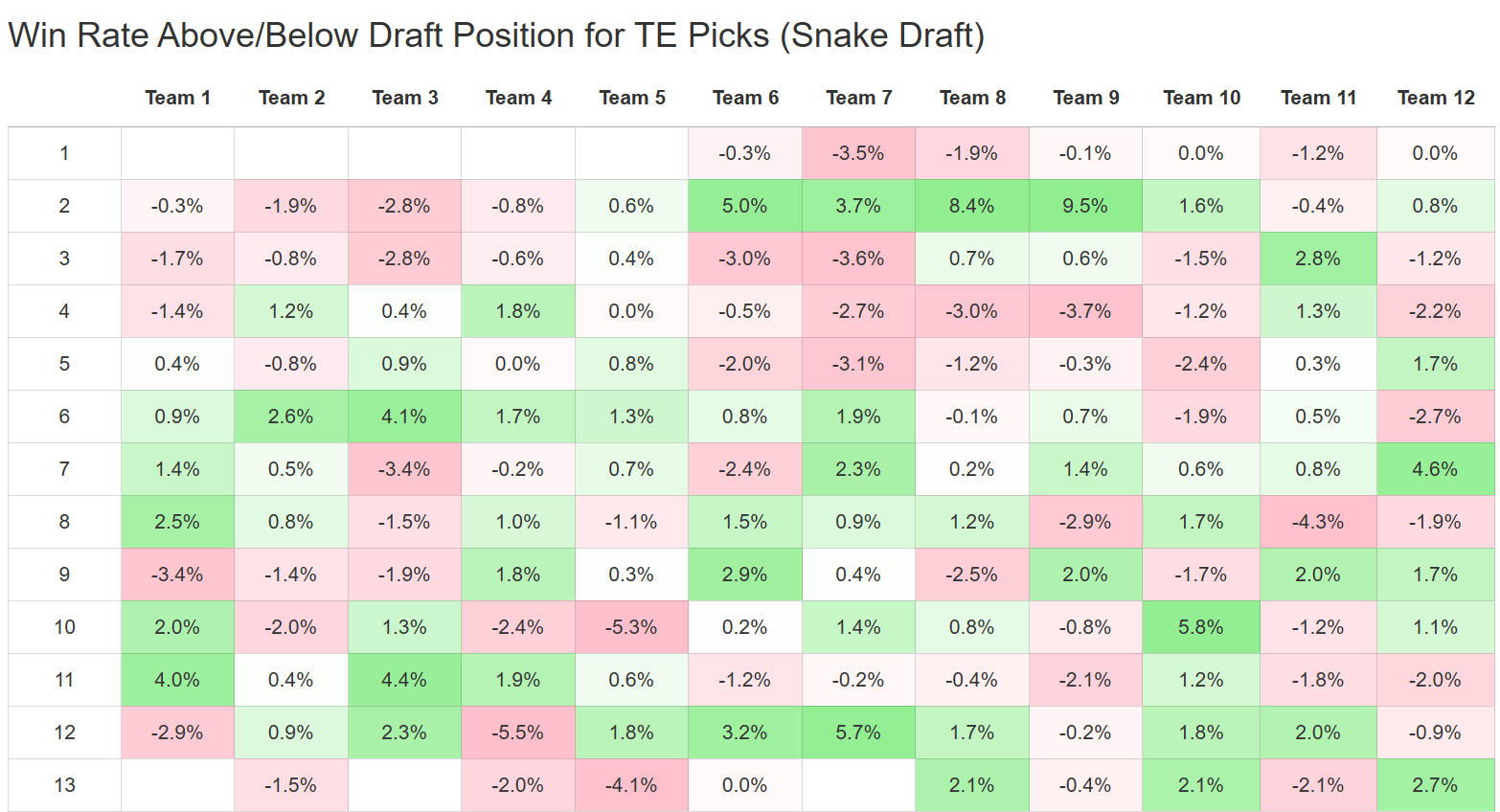
In single-QB best ball drafts, the back half of the order has had a distinct advantage in win rate over the past six years. It is refreshing to see things spread out more evenly in superflex drafts.
2020 FFPC SUPERFLEX BEST BALL SLIM WIN RATES BY DRAFT SLOT
2021 FFPC SUPERFLEX BEST BALL SLIM WIN RATES BY DRAFT SLOT
2022 FFPC SUPERFLEX BEST BALL SLIM WIN RATES BY DRAFT SLOT
2023 FFPC SUPERFLEX BEST BALL SLIM WIN RATES BY DRAFT SLOT
2024 FFPC SUPERFLEX BEST BALL SLIM WIN RATES BY DRAFT SLOT
2025 FFPC SUPERFLEX BEST BALL SLIM WIN RATES BY DRAFT SLOT
Even as we break things out by individual year, the win rates by draft position are all over the place. This speaks to the unique draft environment each year presents, which should give us confidence that we can emerge in our leagues regardless of where we fall in the order if we lean into the edges we have at our disposal.
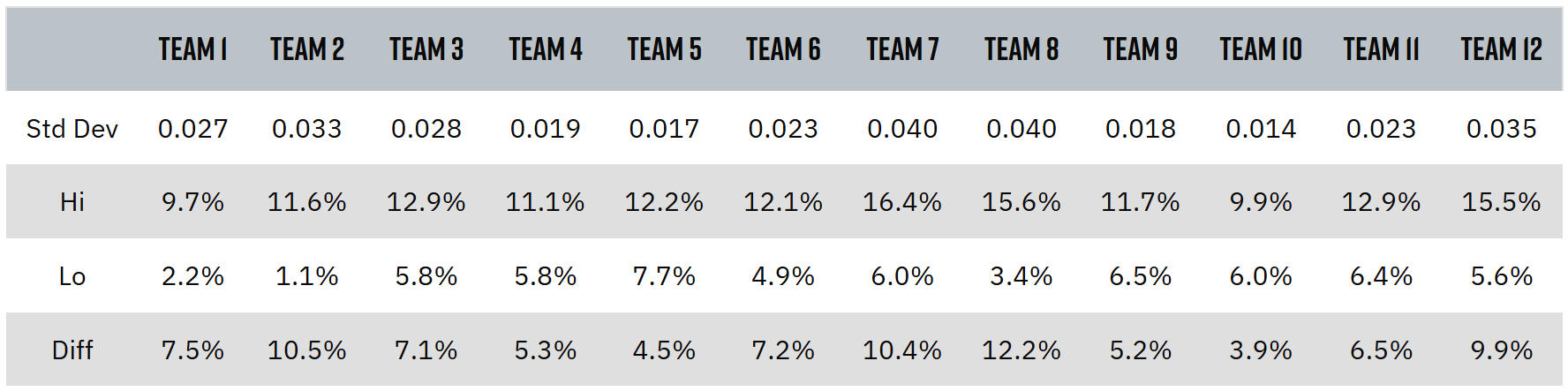
If we’re really hunting for some semblance of consistency, the 4, 5, 9, and 10 slots have the smallest standard deviations in their six-year win rates. Still, I don’t think we should read too much into it, especially with only six data points available for each draft slot.







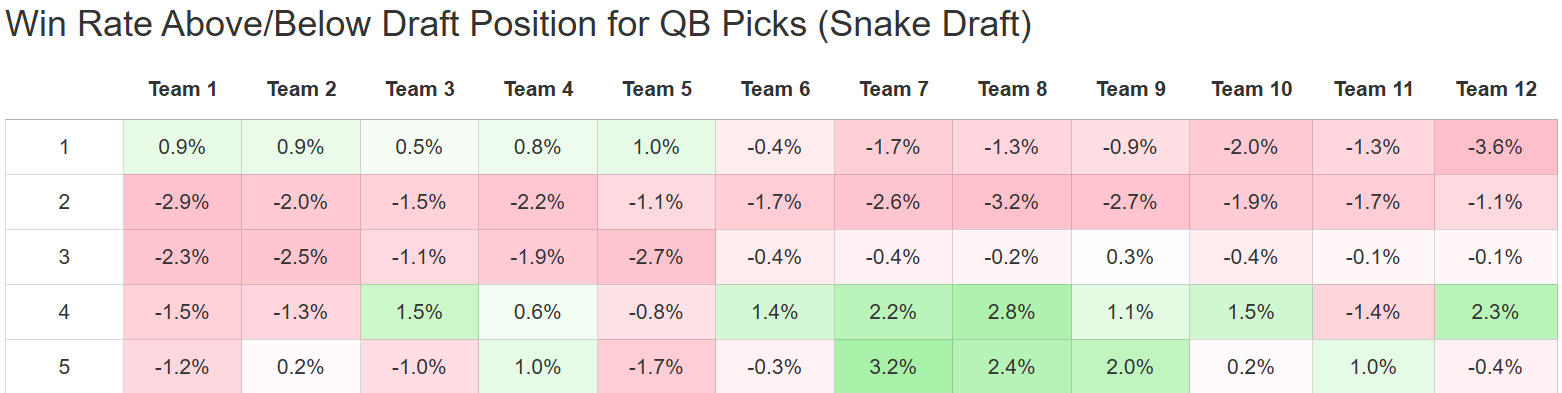
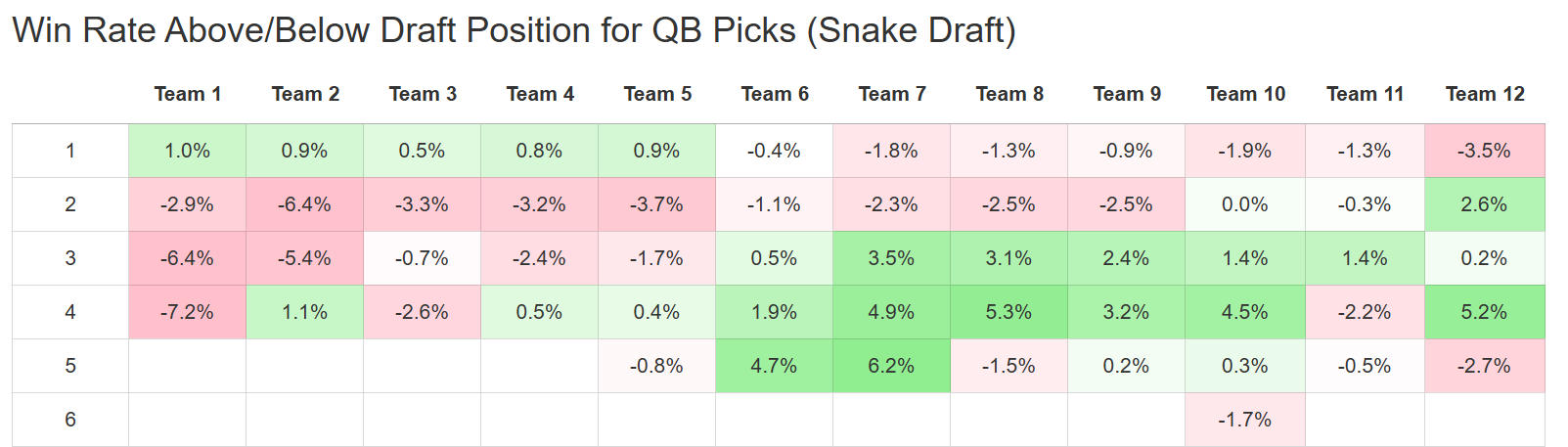
Perhaps one of the reasons that drafters in the six-hole have seen such a dramatic fall-off is the desire to chase QB points in Round 1. Outside of the top five slots, drafters have not seen positive returns when drafting a QB with their first pick. In most cases, the longer teams in the back half of the order waited to draft their first signal caller, the better their returns were:
In the previous installment of the series, we saw pretty disheartening evidence against implementing a QB-heavy approach early. Outside of the top five picks, it appeared that drafters were better off shying away from the position entirely until Round 4.
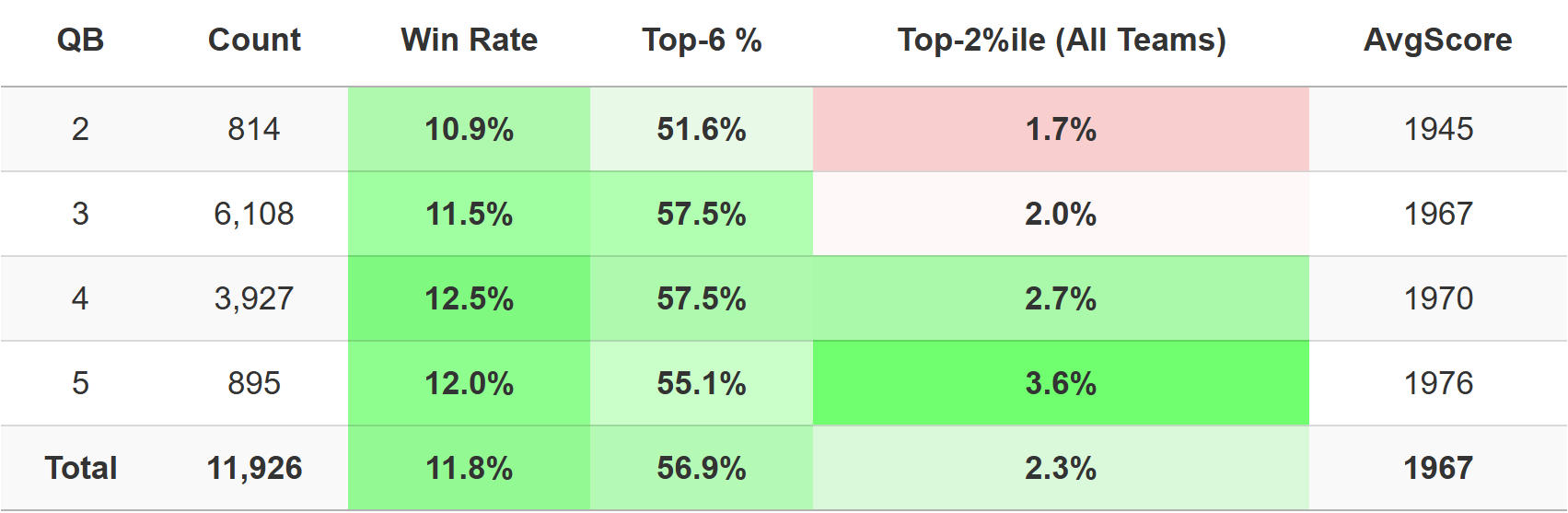
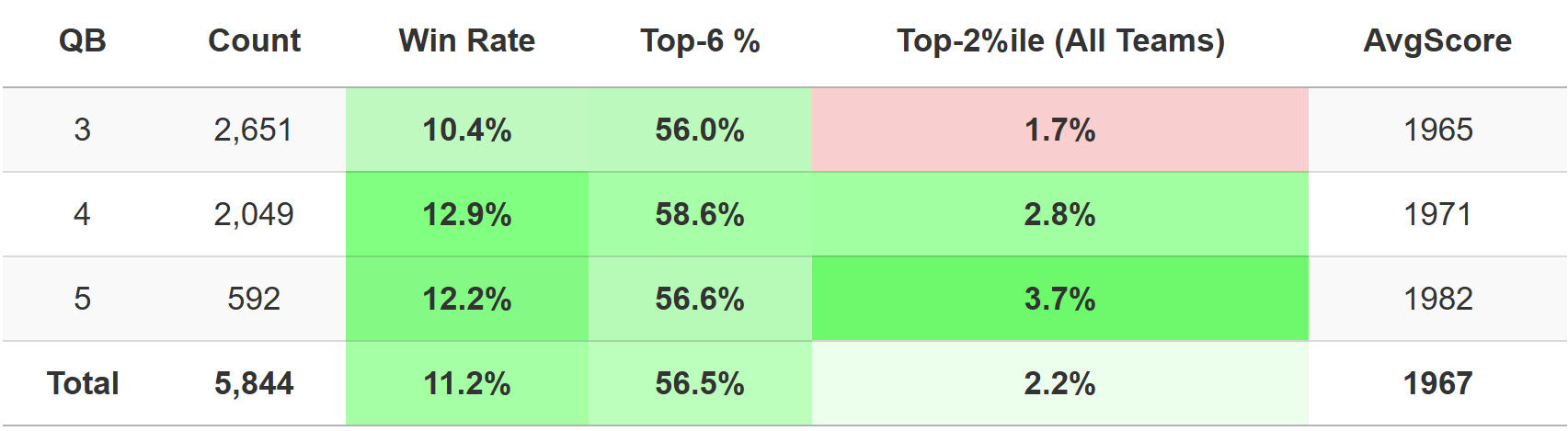
But when we concentrate our focus solely on QB1 selections in the early rounds, things do become slightly more optimistic, most notably at the 1-2 turn and in the back half of the third round. However, the most prevalent edge we see here is waiting until the early fourth or the middle of the fifth to take our first signal caller.
Unsurprisingly, the RCE wholeheartedly agrees that waiting until Round 4 or 5 to grab your first QB has historically been the best way to attack the position.
QB1 AFTER ROUND 3
QB1 AFTER ROUND 4
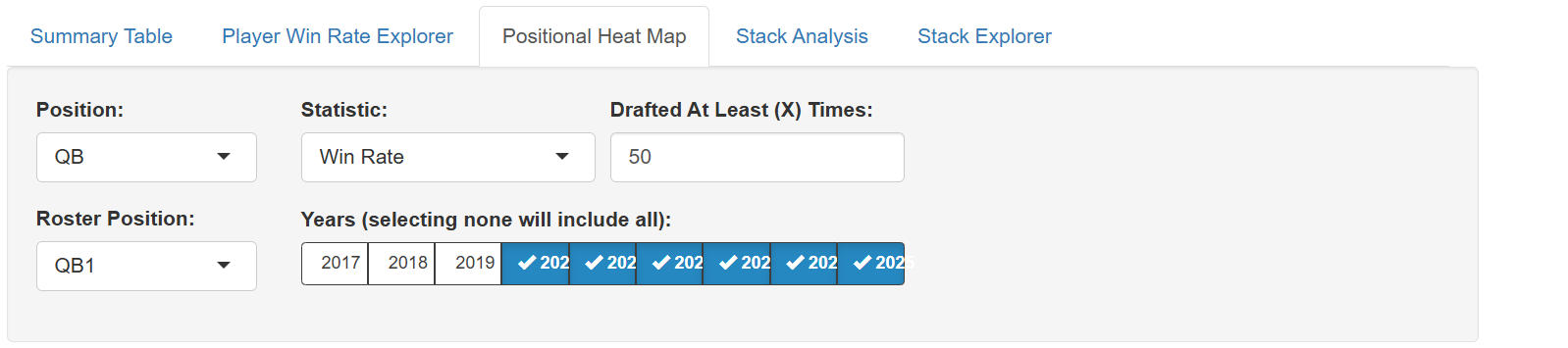
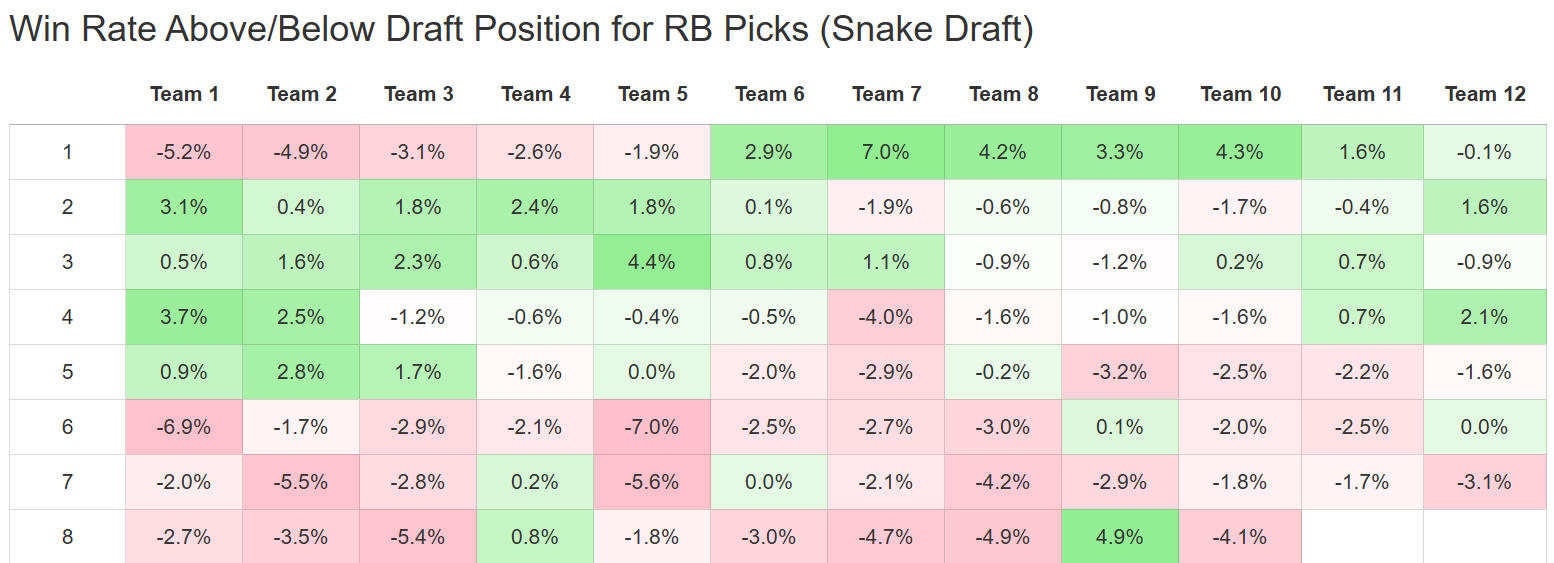
Outside of the 12 spot — where selecting a WR has led to the biggest boost in win rates — the best course of action for the remaining six slots in the draft order has historically been to select a running back with their first pick. Meanwhile, drafters who have waited too long to add their RB1 have generally found themselves behind the eight ball:
Selecting RBs in the top five picks of drafts has not been fruitful over the past six years. But after that, drafting RB1s has generally been positive through Round 3. Things are considerably shakier in the fourth, as two-thirds of the draft slots shave points off of their historical win rates. From there, things continue to go downhill, especially once we get out of the early fifth round.
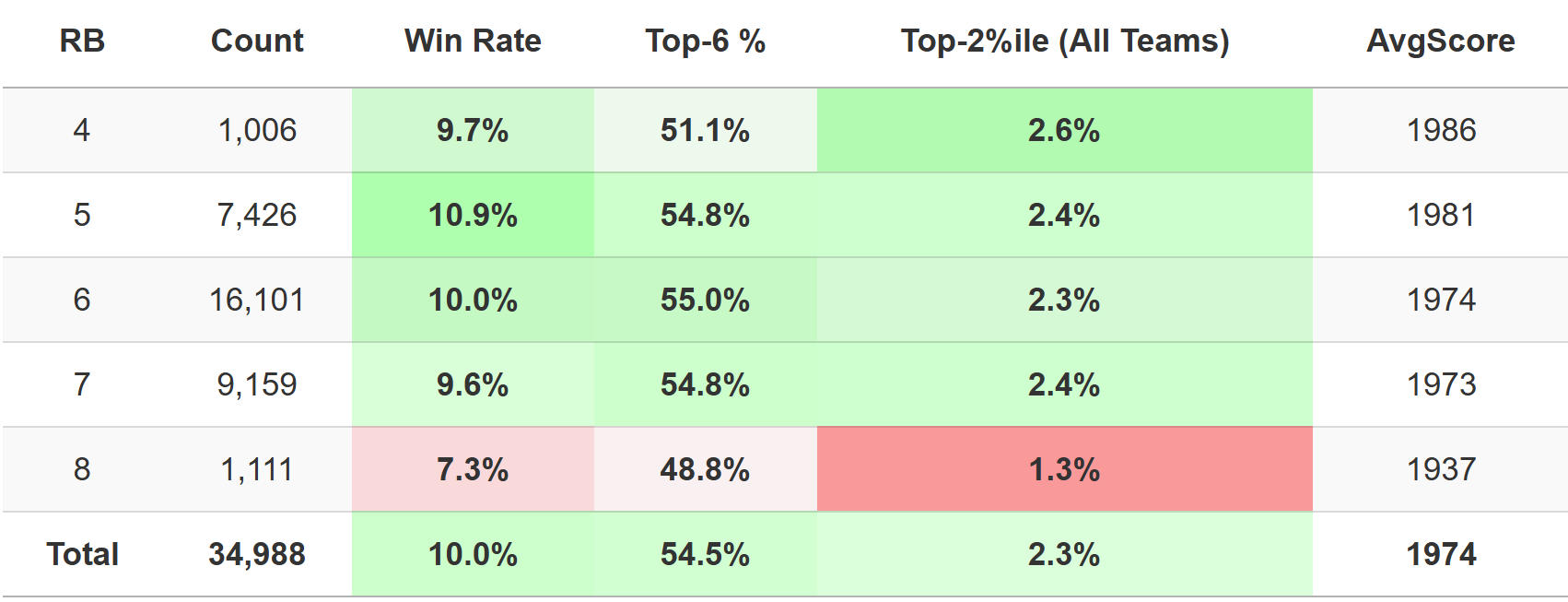
The RCE agrees that grabbing your RB1 early is a smart move. Fantasy managers who added their top back in the first two rounds have experienced a boost in success across nearly all roster constructions.
RB1 BEFORE ROUND 3
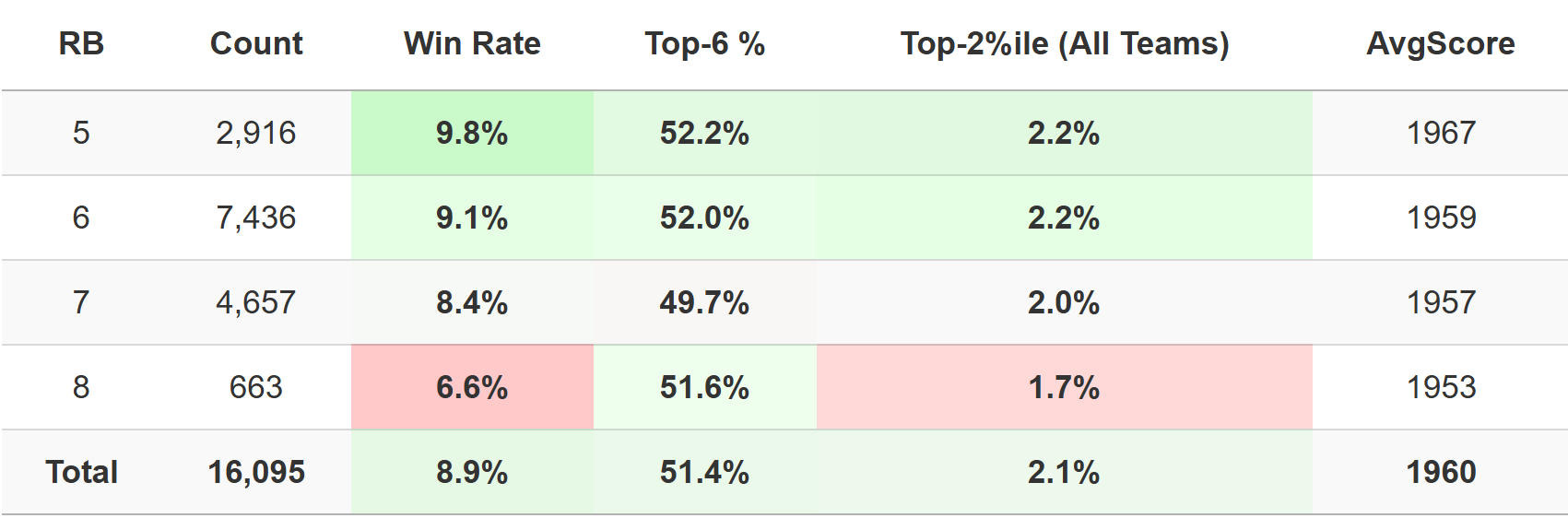
The same holds true when drafting your RB1 in Round 3, although the benefits are not as strong. We also lose our four-RB constructions to small sample sizes.
RB1 IN ROUND 3
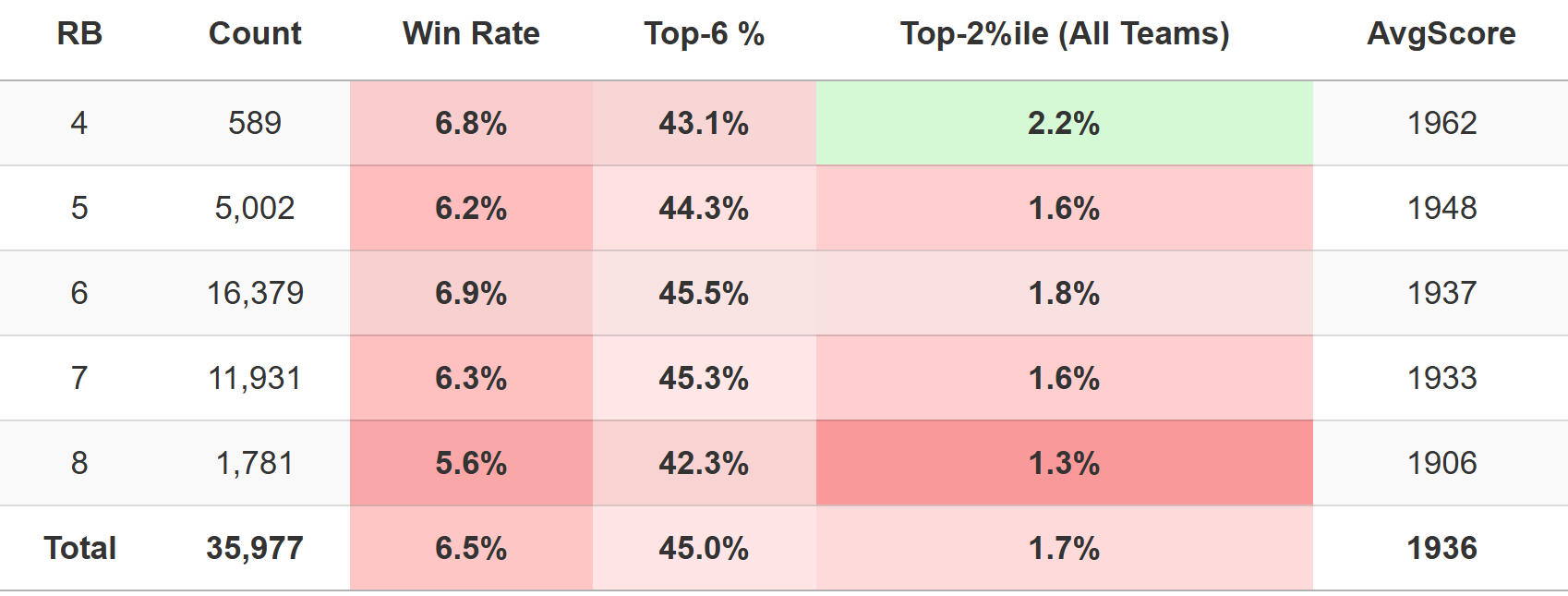
Despite the returns from third-round RB1s being slightly underwhelming compared to the top two rounds, the results are still light years ahead of what we have seen when waiting until the fourth round or later to draft our first back.
RB1 AFTER ROUND 3
History tells us that drafters who get boxed out at RB in the first three rounds can work their way back toward a baseline win rate if they invest in the position in the fourth, as long as they commit to a six-RB build. That path to safety essentially disappears if they wait an additional round, and then things only get worse from there.
RB1 IN ROUND 4
RB1 IN ROUND 5
Landing in the five and six slots allowed me to kick off one draft with a foundational QB and the other with a workhorse RB. But their close proximity on the draft board led to considerable overlap in my strategy after the opening round.
In my first draft, Lamar Jackson fell to me at his normal ADP, which helped me avoid reaching for Jayden Daniels. From there, I turned my attention to filling out my RB room:
There was an off chance that one of Jahmyr Gibbs or Bijan Robinson might fall to me. Thankfully, fate did not choose to tempt me at 1.05.
From there, things seemed pretty simple: draft my two favorite RBs with my next two picks. However, a sliding Trey McBride almost made that decision considerably more difficult. The WRE prefers an RB1 over a TE1 at the 2.08, but both options have boosted the historical win rate out of the five slot.
While it is true that Round 3 has yielded the best returns for RB1 picks in my draft slot, I opted in favor of a macro trend from the past six years.
RB2 BEFORE ROUND 4
James Cook would have been the pick by ADP in Round 2. I think Cook is fine at cost, but I really wanted a back I could get excited about. So I reached six picks past ADP for Omarion Hampton.
I assumed there would be another exciting RB waiting for me in Round 3. Sadly, I was left staring at Derrick Henry or another half-round reach to add Jeremiyah Love. Ordinarily, I would have gone with the exciting rookie, but after witnessing the bump we get from QB1/RB1 stacks, I sided with the veteran.
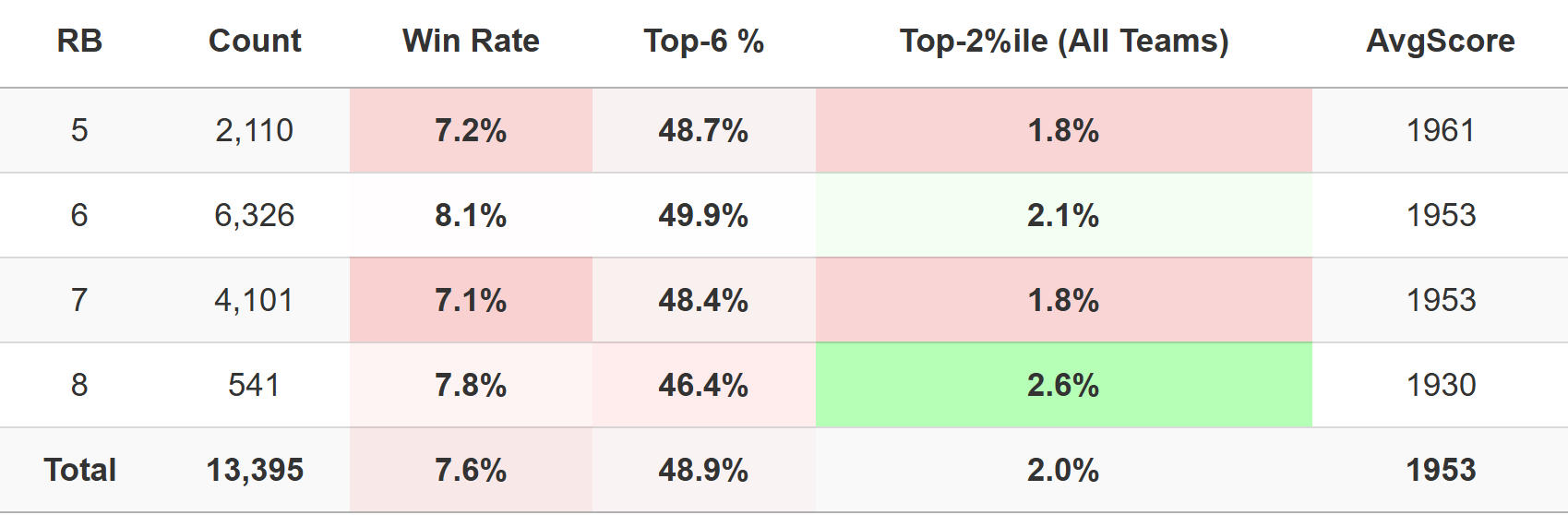
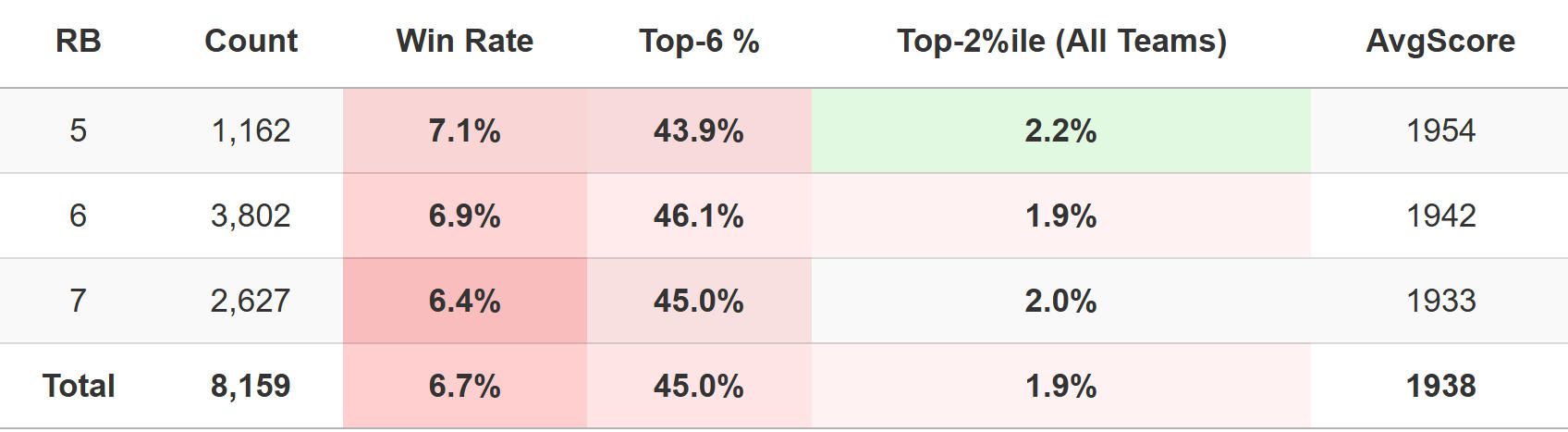
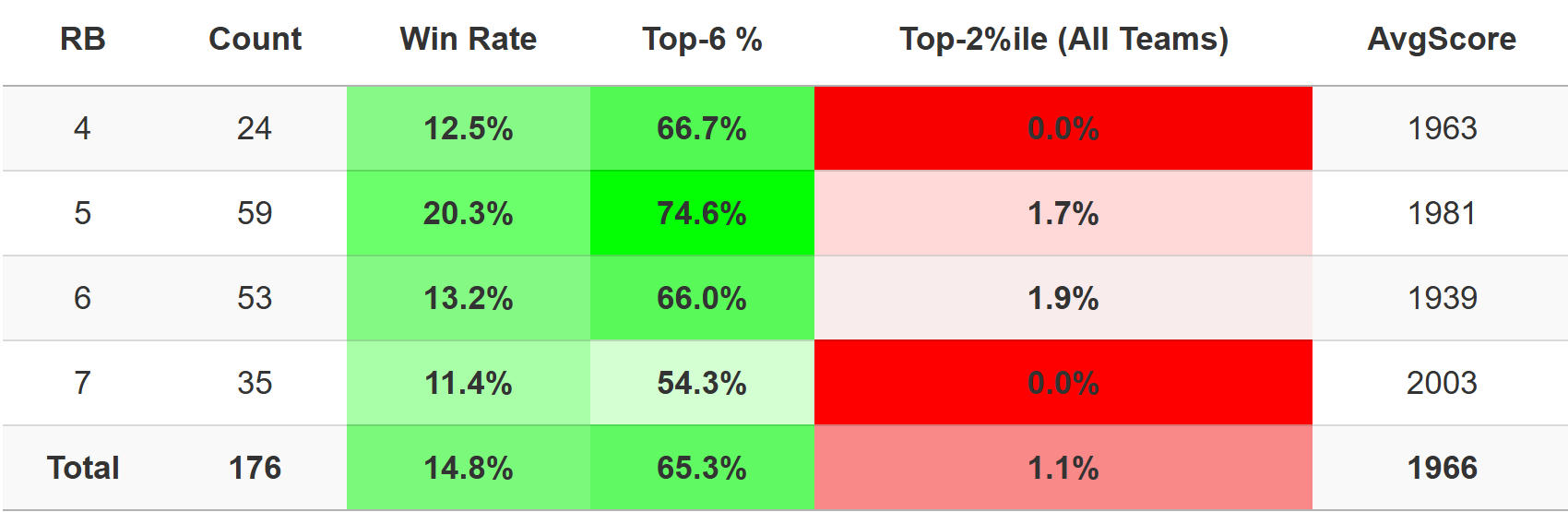
I was in good shape in the eyes of the RCE, especially if I was comfortable relying on one small sample in particular.
QB1 IN ROUND 1 — RB2 IN ROUND 3


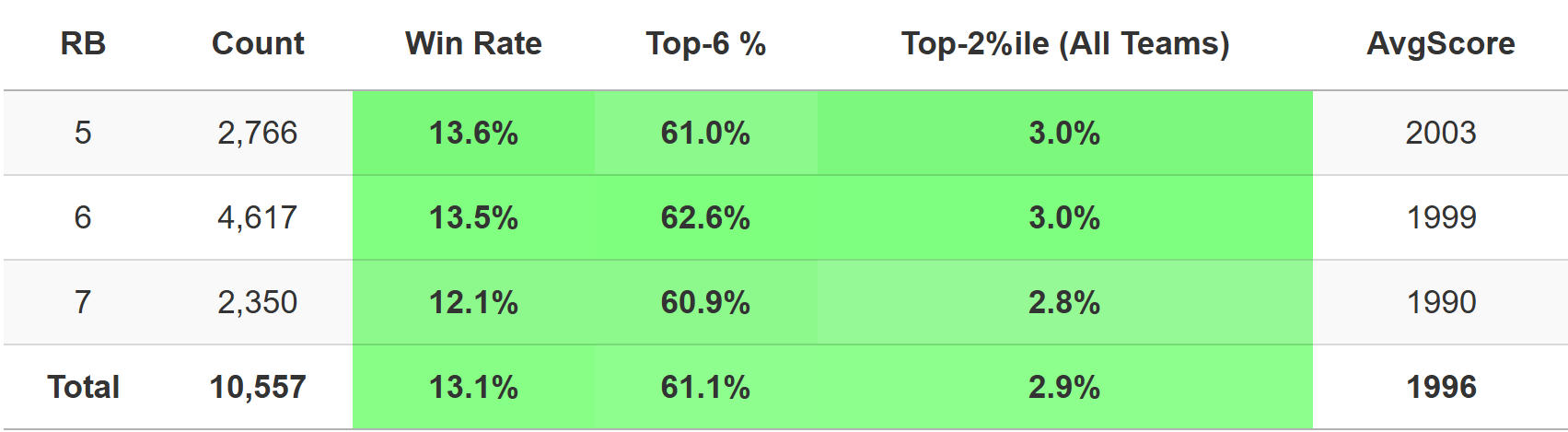


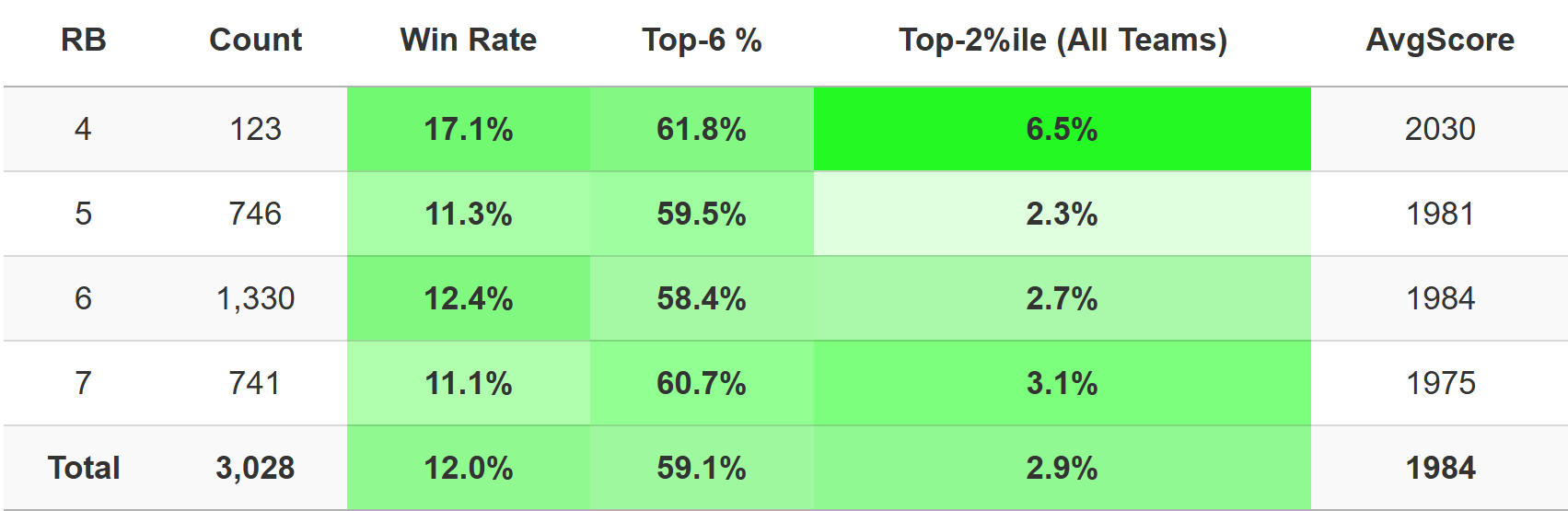
Admittedly, my RB choices here were a mixed bag. If I were not relying on the stacking data in the WRE to guide me, I almost certainly would have headed in another direction with the Henry pick. But the Ravens’ unexciting veteran was balanced out by the massive upside of the Chargers’ second-year back. Here is what Shawn Siegele had to say about Hampton’s 2026 outlook in the Big Gorilla Blueprint:
- Omarion Hampton was breaking out as a receiver with three consecutive games of five-plus targets before his Week 5 injury. That and the 21% rookie evasion confirmed what was a starring and fantasy-friendly collegiate profile for the 220-pound back. His top rank in points above average per attempt (PAA/A) among all backs with at least 100 carries[2] opens the door to a scenario where he’s the most valuable RB in football with Mike McDaniel as offensive coordinator.
2026 Big Gorilla Blueprint: 200 Players, 12 Tiers, 37 Priority Targets
In my second draft, I was backed into a bit of a corner. While detailing the best and worst picks on the San Francisco 49ers, I laid out the bear case for Christian McCaffrey in 2026:
At age 29, McCaffrey recorded the fourth overall PPR RB1 season of his career. However, he needed a career-high 440 opportunities to get there, a number that led the entire NFL by more than 50. His 311 carries cleared his previous career high by 24. Meanwhile, his 129 targets only fell short of his 2019 season, when his 143 looks through the air were the most of any RB since the turn of the century.[3]
But the cracks are starting to show in McCaffrey’s armor. His -17.0 fantasy points over expectation (FPOE) as a runner was the fifth-worst total of any back in the league last year, although he was able to save face with the third-most FPOE in the pass game.
But it was not as if McCaffrey’s blockers were letting him down. The 49ers’ offensive line ranked eighth in points earned (PE) per run play and fifth in wins above replacement as a unit. Individually, three players on San Francisco’s line ranked in the top 10 in points above average (PAA) per run play, with mainstay left tackle Trent Williams surprisingly not being one of them.
The 49ers are largely running it back with the same core group of linemen as last year, with the most notable addition being guard Robert Jones, who sat out all of 2025 after suffering a neck injury in Cowboys training camp.
*Ranks are by position and only include players with at least 300 total snaps in 2025.
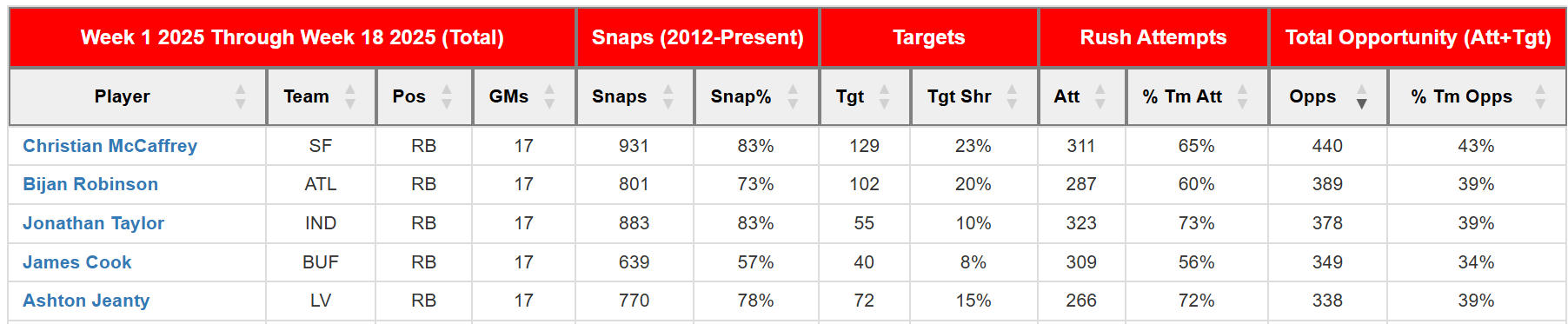
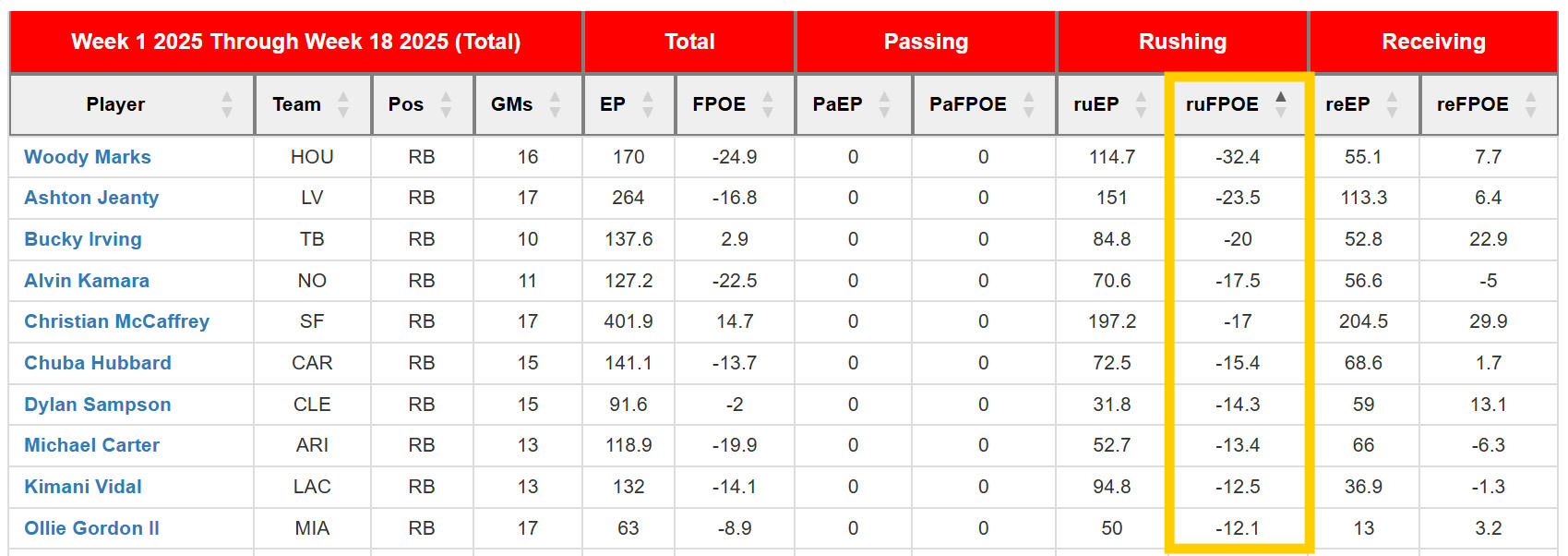
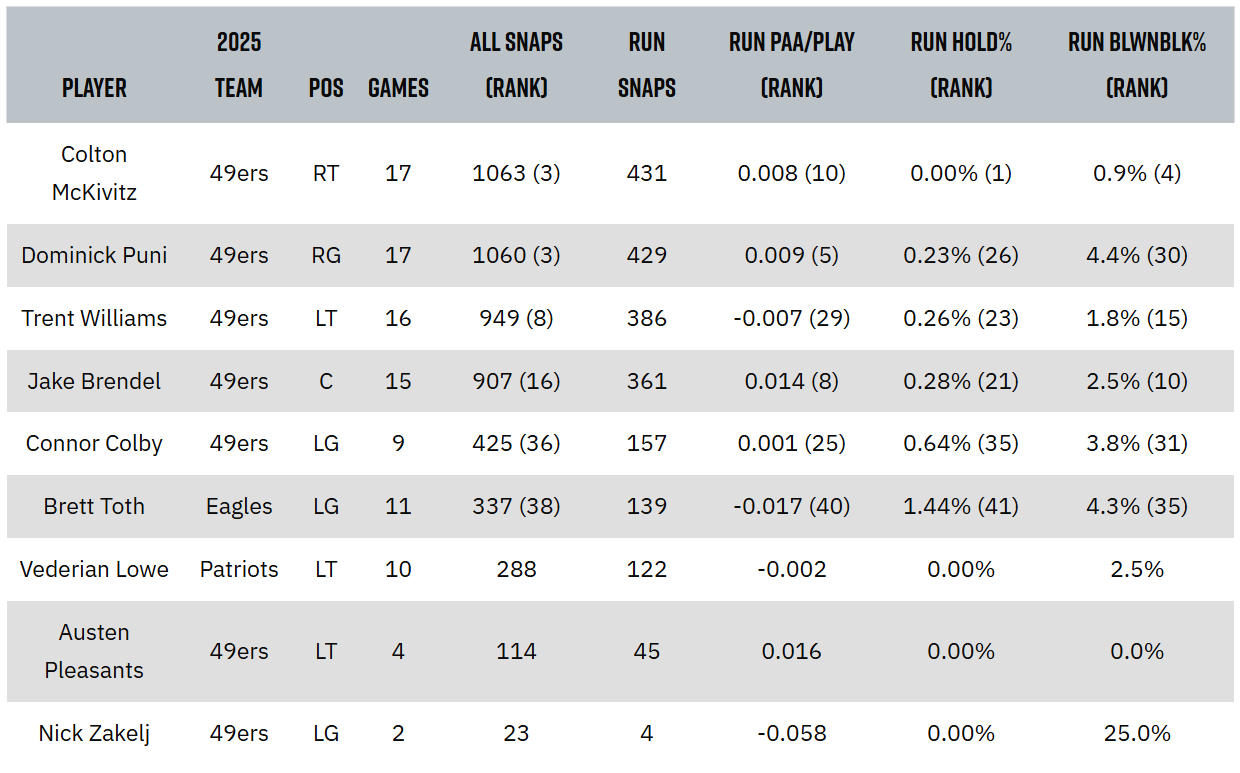
McCaffrey’s massive drop in efficiency, injury history, and advanced age have had me looking in other directions with my first-round picks this year. Still, he can probably get by on his receiving workload alone, but is that really worth our top pick in drafts?
His 234.4 PPR points as a receiver from 2025 may lead us to say yes. But now that the 49ers’ receiving corps is deeper and healthier than it was a year ago, it is unlikely that McCaffrey earns a historic RB target share for a second season in a row.
It is better to get out a year too early on declining players than a year too late. Even with that in mind, I am experiencing a serious case of FOMO by fading 2025’s RB1. Therefore, I have been sprinkling McCaffrey in, although I will be severely underweight in my exposure to him when the season rolls around.
Sticking to my guns, I opted for Jonathan Taylor at the 1.06. While Shawn has McCaffrey ahead of the Colts’ superstar in his Big Gorilla rankings, he still painted an intriguing picture of Taylor:
- The No. 10 player in this group, Jonathan Taylor, averaged 21.4 PPG last year despite only averaging 12.9 over his last seven. He had the fastest ball-carrier time in 2025 after posting three of the five fastest during his electric 2021 campaign. He also had two of the three most remarkable rushes according to NextGen, twice taking a carry for 80-plus yards when the expectation was to gain 5 yards or fewer.
From there, I continued to focus my attention on the RB position, especially once the ADP values began rolling in:
De’Von Achane’s outlook as the centerpiece of a terrible Dolphins offense is not without its risks, but he is also in line to command the largest workload of his career. Saquon Barkley and Chase Brown both offer similar upside to Achane, but on significantly better offenses. In the end, I decided to roll the dice on Achane in hopes that Miami will not be as terrible as most are predicting.
After making some significant reaches early in my previous draft, that trend also bled into my second run-through of the exercise. Luckily for me, my fortunes were about to change in a big way.
When I came up on the clock in Round 3, Barkley was still on the board a half round past ADP. Kenneth Walker and Jeremiyah Love were also in the mix. Justin Jefferson would have been in consideration if he had lasted one more pick, even if it ran counter to my initial game plan.
With Drake London being the top WR option on the board, my decision to add a third straight RB became a little easier. Selecting a wideout at 3.05 offered a slight boost to my draft slot’s historic win rate. But the returns drafters have seen when kicking off drafts with three RBs were considerably more appealing.
RB3 IN ROUND 3
After pulling the trigger on my fair share of reaches, I decided to let the pendulum swing in the opposite direction this time around. I took the ADP value on Barkley, adding a third true workhorse to my stable of RBs. The trio of Taylor, Achane, and Barkley gave me three of the top six RBs in team opportunities from last year. That nugget of information had me feeling good about shifting my attention elsewhere with my next pick.
That is, until I got to my next pick and Jeremiyah Love was sitting there, gift-wrapped for me a half round past ADP.
Only 0.2% of teams in the RCE database for this format have kicked off drafts with four straight RB picks. Although the numbers for our preferred RB builds drop across the board compared to where we were a round earlier, the value I received on Love was just too good to pass up.
Another positive was that none of these RBs have overlapping byes. This made holding at four RBs a more realistic option, despite the RCE heavily suggesting I add a fifth back at some point.
RB4 IN ROUND 4


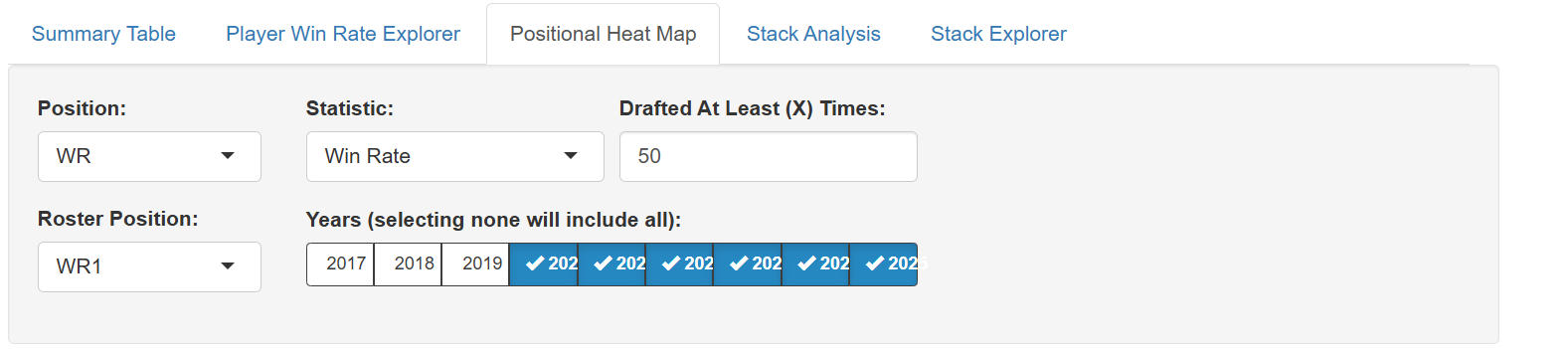
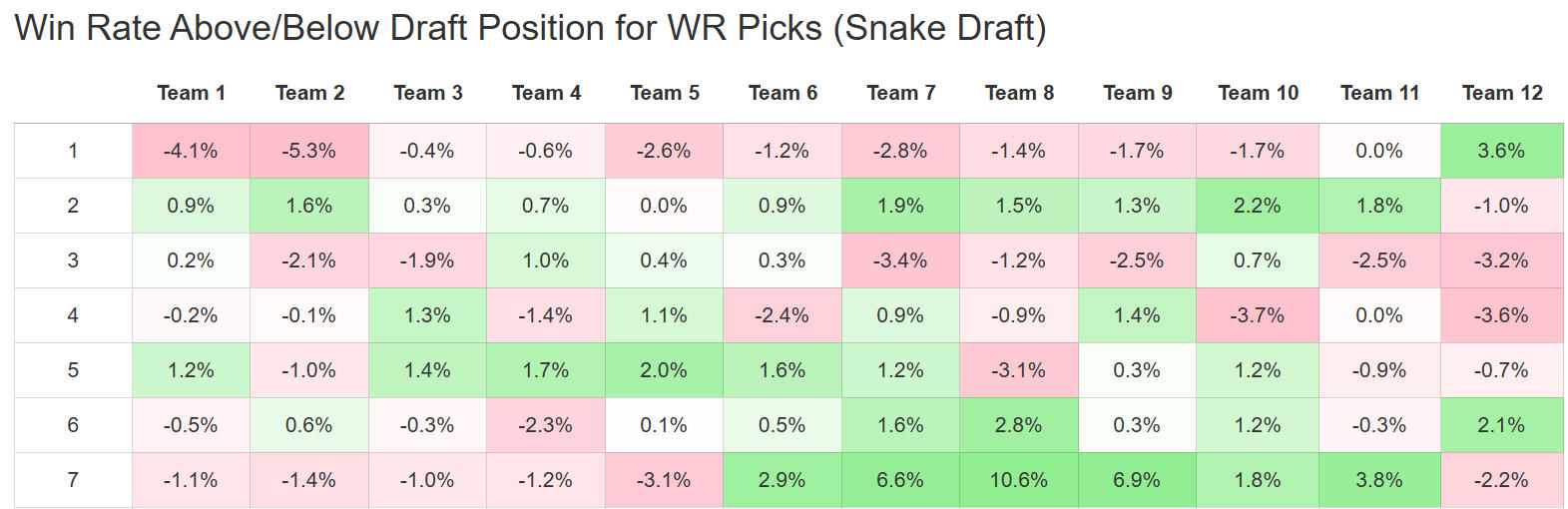
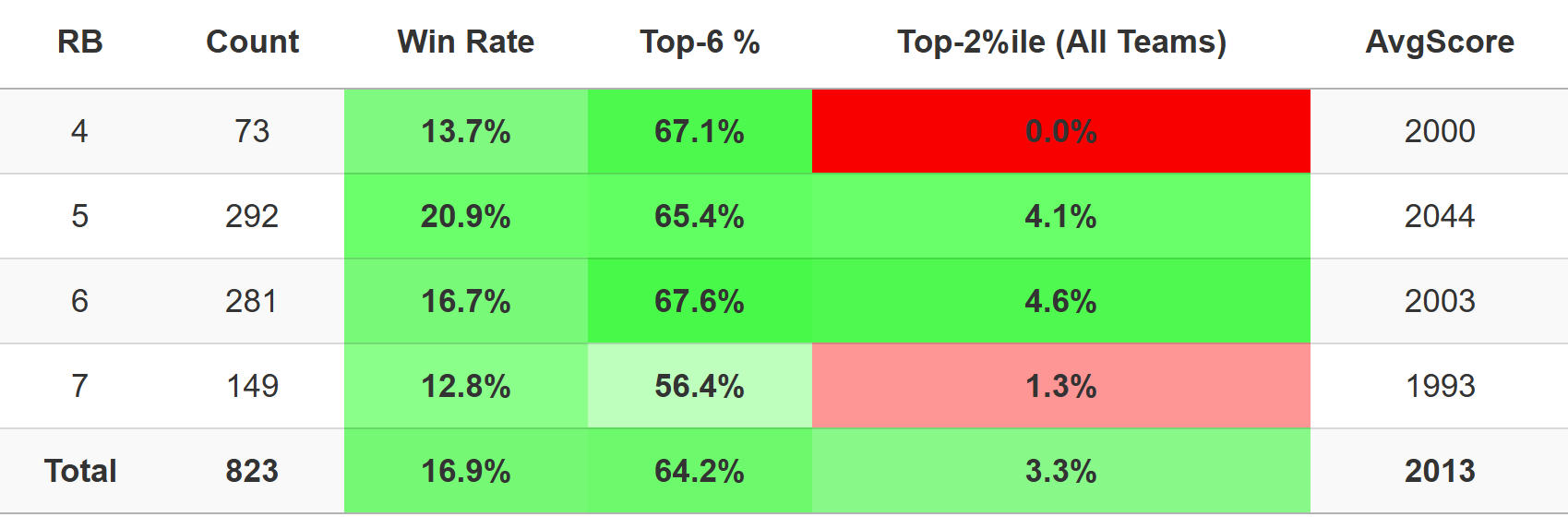

One macro strategy that came to light in my research was the advantage that waiting on WR has historically given teams:
We don’t see positive returns from WR picks until we reach the 1-2 turn. From there, the position experiences a nice runout in the second round before getting some mixed results in Rounds 3 and 4. However, history provides us with a strong case for waiting on WR until the Round 5-7 range, particularly for teams that land in the middle of the draft order. Meanwhile, it can be argued that teams positioned closest to the turns have had the best success when going WR early in drafts.
The RCE suggests that drafters who don’t want to miss out on a WR value in the first round should consider rostering a total of eight wideouts to improve their chances of getting back above a baseline win rate.
WR1 IN ROUND 1
But given the information we received from the WRE, it shouldn’t be a massive surprise that drafters have seen the best macro returns by waiting until the Round 6-7 range to add their first wideout. But as we touched on earlier, not all draft slots have benefited equally from this approach.
WR1 AFTER ROUND 5 — WR1 BEFORE ROUND 8
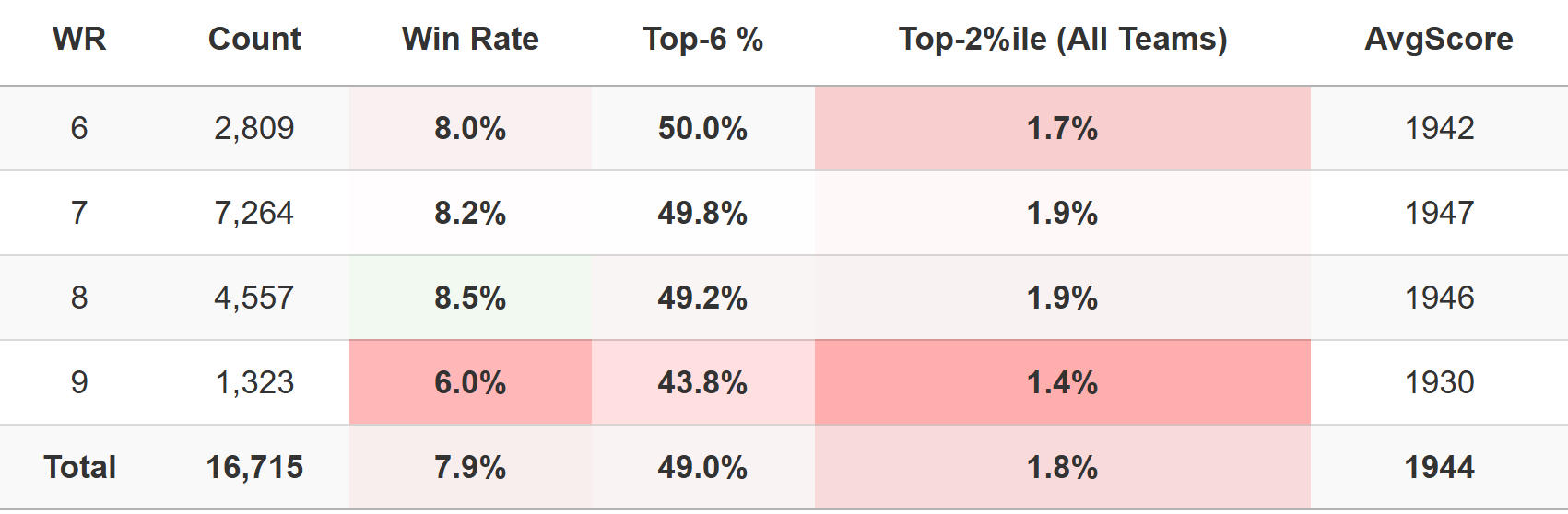
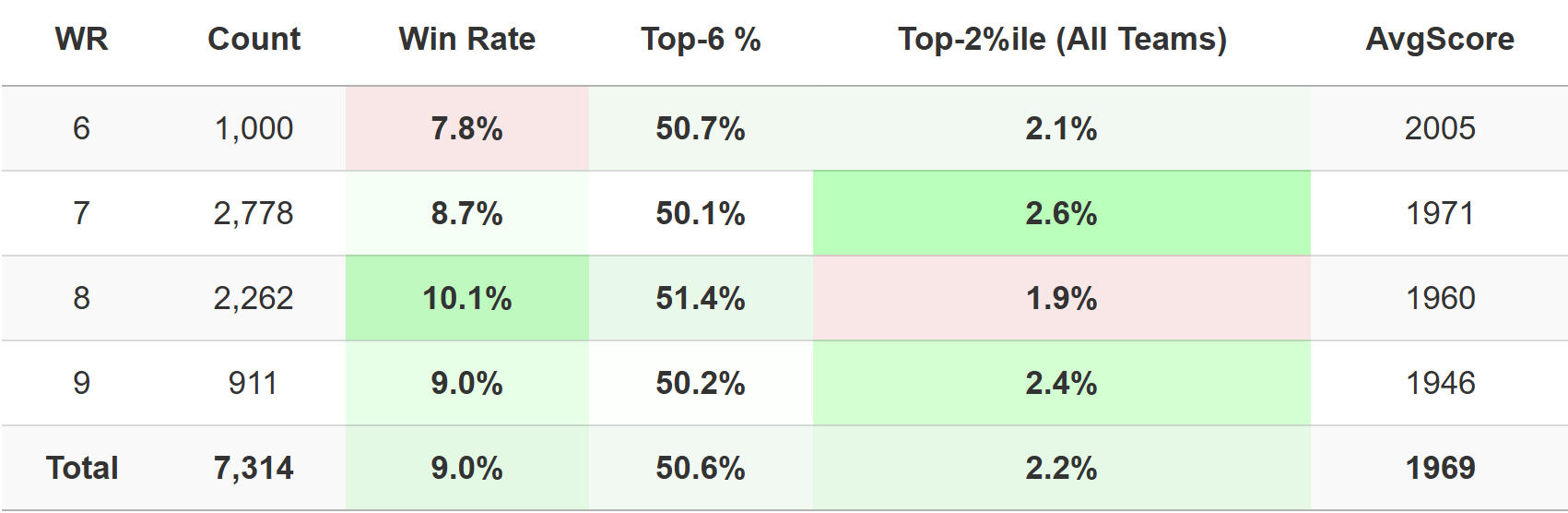
When drafters waited until the middle rounds to add their first wideout, it was generally best to continue to hammer the position into the early double-digit rounds.
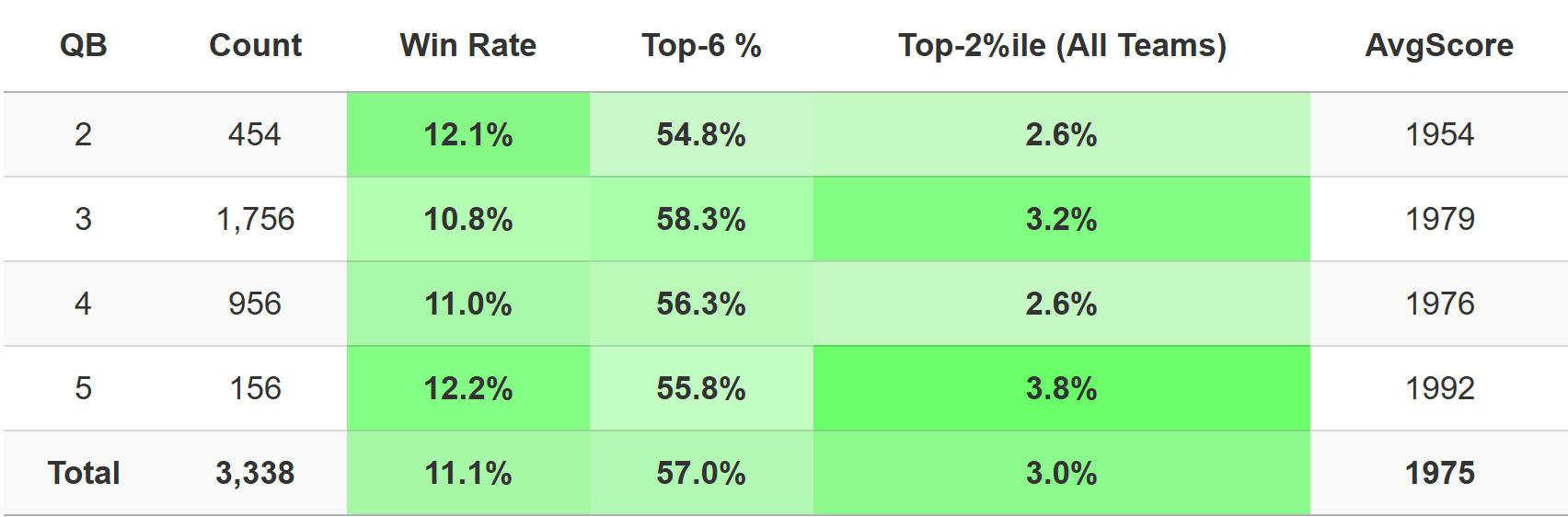
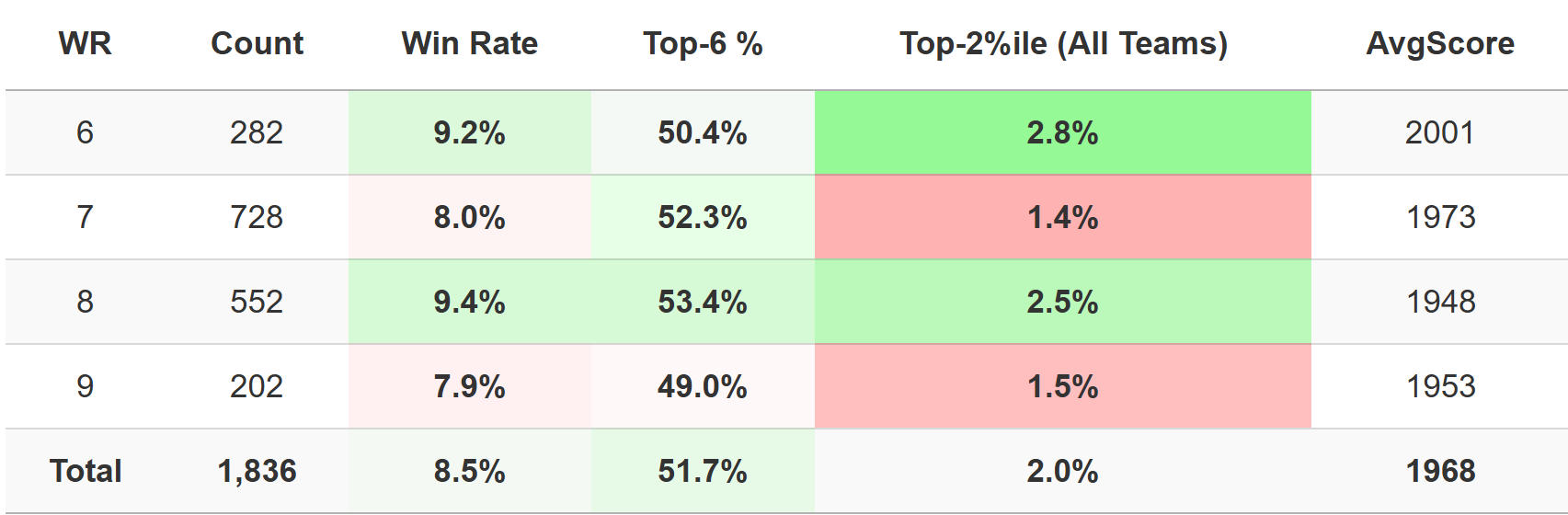
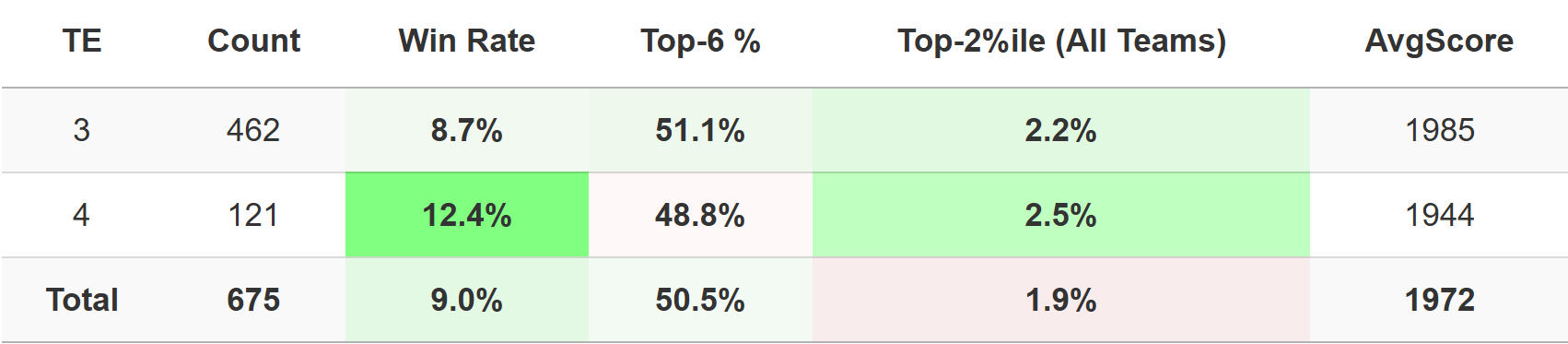
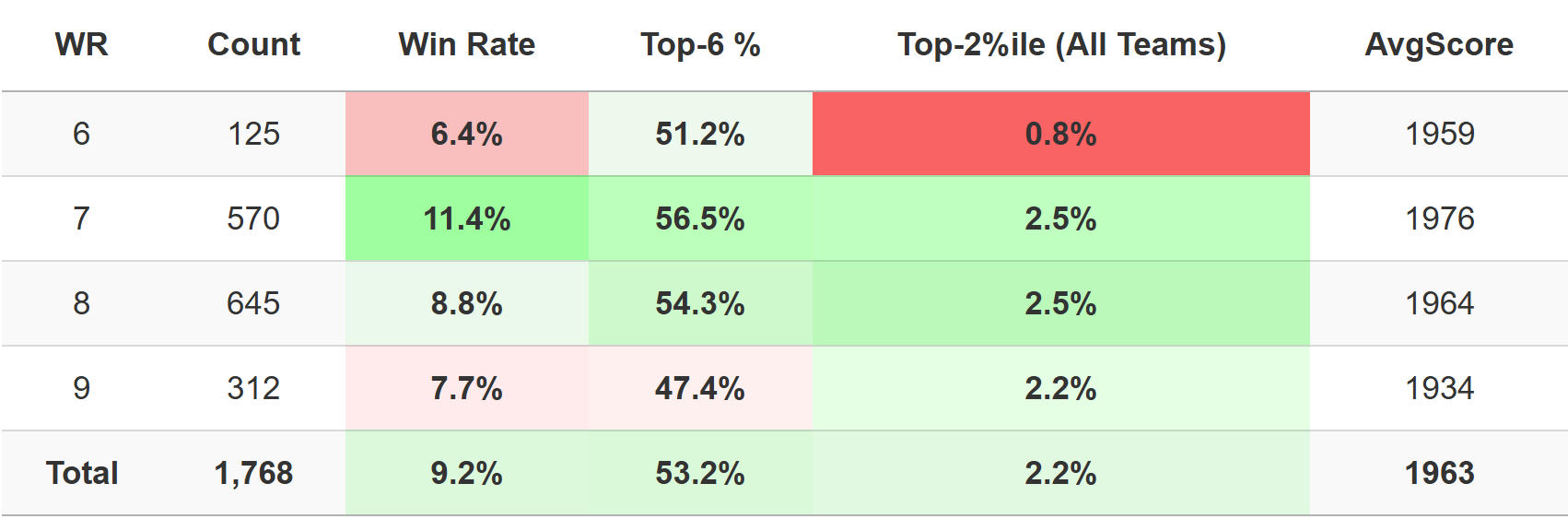
In both drafts, I waited until at least Round 5 to add my WR1, yet ended up with five wideouts through the 11th. I took two detours along the way in each draft and was in good shape heading into the second half of my drafts. Following my Lamar Jackson start at 1.05, I avoided QB with my next 10 picks. But adhering to the advice of the tools led me to some reaches and player selections I didn’t completely believe in:
Despite my reaches and questionable player selections, I was still on the right track as far as the WRE and RCE were concerned. Obviously, small samples are already an issue when assessing the effectiveness of my roster construction. But looking at the build from a few different angles does help.
We have already seen the returns this RB start has yielded. Now it’s time to see how the rest of these positional builds have fared. Still, I think it is fair to wonder how much my potential missteps might affect the top line.
QB1 IN ROUND 1 — QB2 AFTER ROUND 7
WR1 IN ROUND 5 — WR2 AFTER ROUND 7
TE1 IN ROUND 6 — TE2 IN ROUND 7
Rounds 8-11
Based on the information above, it is pretty apparent that my WR room needed some attention. Luckily, this has historically been the range to target wideouts, both for my draft slot and the community at large.
I took four straight receivers in the middle rounds, focusing on players who could add a healthy mixture of floor and ceiling to my WR room. Each wideout also provided some playoff correlation with players on my roster or solidified plans I had for this team further down the line.
The only selection that did not boost my draft slot’s historic win rate was Michael Pittman. But in the aggregate, this string of WR selections got my seven-WR build back on track.
WR1 IN ROUND 5 — WR5 BEFORE ROUND 12


Following a four-RB start in my second draft, the two detours I made were for signal callers. I remained on course in the eyes of the RCE and WRE here as well:
The values kept coming in Round 5 as Jordan Love slid a half round past his ADP. I was happy to scoop him at the 5.06, a spot that has generated some nice returns for QB1 picks since 2020.
From there, my primary focus in the middle rounds was to bolster my WR room.
Five of my next six picks were wideouts, with Xavier Worthy being the grizzled veteran of the bunch as he heads into Year 3. My top two wideouts, Tetairoa McMillan and Luther Burden, each came attached to a half-round discount or more. Worthy was the only significant reach, coming nearly a round before his ADP.
I did contemplate adding Jayden Reed in the 11th but ruled in favor of Worthy, knowing Matthew Golden was still lurking later on. Altogether, I was happy with my approach and the amount of young WR talent I was able to add to my roster as I entered the back half of the draft.
WR1 AFTER ROUND 5 — WR5 BEFORE ROUND 12
My lone detour during this stretch was for Fernando Mendoza, who will hopefully be firmly entrenched as the Raiders’ starter long before Jordan Love’s Week 11 bye. From the perspective of historical success, my QB room was quickly becoming the backbone of this roster.
QB1 AFTER ROUND 4 — QB2 AFTER ROUND 8
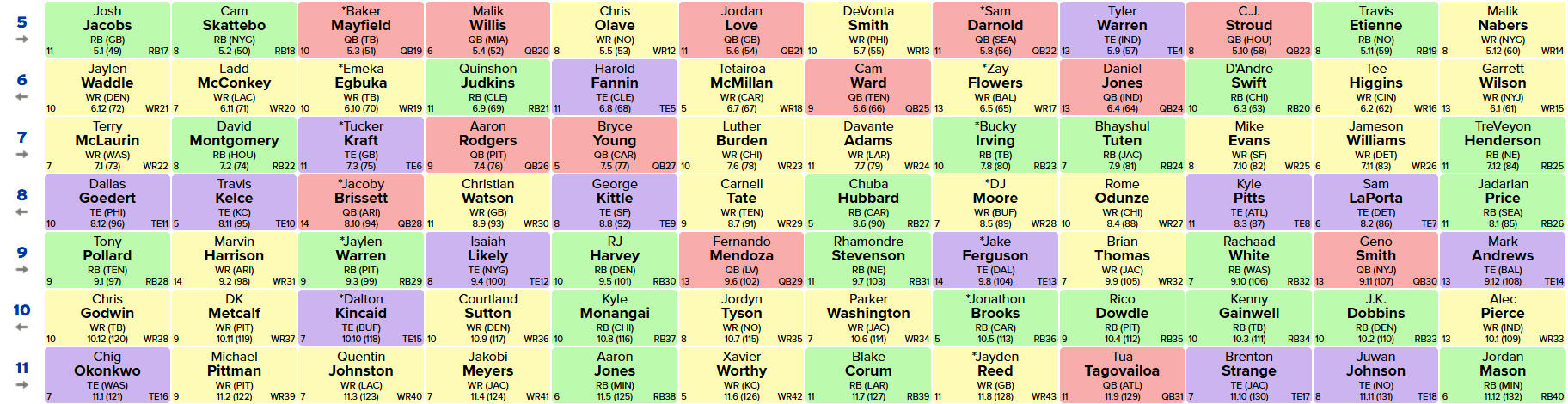
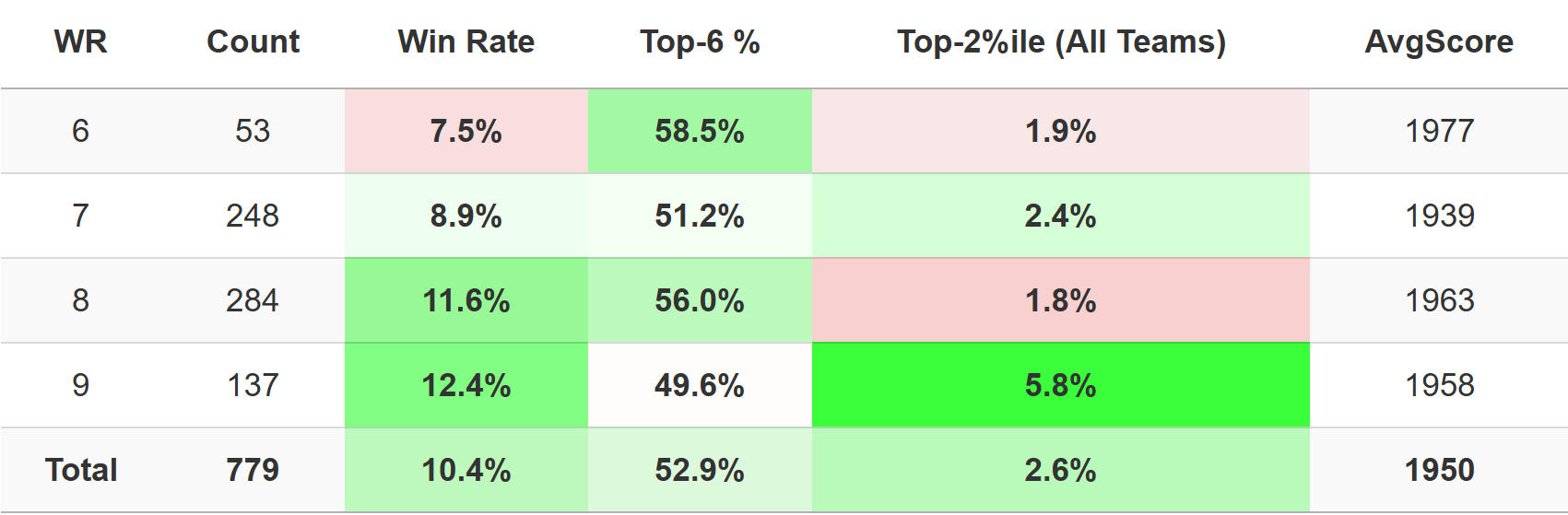
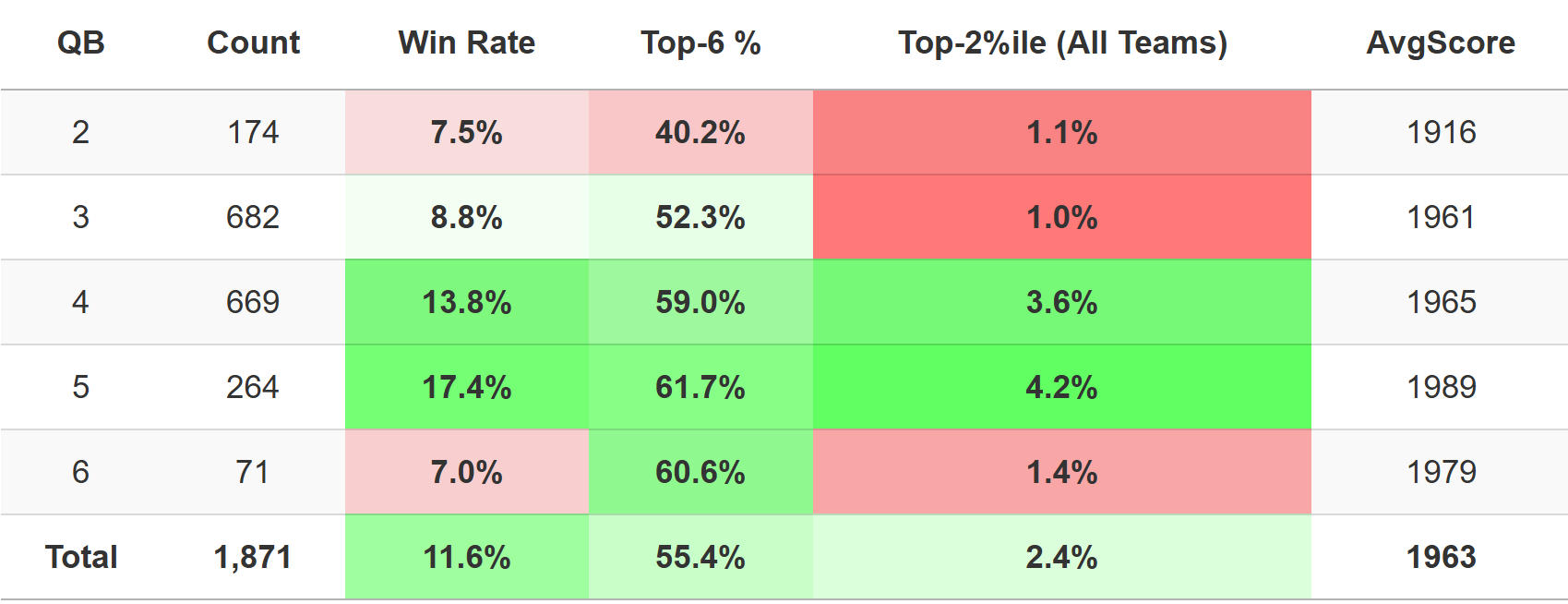
The paths of the two teams diverged pretty dramatically over the back half of these drafts. In my first draft, my primary focus in the early double-digit rounds was filling out my QB room. My second squad did not include a single TE through 11 rounds. But history showed that waiting at the position was a viable route to boosting win rates:
When fantasy managers have combined their TE2 and TE3 picks in Rounds 11-15, they have gotten some nice returns.
TE2 AFTER ROUND 10 — TE3 BEFORE ROUND 16
Meanwhile, teams that clustered their first three TE picks in Rounds 12-15 have experienced some strong success as well.
TE1 AFTER ROUND 11 — TE3 BEFORE ROUND 16
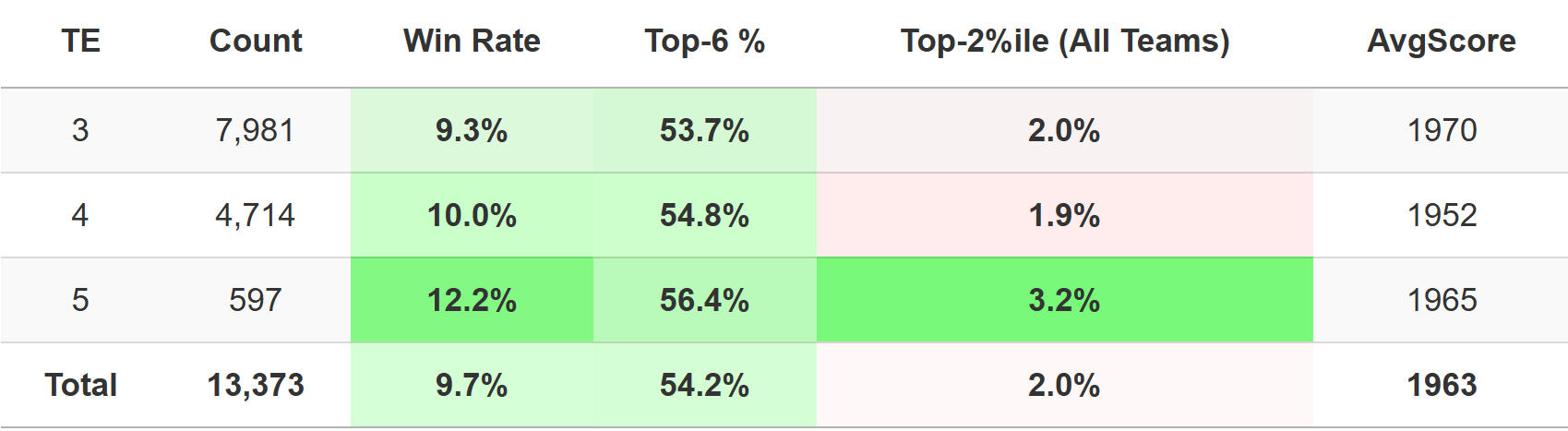

I leaned into the RCE’s suggestion and held at three TEs against my better judgement:
The RCE also identified this range of drafts as fertile ground for TE selections, even suggesting one seldom-used construction that had shown plenty of promise over the past six years.
TE1 AFTER ROUND 11 — TE3 BEFORE ROUND 15
If we add another round to the end of this range to increase the sample size, it still looks like a three-TE build is the way to go. Although this route would diverge from my original flight plan, I was curious to see where this new direction would lead.
TE1 AFTER ROUND 11 — TE3 BEFORE ROUND 16
I used my next three picks on the TE position, fully intending to follow the RCE’s suggestion. I must say, this was easier said than done. But in the end I held steadfast in the face of temptation.
One reason I felt the urge to add more players at the position was the significant uncertainty about each of my TEs’ roles in 2026. I believe in Oronde Gadsden’s talent, but a congested passing attack and the recent steam for Charlie Kolar are a bit discouraging. Kenyon Sadiq is still recovering from hernia surgery, and the Jets’ offense perennially teeters on the verge of disaster. Meanwhile, Eli Stowers might not even see the field in Year 1. If he does settle into a meaningful role, it is unlikely to come until the second half of the season.
After taking a few liberties with the WRE and RCE earlier in the draft, this may not have been the best place to take a stand in terms of sticking to the guidelines of the exercise. Still, it is hard not to like the talent and price of these young TEs; Gadsden and Sadiq came at a half-round discount.
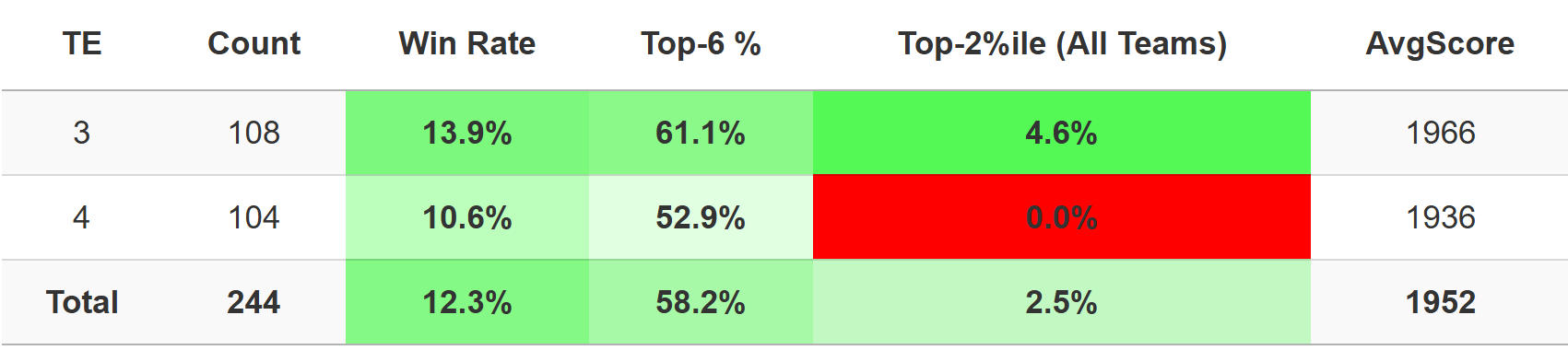
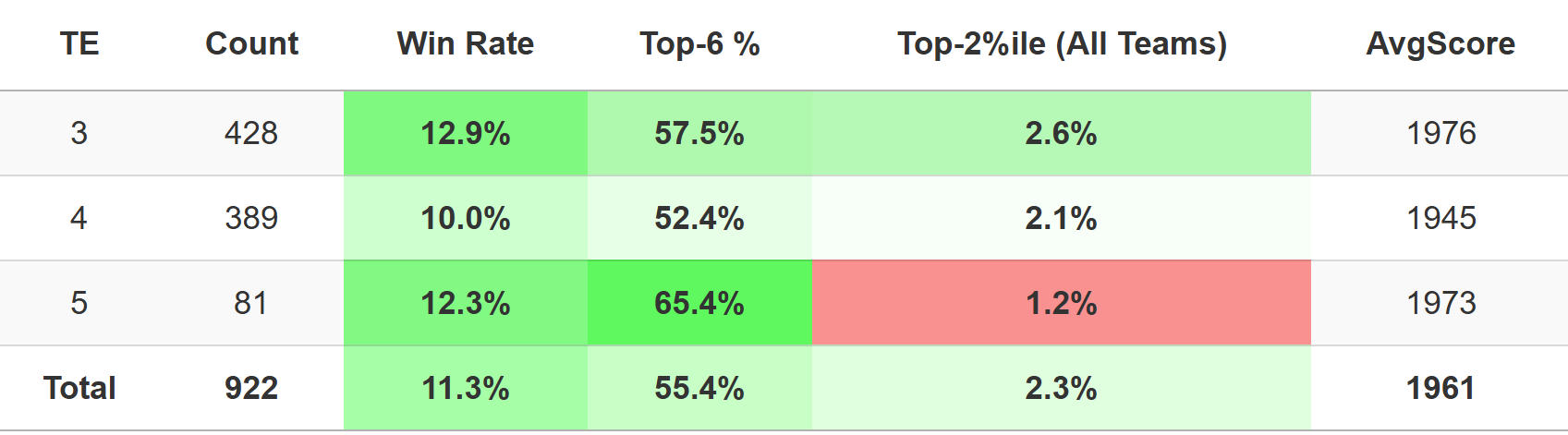

When my first draft came to a close, the RCE was mostly happy with the team. The clear exception was my TE room, which may have gone off course when I decided to add a fifth player at the position. I wasn’t necessarily ecstatic about the team, but there was still a lot to like:
QB1 IN ROUND 1 — QB2 AFTER ROUND 11 — QB4 AFTER ROUND 16 — 4 QBS TOTAL
RB3 BEFORE ROUND 5 — RB4 AFTER ROUND 14 — 4 RBS TOTAL
TE1 AFTER ROUND 5 — TE3 AFTER ROUND 13 — TE4 AFTER ROUND 17
WR1 AFTER ROUND 4 — WR5 BEFORE ROUND 12 — WR6 AFTER ROUND 15
Final Thoughts
Was my execution in this draft flawless? No.
Am I a huge fan of all the players on this roster? Again, no.
Still, I adhered to the vast majority of the guidelines I set up for myself before the draft. And perhaps most importantly, I had a ton of fun building a blueprint and shuffling between the tools in an attempt to squeeze every last bit of historical value I could out of this roster. At the very least, this draft should get us thinking about new ways to attack our next FFPC Superflex Best Ball Tournament entry.
When doing structured exercises like this, it’s important to focus on the most relevant elements and leave the rest. The WRE and RCE tell us that these approaches will feel foreign to the majority of the best ball community. The tools also tell us that these edges have historically helped drafters separate from the pack in a positive, meaningful way.
If nothing else, the RCE is telling us this team is unique. If the hyperfragile RB build holds up and some of my QB predictions come true, this squad has a real chance to make some noise.


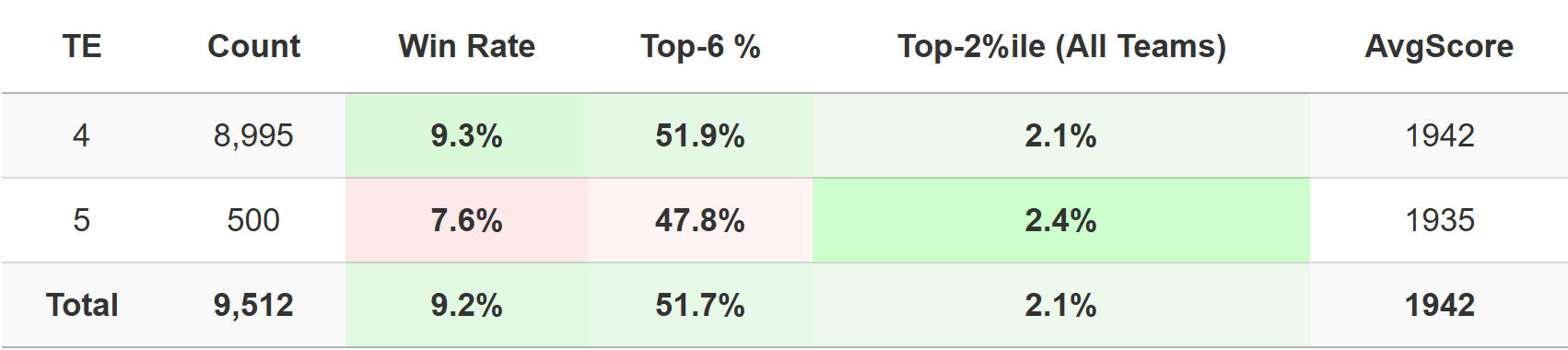
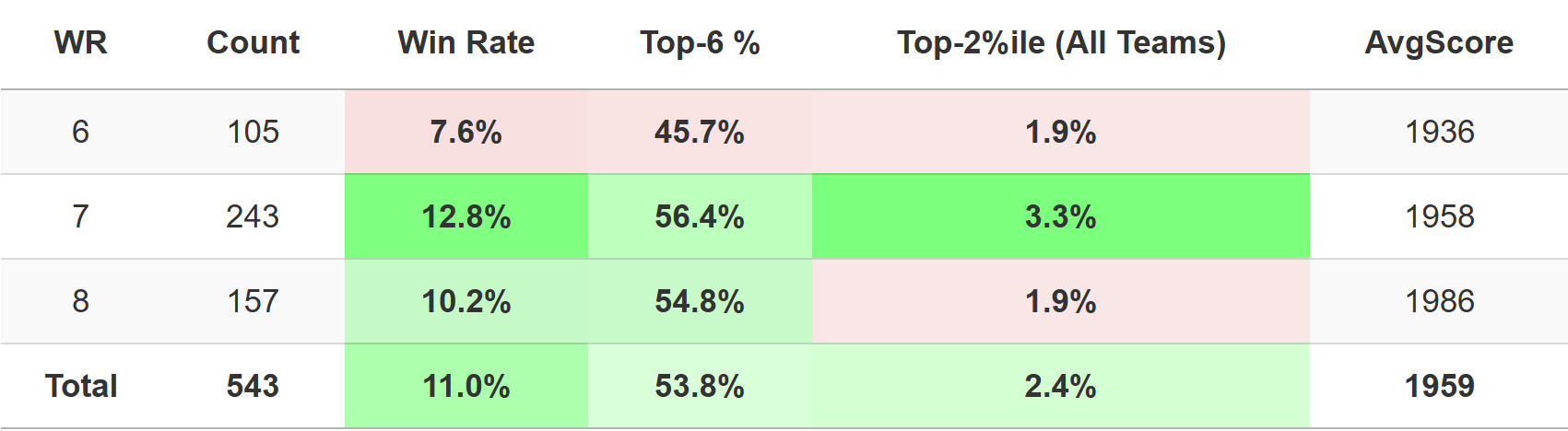
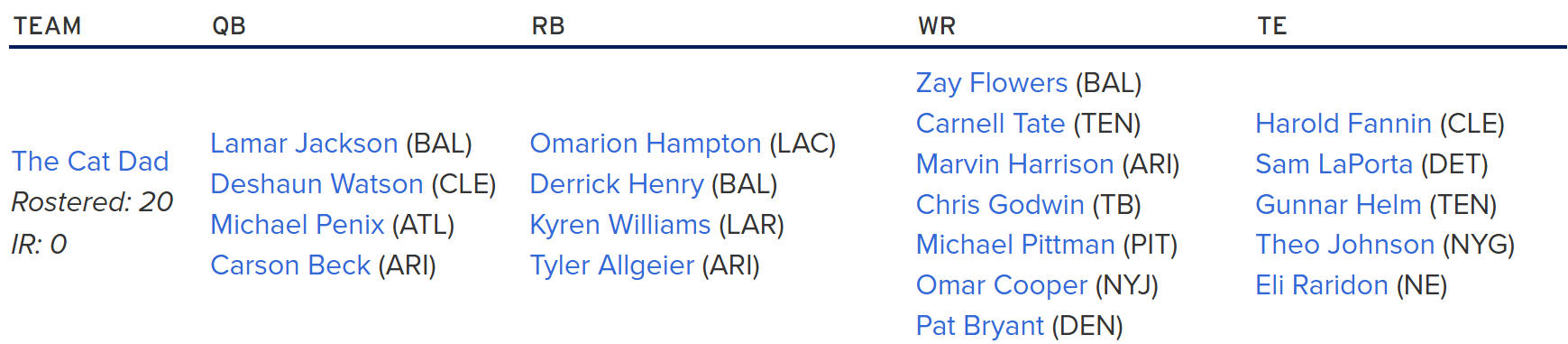
Unsurprisingly, when I added a little more subjectivity during my second pass through the exercise, I found the results considerably more intriguing:
Final Thoughts
If I had to choose one word to describe this roster, it would be fragile. If I had to choose a second word, it would be fascinating.
I definitely played this draft a little looser than my initial pass through this exercise. After following the parameters rigidly last time around, I believe this draft is more representative of how we should be using the information in the RCE and WRE to complement our draft strategies rather than dominate them.
If I were drafting without the aid of either tool, I surely would have made some different choices, with a selection of Ja’Marr Chase at 1.06 being the one that sticks out the most. Still, I am happy with how the roster shook out, and I am excited to construct more teams with a similar blueprint moving forward.
Let’s take a final pass through each position group as I share some final thoughts.
Running Backs
I’m not sure whether my RB approach is best described as robust or hyperfragile — I would lean toward the latter. I have three proven workhorses and this year’s third overall pick, all of whom should find their way into my flex spots regularly. Although there are some concerns about each of their offenses, injuries are still by far my biggest worry here.
Even though the RCE strongly suggested rostering five RBs, the value I received on Barkley and Jeremiyah Love ultimately led me to stick with four.
Quarterbacks
I will be relying heavily on Jordan Love this year, particularly over the first half of the season. So, for my sake, let’s hope Matt LaFleur loosens up his playcalling a bit. Mendoza will undoubtedly see time on the field, but it is fair to question how effective he’ll be in Year 1. At best, Sanders and Beck are poor man’s versions of Mendoza, while Jones represents the ultimate wild card.
History tells us this is a viable way to build out our QB rooms, but this approach is definitely not for the faint of heart.
Tight Ends
Speaking of not being for the faint of heart, I have already addressed my concerns with this TE room. If tasked with doing this draft again, I may have opted for a veteran presence with one of my TE picks, but I still love all the players I wound up with.
If I were relying solely on my own intuition, I doubt I would ever end up with a TE room like this. So in that regard, TE is the position I am relying on the RCE for the most.
Wide Receivers
This feels like a RotoViz WR room. Between the talent of my RBs and WRs, I really do love how this roster shook out. Now they just have to live up to my expectations.
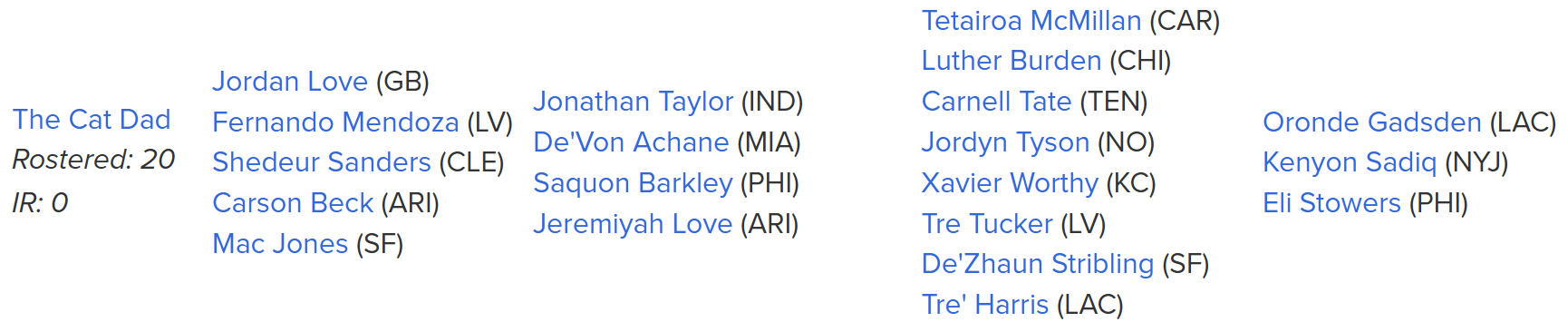




Obviously, entering very specific builds in the RCE is going to lead to some small sample sizes. When we intentionally deviate from common roster constructions, these results will inevitably become even thinner and, therefore, less reliable. Still, the limited information we have regarding the builds from these drafts is promising and certainly paints them as unique.
History can provide us with some valuable guardrails to follow in our 2026 FFPC Superflex Best Ball Tournament drafts. Examining past results also allows us to pinpoint builds that are not being utilized regularly by our competition. But we shouldn’t treat historical trends as hard-and-fast rules that must be followed. However, they can certainly provide us with solid direction and encourage us to consider alternative approaches that may differ from our primary drafting instincts.
Footnotes
| ↑1 | Unfortunately, the WRE does not include team QB2 information, so we cannot dive into the information regarding backup signal callers. |
|---|---|
| ↑2 | In recording Stealing Bananas with Ben recently, I discovered that Hampton’s rookie prowess is up for some debate. I’d like to see him perform better before contact, but that should be coming as context shifts. Only Tyler Allgeier was hit at the line on a higher percentage of his carries. The Chargers’ decimated offensive line ranked No. 29 in run-blocking points earned per snap. Hampton slid right in between Gibbs and Taylor in RYOE. |
| ↑3 | McCaffrey’s 2025 target total was the fourth-highest mark of any RB since 2000, also falling behind LaDanian Tomlinson’s 2003 season (137 targets) and Matt Forte’s 2014 (130). |


